



Our verdict: D-ID pioneered turning a single photo into a talking presenter, and its Creative Reality Studio still does that better and cheaper than most, at the lowest annual price in this roster. Its real momentum in 2026 is elsewhere: real-time Expressive Visual Agents (V4) and an API for conversational avatars. For talking-photo clips, translation and developer integrations it is a strong, affordable pick; as a full avatar studio it is narrower than the leaders.
How D-ID measures up
What we look for →What D-ID is, and who it is for
D-ID’s Creative Reality Studio creates photorealistic talking-head video from a single still image: upload a photo or pick an avatar, add a script or audio, choose a voice in one of 120+ languages, and it animates a speaking portrait. Alongside the studio it offers a Video Translator, a Talking Head API for developers, and Canva and PowerPoint integrations. In March 2026 it launched V4 Expressive Visual Agents for real-time, LLM-connected conversations.
Reach for D-ID if you specifically want the speaking-portrait effect from a photo, cheap talking-head clips, or an API to embed avatars in your own product, and increasingly if you want real-time conversational agents. If you want a broad, polished avatar studio for marketing video, HeyGen and Synthesia are more complete.
How D-ID performs, criterion by criterion
D-ID’s distinctive strength is animating a still photo into a convincing talking portrait, which gives it solid lip-sync and digital twin scores for that specific job. Languages are strong at 120+ with a Video Translator, and V4 sharpened lip-sync and expressions with lower latency for real-time use.
As a general avatar studio it is narrower. Realism and body language from a single photo are good but flatter than the full-body studio avatars of the leaders, and workflow is more focused on the talking-photo and API use cases than on producing polished marketing scenes.
On true cost and fairness D-ID is mid-pack but wins on affordability: its annual pricing is the cheapest in this roster. The meter is per-minute credits that expire monthly, and API minutes draw from the same balance, so budget on the minutes you will actually generate.
Key features
- Creative Reality Studio: talking-head video from a single photo
- V4 Expressive Visual Agents (2026) for real-time, LLM-connected conversation
- Talking Head API for embedding avatars in your own product
- Video Translator across 120+ languages
- Canva and PowerPoint integrations
- Selectable sentiments and expressions on the latest models
D-ID pricing and value
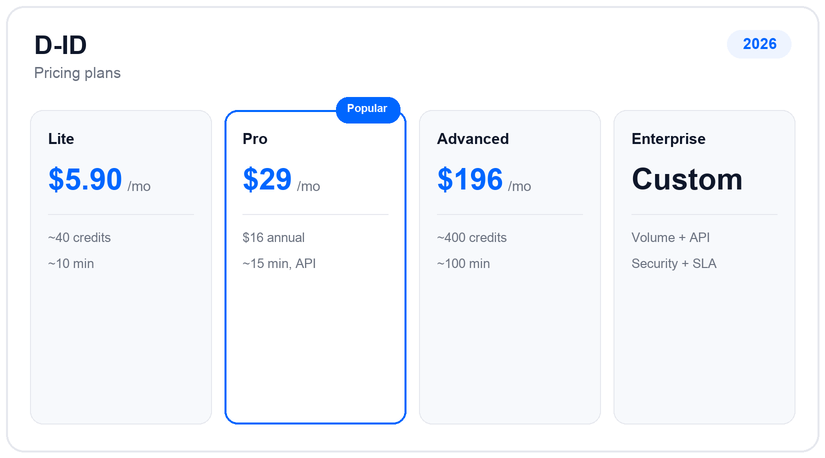
D-ID’s paid plans start very low: Lite at $5.90/mo (about 40 credits, roughly 10 minutes), Pro at $29/mo which drops to about $16/mo billed annually (around 60 credits, roughly 15 minutes), and Advanced at $196/mo (around 400 credits, roughly 100 minutes), with custom Enterprise pricing. A free trial gives about 5 minutes. The API is billed per minute and draws from the same balance.
The annual Pro rate is the cheapest serious plan in this roster and undercuts both Synthesia and HeyGen. The caveat is that minutes are credits that expire monthly and do not roll over, and heavy or API use climbs the tiers, so size the plan on the minutes you will generate rather than the low entry price.
Pros and cons
- Cheapest annual pricing in this roster
- Best-in-class talking-photo from a single image
- Talking Head API for custom integrations
- 120+ languages with a built-in translator
- Narrower than a full avatar studio for marketing video
- Credits expire monthly and API draws the same balance
- Strategic focus shifting toward agents over studio video
- Body language from a photo is flatter than full-body avatars
Support and reliability
D-ID support runs through a help center, email and developer documentation for the API, with enterprise support on custom plans; there is no public phone line. The company acquired simpleshow in September 2025 and reports strong ARR growth, and its pivot to real-time visual agents earned a CES 2026 Innovation Award, so it is a well-resourced, actively developed platform.
D-ID vs the alternatives
If you need a broader studio than D-ID, HeyGen and Synthesia are more complete; for real-time conversational agents specifically, D-ID now competes with Tavus. Our HeyGen alternatives guide and the hub cover the field.
Frequently asked questions
How much does D-ID cost?
D-ID starts at $5.90/mo Lite, $29/mo Pro (about $16/mo billed annually) and $196/mo Advanced, with custom Enterprise pricing and a free trial of about 5 minutes. The annual Pro rate is the cheapest serious plan in this roster. Confirm current rates on their site.
What is D-ID best known for?
Turning a single still photo into a talking-head video, the speaking-portrait effect. Its Creative Reality Studio does this better and cheaper than most, and it now also offers real-time visual agents.
Does D-ID have an API?
Yes. The Talking Head API lets developers embed avatar video in their own products, billed per minute from the same credit balance as the Studio.
How many languages does D-ID support?
120+, with a built-in Video Translator that localizes talking-head video across markets.
Is D-ID still an avatar video tool or an agents platform?
Both, but its strategic momentum in 2026 is real-time Expressive Visual Agents. The Creative Reality Studio talking-photo product remains, and is what most people still use D-ID for.
Related guides
More AI avatar guides: Real-time AI avatars · AI clone generators · AI digital twins.
Add us as a preferred source on Google, and our reviews and picks show up in your Top Stories and AI Overviews.