
If you build or market software, your next buyer probably is not starting on Google. They are asking an assistant “what’s the best tool for X?” and acting on the two or three products it names. That answer is the new category page-one, and almost no founder knows how their product lands in it.
Want to see where you sit in this data? Check your own brand’s AI visibility across the leading AI assistants, free.
Appscribed sits in a spot most SaaS sites are heading toward: hardly anyone arrives from a search engine, yet AI assistants quote us roughly 2,200 times a day. That gave us an unusually good laboratory. Instead of guessing about answer engine optimization (AEO), we ran a controlled experiment on our own citations, and the results contradict most of the advice founders are being sold.
We did not theorize about AEO from the outside. We queried the assistants directly, at scale, from two locations, and archived every single response with a timestamp. This is the research corpus every finding below is built on.
 ChatGPT
 Claude
 Perplexity
 Gemini
 Google AI Overview
 Bing Copilot
 OpenRouter
 DataForSEOBing Webmaster ToolsGoogle Search ConsoleGA4 (bot-filtered)Incognito Chrome + VPN
Where a number is small (10 fires per cell) we say so; where it is large (196,554 citations, 30+ API runs on one query) we lean on it. Every claim below links to an archived, timestamped response. Nothing here is opinion dressed as data.
- Across Google and Bing, AI assistants cited Appscribed 196,554 times in 91 days (~2,160/day) while sending roughly 50x fewer web clicks.
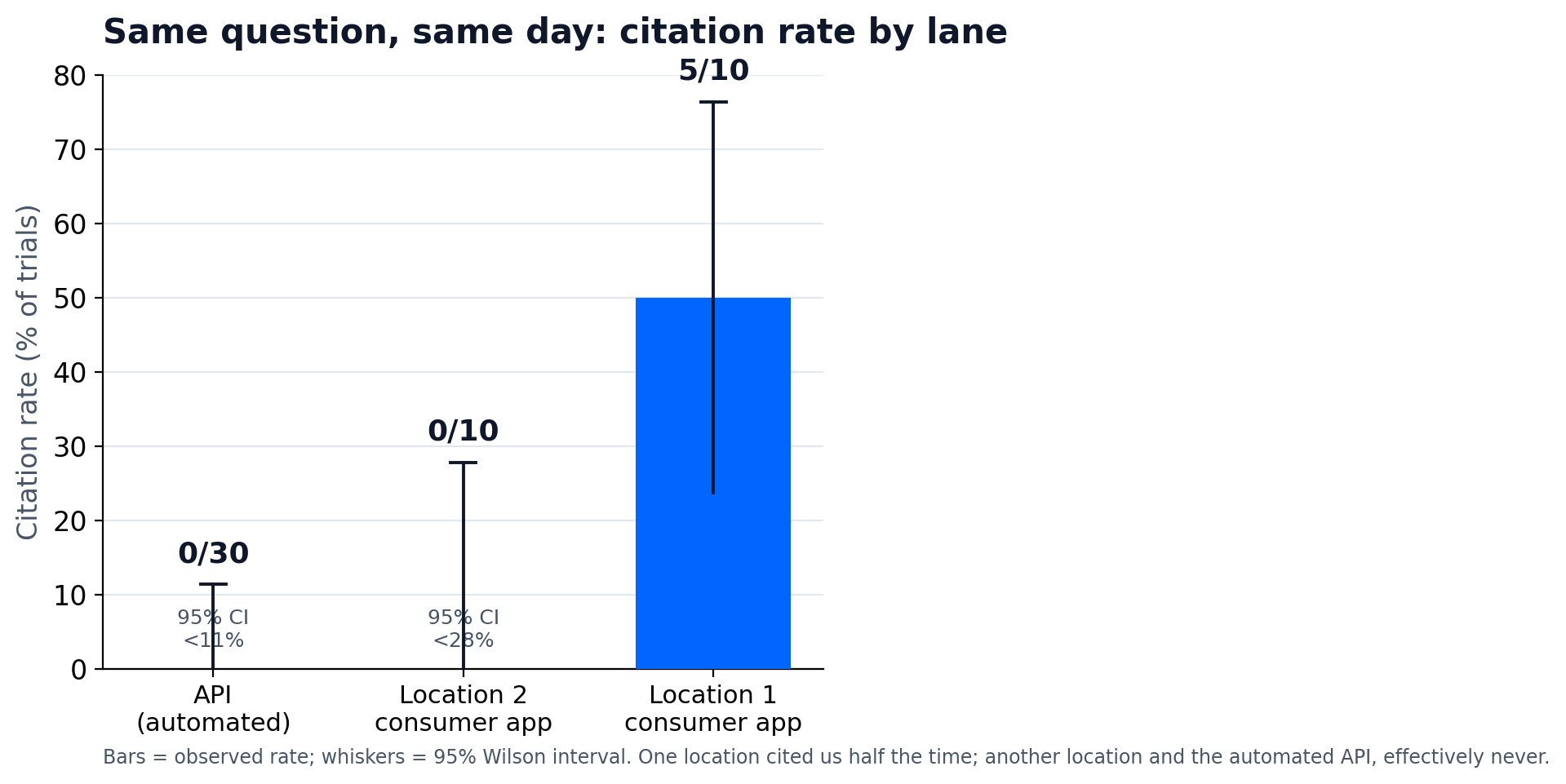
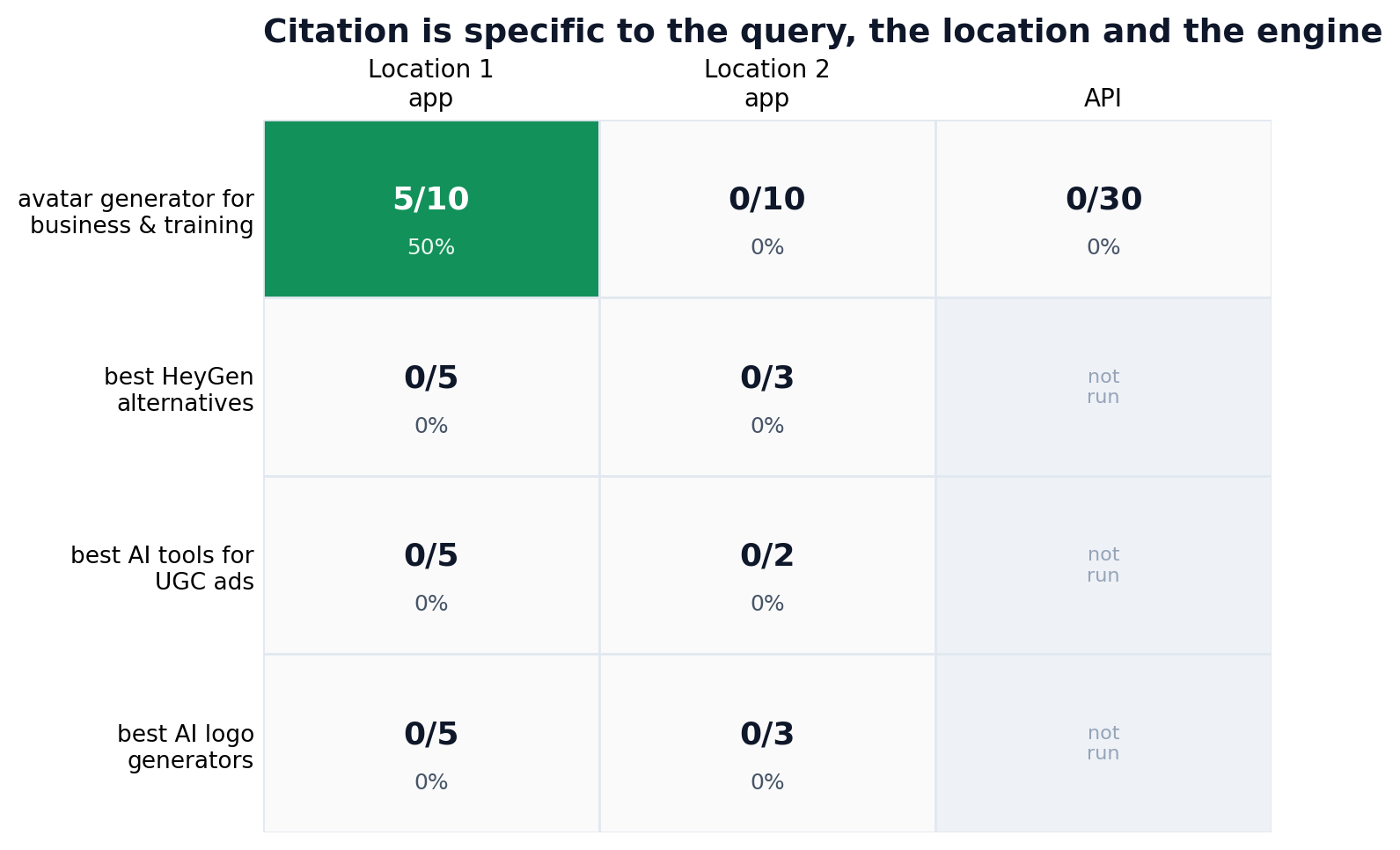
- The same buyer question was cited 50% of the time in the live ChatGPT app and 0 out of 30 times via an automated API. AI citation is probabilistic, and API tools undercount it.
- Pages ranking #80 or lower in Google were still cited. AI citation does not track search rank.
- AI cites third-party comparison pages for evaluative claims and vendor pages for product facts.
- Citation shifts by engine and by market, so a blended visibility score hides whether your buyer actually sees you.
What are generative engine optimization (GEO) and answer engine optimization (AEO)?
Generative engine optimization (GEO) is the practice of structuring your content so AI assistants reuse and cite it when they generate an answer. Answer engine optimization (AEO) is the same discipline seen from the citation side: structuring a page so the assistant quotes it as the direct answer a buyer asked for. Most teams use generative engine optimization and AEO interchangeably; both are the AI-search cousin of SEO. Instead of ranking a page to earn a click, you structure it to be quoted inside ChatGPT, Copilot, and Google’s AI Overviews, which is where a growing share of software discovery now happens.
GEO and AEO vs SEO: what actually changed?
SEO earns a ranked link a person clicks. Generative engine optimization (GEO) and AEO earn a citation inside the AI’s answer, where a growing share of buyers now decide. Same content skills, different finish line: instead of ranking to be clicked, you structure to be quoted.
| SEO | GEO / AEO | |
|---|---|---|
| Goal | Rank a page | Be cited in the answer |
| Unit of success | A click | A citation or mention |
| Surface | The ten blue links | ChatGPT, Copilot, AI Overviews |
| What wins | Keywords, links, rank | Answer capsules, original data, structure |
| Measured by | Position and clicks | Citation rate per engine and market |
The overlap is real: pages that rank often also get cited. But the reverse is not guaranteed. As this study shows, we are cited on pages that rank #80 or nowhere at all, so AEO is its own discipline, not a by-product of SEO.
What kind of content gets cited by AI?
Across 91 days, the pages AI answers quoted most were not our home page or product pages. They were research round-ups, comparisons and pricing explainers: the pages that do the reader’s homework. An assistant answering “what’s the best X?” wants a page that already answered it, with structure, evidence and a verdict. Two of the exact pages AI quoted in our tests are our best free AI research tools round-up and our best graphic design apps guide, both category comparisons rather than brochures.
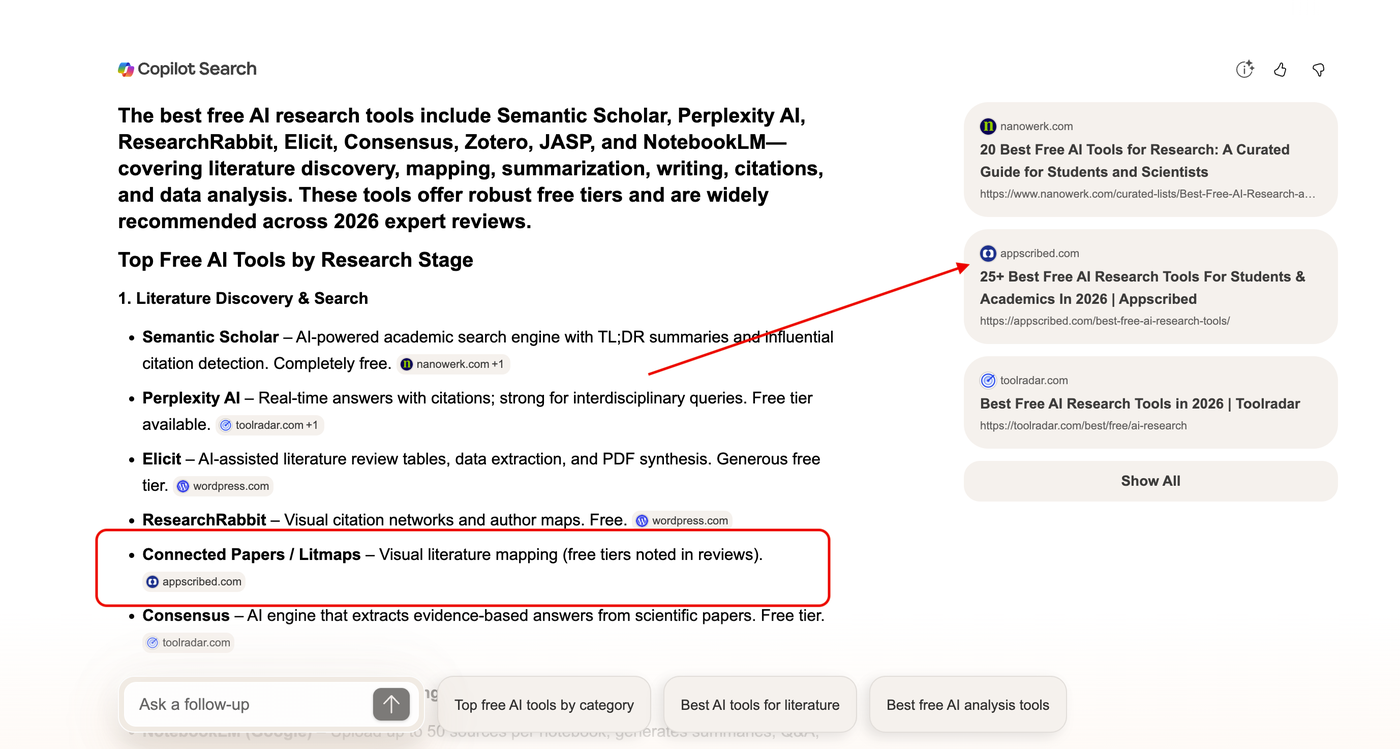
Fire this exact query in Bing Copilot and you should see Appscribed cited, just like the screenshot above. Citation is probabilistic, so you may need a couple of tries.
query: best free AI research tools
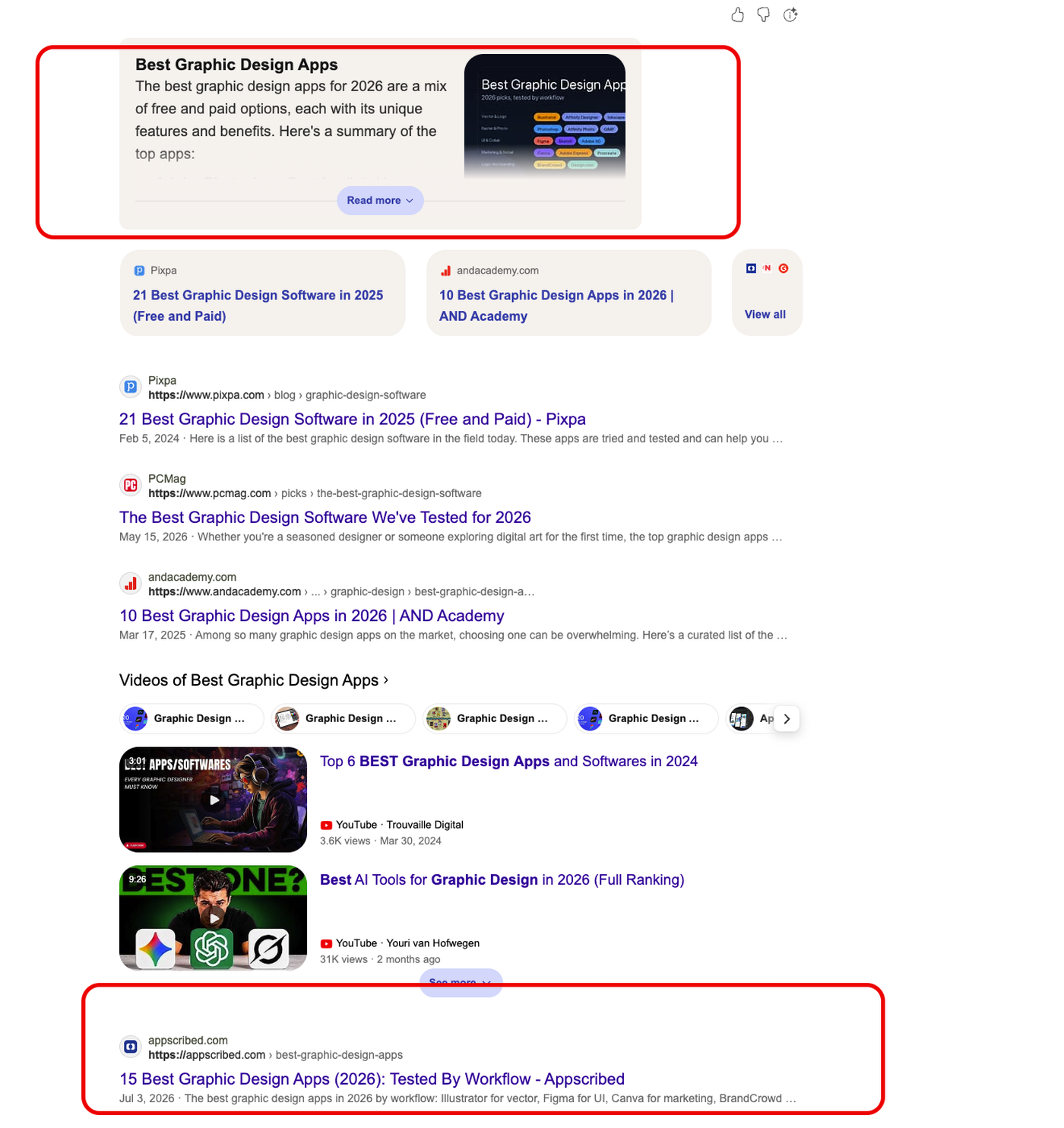
Fire this exact query in Bing Copilot and you should see Appscribed cited, just like the screenshot above. Citation is probabilistic, so you may need a couple of tries.
query: best graphic design apps
Why do AI-citation tools disagree with reality?
We first tested a buyer question through the popular API method: an automated tool that queries the model 30 times. Result: our site cited 0 out of 30. Then we asked the exact same question in the real ChatGPT app, the way a person does. It cited us repeatedly. The API runs from a fixed location on a stripped-down search stack, so it measures a ghost. If you audit AI citations through an API, measure the real app instead.
{
“model”: “gpt-5.6-luna”,
“query”: “best AI avatar generator for business and training videos”,
“sources_cited”: [“heygen.com”, “synthesia.io”, “colossyan.com”],
“appscribed.com”: false
}
// across all 30 runs: appscribed 0/30. The live app cited us 50% of the time.
Is AI citation reliable, or a coin flip?
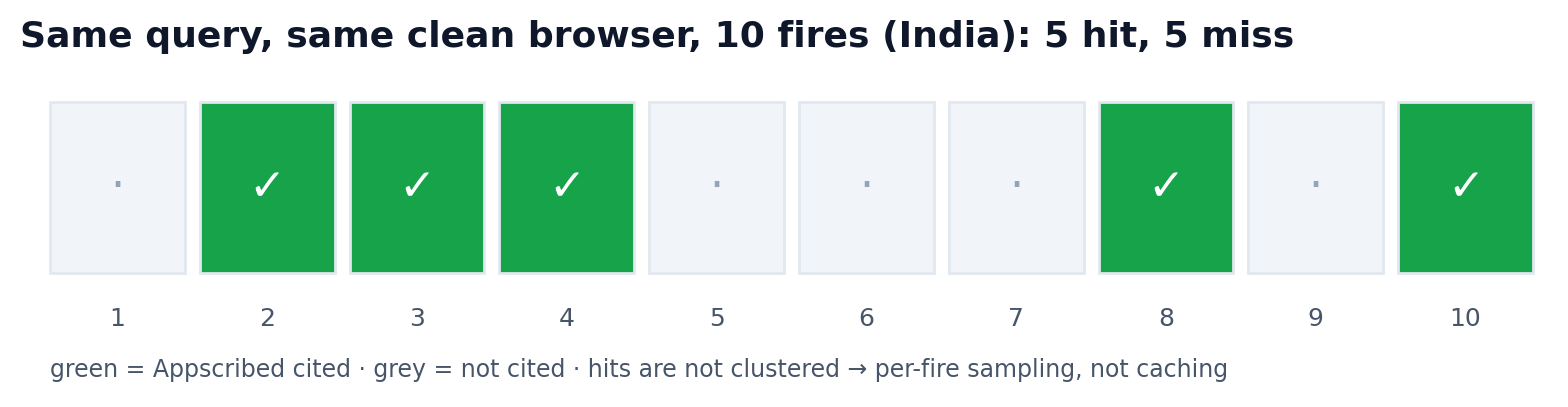
We fired that identical question into a clean, logged-out ChatGPT ten times. It cited Appscribed in five of them, and the hits were scattered, not clustered, so it is not caching. ChatGPT rewrites your question into different searches each time, so citation is probabilistic. A single check tells you almost nothing; a rate tells you everything.
Which sentence does AI actually cite?
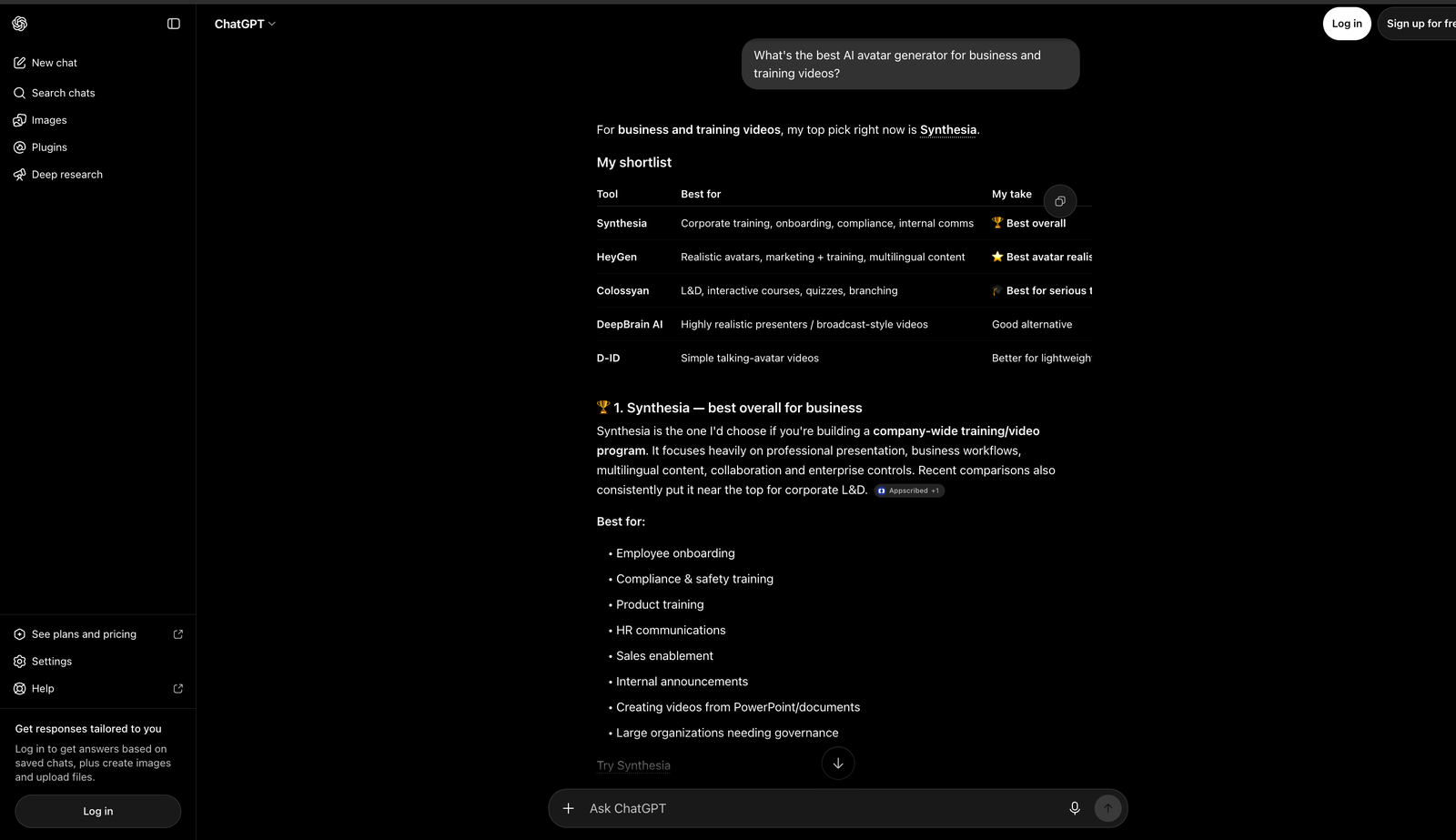
When we looked at where our link attaches, a pattern emerged. AI cites the vendors’ own pages for product facts, but for an evaluative, comparative claim it reaches for a neutral third party. That third party was us. Pages that state clear, sourced comparative judgments give an assistant a sentence it can safely quote. That is the citation surface, and you can see it on our own best AI avatar generators comparison, the page behind the screenshot above.
Do you need to rank #1 to get cited?
No. Several pages that AI assistants cite do not rank anywhere near the top of classic search for their head term. AI retrieval draws on the assistant’s own index and query fan-out, which does not mirror the classic top ten.
| Query family | Our Google rank | Cited by AI? |
|---|---|---|
| free VoIP services | #80 | Yes |
| graphic design apps | not top 100 | Yes |
| AI avatar / alternatives | not top 100 | Yes |
Does your location change what AI cites?
“Are we cited in AI?” is underspecified. The same question returns a different set of sources depending on which assistant answers and where the reader searches from. In our tests, one location (call it Location 1) cited Appscribed on half of all tries for a given question; from a second location the same question surfaced a different roster of sources entirely. We are anonymizing the specific locations on purpose: the point is that citation is local, so measure your own buyer’s location rather than assuming ours transfers.
How to get cited by ChatGPT: 7 moves
- Write the comparison, not the brochure. Answer “what’s the best X?” better than anyone, on one page.
- Put a quotable verdict in a sentence. State clear comparative judgments; that is the sentence an assistant lifts.
- Lead with evidence. Original data and statistics are disproportionately quoted.
- Structure it. Question headings, a 30 to 50 word answer capsule beneath each, tables and lists.
- Stop treating rank as the goal. You can be cited from page eight.
- Measure a rate, per engine, per market. One check is noise; fire each query 10+ times.
- Audit the app, not the API. API tools measure the wrong stack and undercount you.
Those seven moves are exactly what we run, every week, for the companies in our AI Visibility program, measuring the citation rate per engine and per market and moving it deliberately rather than hoping.
For SaaS and AI founders: more straight answers
Beyond the three questions at the top of this page, these are the other things founders and GTM teams search most when trying to crack AI search.
Is AEO replacing SEO? Is SEO dead?
No. SEO still wins the click; AEO wins the citation inside the AI answer. They overlap but are not the same: in our data we are cited on pages that rank #80 or nowhere, and we rank on pages AI ignores. Treat answer engine optimization as a second, separate surface to optimize, not a replacement for SEO.
Do I need a big brand or lots of backlinks to get mentioned?
Less than you would for SEO. Assistants weight evidence and consensus over domain size: original data, a quotable verdict, and third-party mentions on Reddit and in press. In our data a mid-size directory is cited roughly 2,200 times a day without ranking, because the content is the best evidence, not because the brand is the biggest.
How do I check whether my brand is being cited by AI?
Fire your buyer’s real questions into the live app 10 or more times, from your buyer’s location, on each engine, and count the rate. Do not trust a single check or an API tool: in this study the same query was cited 50% of the time in the app and 0 out of 30 times via API. Track a citation rate per engine and per location over time.
How do you measure your AI citations?
No single tool sees the whole picture, so we triangulated across five instruments and archived every response the moment we pulled it. That is the difference between an opinion about AI citations and a measurement of them.
| Instrument | What it measured |
|---|---|
| Consumer-app probes (ChatGPT, logged-out) | Ground-truth citation rate per query and market, fired 10+ times each, archived |
| OpenRouter API (native web) | The automated-tool baseline; 30 runs saved as raw JSON |
| DataForSEO | Live SERP rank, category demand, and a reverse-lookup of competitor citations |
| Bing + Google dashboards | The 91-day AI-citation census across both engines: 196,554 citations captured in Bing Webmaster Tools and Google Search Console |
| GA4 | AI-assistant referral clicks and engagement, bot-filtered |
In the interest of honesty: the controlled probes ran at 10 fires per cell, enough to see coarse effects, not to pin an exact rate. The aggregate counts are from a fixed 91-day window and will drift. We tested a handful of queries, mostly on ChatGPT; Copilot and Perplexity behave differently. The direction of every finding is solid; treat the precise percentages as indicative, and re-measure your own category.
Frequently asked questions
How do you get cited by ChatGPT?
Publish a page that directly answers the question with a question-style heading, a concise answer capsule, original data and comparison tables, then earn third-party mentions. Assistants cite the neutral source the wider web agrees on, not vendor marketing.
What is generative engine optimization (GEO)?
Generative engine optimization (GEO) is the practice of structuring your content so AI models reuse and cite it when they generate an answer. It is the AI-search cousin of SEO: instead of ranking a page to earn a click, you structure it to be quoted inside ChatGPT, Copilot, Perplexity and Google’s AI Overviews.
Is GEO the same as AEO?
In practice, yes – most teams use generative engine optimization (GEO) and answer engine optimization (AEO) interchangeably. GEO is the broad term for optimizing so AI models reuse your content; AEO frames the same goal around being the cited answer. Both mean: structure your page to be quoted inside AI answers, not just ranked.
Is GEO replacing SEO? Is SEO dead?
No. SEO still earns the click; GEO earns the citation inside the AI answer. They overlap, since pages that rank often get cited, but not always: in this study, pages ranking #80 or nowhere were cited while page-one pages were not. Treat GEO as a second surface to optimize, not a replacement for SEO.
What is the best GEO or AEO tool?
No single tool sees the whole picture. We triangulate: consumer-app probes for the ground-truth citation rate, Bing Webmaster Tools and Google Search Console for the citation census, and DataForSEO for rank and competitor citations. Measure a citation rate per engine and per market rather than trusting one API-based score.
What is answer engine optimization (AEO)?
AEO is the practice of structuring content so AI assistants return it as a direct, cited answer. Instead of ranking a page for a click, you structure it to be quoted inside ChatGPT, Copilot and AI Overviews.
What is the difference between AEO and SEO?
SEO optimizes a page to rank and earn a click. AEO optimizes content to be cited inside an AI answer. In this study, pages ranking #80 or lower were still cited, so AEO does not simply follow SEO rank.
Do you need to rank #1 on Google to be cited by AI?
No. AI assistants pull from their own index and rewritten sub-queries, not Google’s top ten. Pages ranking #80 or not in the top 100 were still cited when they were the best evidence for the question.
What kind of content gets cited by AI?
Category comparisons, best-of round-ups and pricing explainers that rank and judge a whole category with a clear verdict and original data. Brochure and product pages are rarely cited.
Why do AI-citation tools disagree with what I see in ChatGPT?
Most tools query the model through an API from a fixed location on a reduced search stack, which is not what a logged-in person in your market sees. Measure the real app, fired multiple times, from your buyer’s country.
Is being cited by AI worth anything if people do not click?
Yes. In this study AI citations outnumbered web clicks roughly 50 to 1. The value is influence over the answer, being the source that shapes what the assistant tells a buyer.
What is an example of answer engine optimization?
A category comparison page that ranks the tools, states a clear verdict in a quotable sentence and backs it with original data, so an assistant cites it when a buyer asks what the best tool is.
How do I optimize my content for AI search?
Lead each section with a direct answer, keep answer paragraphs link-free, add three to five statistics per hundred words, publish original data, allow the AI crawlers, ship clean schema, and measure your citation rate per engine and market.
This is the work, not a theory. We run the same measurement-and-optimization loop for a small number of SaaS and AI companies, and report the citation rate we move, per engine and per market.
See how AI Visibility works →The categories we measure this in: AI avatar generators, AI voice agents, AI UGC tools, AI receptionists, AI scheduling, business phone systems.
Add us as a preferred source on Google, and our reviews and picks show up in your Top Stories and AI Overviews.