
How much does Claude cost?
Claude has a free tier and two individual paid plans: Pro at $20 a month (about $17 on annual billing) and Max at either $100 a month for 5x Pro usage or $200 for 20x. Team plans start at 2 seats (up to 150) and run $25 per seat on Standard or $125 on Premium, dropping to $20 and $100 with annual billing, and Enterprise is $20 per seat a month billed annually, with usage billed separately at API rates. Claude Code is included on every paid plan from Pro up. The API is billed separately per million tokens: Haiku 4.5 at $1 input and $5 output, the latest Sonnet at $2 and $10, and Opus 5.5 at $4 and $20, with cache reads and the Batch API cutting those rates further. Prices current October 2026.
| Free | $0, daily message limits |
| Pro | $20/mo ($17 annual), includes Claude Code |
| Max | $100/mo (5x Pro) or $200/mo (20x Pro) |
| Team Standard | $25/seat ($20 annual), 2 seat minimum |
| Team Premium | $125/seat ($100 annual), more usage |
| Enterprise | $20/seat annual plus usage, SSO and admin controls |
| API (per M tokens) | Haiku 4.5 $1/$5, Sonnet $2/$10, Opus 5.5 $4/$20 |
Claude pricing in 2026 starts at $0 for the free tier and tops out at Enterprise, which is $20 a seat plus usage, with most buyers picking between Pro at $20 a month, Max at $100 or $200, Team Standard at $25 a seat, and Team Premium at $125 a seat. API pricing is a separate decision from the chat plans and is billed per million tokens by model. This guide breaks down every Claude plan, what each one actually unlocks, and how to pick the right one for your usage.
The short version: most individuals should start on Pro and only move to Max when they hit usage limits often, most teams should default to Team Standard and only upgrade specific seats to Premium, and most builders should treat the API as a parallel buying decision instead of bundling it with chat plans. If you want the broader Claude context, our Claude updates hub tracks every shipping change, and our Claude Skills explainer covers the reusable-workflow side most pricing pages skip.
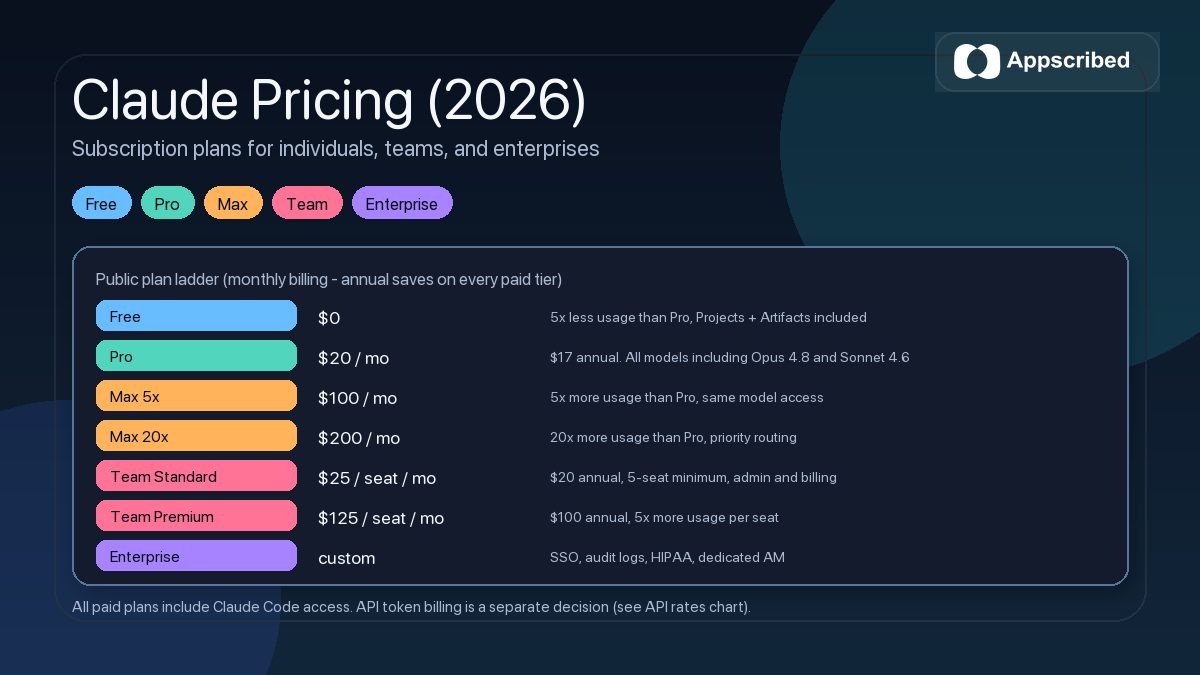
Quick verdict: Pro at $20 a month is the right default for almost every individual using Claude daily. Max only makes sense once Pro stops being enough and you find yourself rate-limited multiple times a week. Team Standard at $25 a seat is the right baseline for organizations; Team Premium at $125 a seat fits power users on the same team. API pricing scales with usage and is paid on top of, or instead of, chat plans depending on how you build.
Is Claude free?
Yes, Claude is free. Anthropic offers a real free tier that requires only an account, no credit card. The free tier was expanded meaningfully in February 2026 to include Projects, Artifacts, and app connectors, narrowing the gap with Pro for casual users.
What you get on free: access to Claude (usually the latest Sonnet, but with usage limits and lower priority routing), Projects for organizing ongoing work, Artifacts for previewing code and documents in side panels, and app connectors. What you do not get: the larger Pro usage allowance, access to the Opus model tier, the 1M context beta, and consistent latency during peak times.
The right way to think about the free tier is as a real trial, not a marketing demo. Most people who use Claude more than a few times a week will hit the free limit and need to decide whether Pro is worth the $20.
How Claude pricing actually works in 2026
Anthropic separates pricing into three lanes that get conflated a lot:
- Chat subscriptions (Free, Pro, Max) for individuals using Claude through the app or website.
- Team and Enterprise plans for organizations that need shared billing, admin controls, and seat-level access.
- API pricing for developers and product teams building with Claude models directly, billed per million tokens by model and use case.
These three tracks share models but bill independently. You can be on Pro for personal use and pay API rates for your product at the same time. A Team subscription does not automatically include API credits, and vice versa. The current Claude model lineup running across all three is Fable 5.1 (the Mythos-class top tier), Opus 5 (the current flagship, $5 input / $25 output), Opus 4.8, Opus 4.7 (the 1M context variant), Sonnet 5 (the new balanced default, released June 30), Sonnet 4.6, and Haiku 4.5 (the fast tier). Fable 5 was briefly suspended by a US export-control directive in June, but the directive was lifted and it has been generally available again since July 1. Anthropic then released Fable 5.1 on September 1, extending Fable 5 at the same $10 / $50 token pricing but cutting cache reads to about a quarter of the cost.
Claude Pro pricing: $20 a month
Claude Pro is the default paid plan for individuals. It costs $20 a month billed monthly, or $17 a month billed annually (which works out to $204 a year instead of $240). The annual saving is straightforward and worth it if you plan to use Claude for more than 11 months out of 12.
What Pro includes:
- 5x more usage than the free tier, the headline lift most people notice first.
- Access to all models currently available, including Opus 4.8, Sonnet 5, and Sonnet 4.6.
- Claude Code access for developer workflows, the same access that previously required separate setup.
- Priority during peak times, so your requests do not get throttled when traffic spikes.
- Projects, Artifacts, computer use in Cowork, and all the integration surfaces Anthropic has shipped this year.
The honest test for Pro is simple: if you use Claude every day or close to it, Pro pays for itself fast. If you only reach for Claude a few times a week, the free tier is probably enough until your habits change.
Claude Max pricing: $100 and $200 a month
Max is Anthropic’s heavy-usage plan, designed for individuals who hit Pro’s usage limits repeatedly. It comes in two flavors:
- Max 5x at $100 a month gives 5x more usage than Pro, with the same model access and feature set.
- Max 20x at $200 a month gives 20x more usage than Pro plus priority routing during peak demand.
The annual billing discount applies on Max too, knocking roughly 15% off the monthly equivalent. Most Pro users do not need Max. The signal that you actually do: you are hitting the Pro usage cap two or three times a week, and the throttle is interrupting real work. If that is happening, Max 5x is the right next step. Most people who jump straight to Max 20x without first trying Max 5x are overbuying.
Claude Pro vs Max: which one is right for you?
This is the highest-frequency buying question on Claude. The honest answer is that Pro and Max share the same models and feature set; the only meaningful difference is usage allowance. So the decision is really about whether you regularly run into Pro’s limits.
| Signal | Pick Pro | Pick Max 5x | Pick Max 20x |
|---|---|---|---|
| Daily usage pattern | Several sessions of moderate length | Many sessions or long agent runs | Continuous agent work, multi-hour sessions |
| How often you hit limits | Rarely | 2-3 times a week | Daily |
| Monthly spend appetite | Up to $20 | Up to $100 | Up to $200 |
| Best for | Daily individual use | Heavy individual use without team needs | Power users who would otherwise spin up multiple Pro accounts |
The pragmatic test: start on Pro for a month. If you get throttled often enough that it affects your work, move to Max 5x. Only consider Max 20x if Max 5x still feels tight after a few weeks.
Claude Team pricing: Standard $25 vs Premium $125 a seat
Anthropic restructured Team plans in 2026 into two seat types that can be mixed inside the same workspace.
- Team Standard: $25 per seat per month billed monthly, $20 per seat billed annually. The default tier for everyday work, includes admin controls, centralized billing, and shared Projects.
- Team Premium: $125 per seat per month billed monthly, $100 per seat billed annually. Higher per-seat usage allowance (roughly 5x Standard) and is the right pick for power users on a team without paying for everyone to have premium headroom.
- Minimum seat count on both Team tiers is 5.
The practical pattern most teams use: default everyone to Team Standard, then upgrade the two or three power users to Team Premium. This costs significantly less than putting everyone on Premium and matches actual usage distribution in most organizations.
Worth noting: Team usage allowance is per seat. It does not pool across the team. So if one seat blows through its allowance, the other seats are unaffected, but the blown seat still gets throttled. Pooled usage is an Enterprise feature.
Claude Enterprise pricing
Enterprise is $20 per seat per month on an annual commitment, and Anthropic’s Enterprise page lists a 20-seat minimum. The seat fee covers access only: usage is billed separately at standard API rates, with no token allowance included. Custom rate limits and hands-on support go through sales.
What Enterprise adds beyond Team Premium: SSO and SCIM provisioning, audit logs, HIPAA-readiness, pooled usage across all seats (so heavy users do not drain a personal cap while others have headroom to spare), priority support with a dedicated account manager, custom data retention policies, and enterprise contract terms. It is the right tier for any organization that needs a procurement process or has regulated workloads.
Honest framing: most organizations under 100 seats are fine on Team Standard with a few Premium upgrades. Enterprise becomes the right answer when SSO, audit logs, or pooled usage matter more than dollar cost, or when procurement explicitly needs an enterprise contract.
Claude API pricing: per-million token rates by model
API pricing is the separate buying decision most pricing pages bury. Anthropic bills per million tokens, separately for input and output, with the rate depending on which model you call. The current 2026 rates:
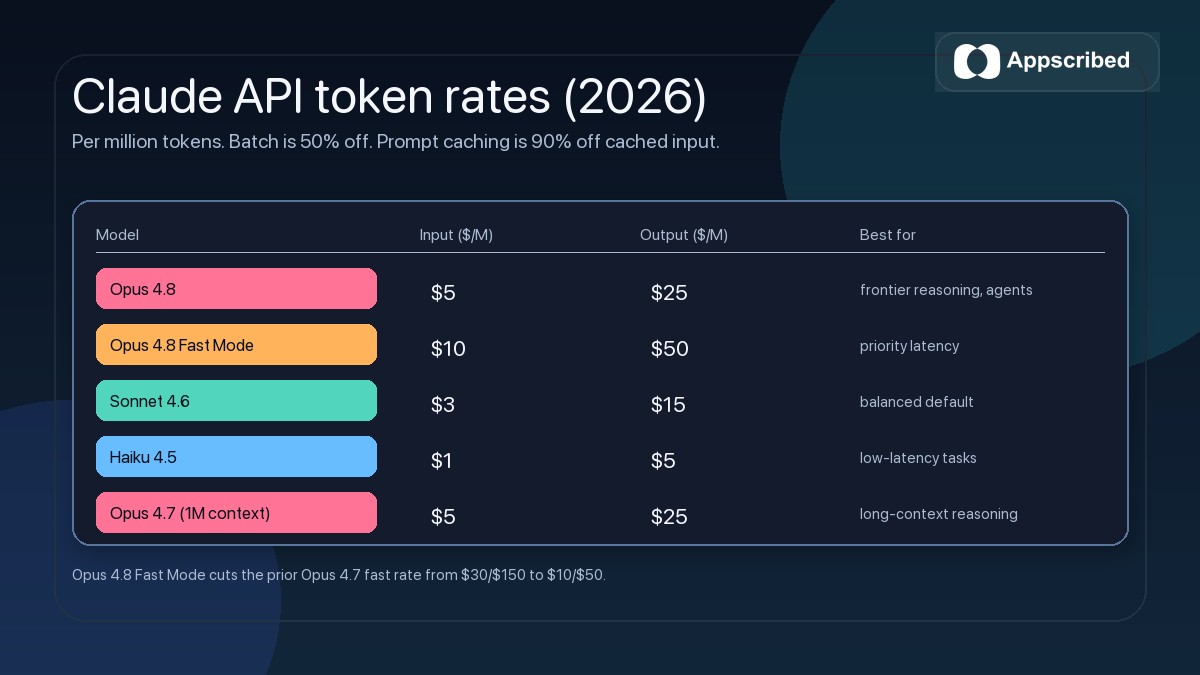
- Opus 4.8: $5 per million input tokens, $25 per million output tokens. The standard rate for the current flagship.
- Opus 4.8 Fast Mode: $10 input, $50 output. Priority latency for time-sensitive workloads. This is meaningfully cheaper than the prior Opus 4.7 Fast Mode rate of $30 input and $150 output.
- Fable 5: $10 input, $50 output. The Mythos-class top tier, generally available again since July 1 after June’s export-control suspension. 1M-token context window by default.
- Sonnet 5: $2 input, $10 output at the introductory rate through August 31, 2026, then $3 and $15. The new balanced default, released June 30.
- Sonnet 4.6: $3 input, $15 output. The balanced default for most production workloads. Best price-performance ratio of the lineup.
- Haiku 4.5: $1 input, $5 output. The right pick for low-latency or high-volume tasks where output quality is not the primary constraint.
- Opus 4.7 (1M context): $5 input, $25 output. Same standard rate as Opus 4.8 but with the 1M token context beta for long-document or full-codebase workloads.
Two pricing levers worth knowing:
- Batch processing halves the per-token rate on both input and output. The trade-off is asynchronous delivery, useful for non-real-time workloads like overnight document processing.
- Prompt caching drops the cached-input rate by 90%. If you have a long system prompt or fixed instruction block that repeats across calls, caching it cuts your effective bill meaningfully.
One practical calculation most builders should run: Sonnet 4.6 is usually within 90% of Opus 4.8’s quality on day-to-day tasks at 60% lower cost. Default to Sonnet 4.6 in production and only call Opus 4.8 for the specific steps that need frontier reasoning. That pattern alone often cuts API spend in half versus calling Opus on everything. And through August 31, Sonnet 5’s introductory rate ($2 input / $10 output) makes the default-to-Sonnet pattern cheaper still.
Annual billing: how much you actually save
Annual billing knocks roughly 15% off every Claude paid tier, paid up front for 12 months. The effective monthly rates:
- Pro: $20 monthly to $17 annual ($204 a year vs $240).
- Max 5x: $100 monthly to $85 annual.
- Max 20x: $200 monthly to $170 annual.
- Team Standard: $25 per seat monthly to $20 per seat annual.
- Team Premium: $125 per seat monthly to $100 per seat annual.
The annual discount compounds across team seats. A 20-person Team Standard organization saves roughly $1,200 a year switching from monthly to annual billing. For an individual on Pro, the breakeven is 10 months. If you are confident you will use Claude longer than that, annual makes sense.
Claude Code pricing: included with Pro and above
Claude Code, the developer workflow tool that turns Claude into an agentic coding assistant inside the terminal, is included on every paid plan including Pro. We break down both billing paths, the full API rate table, and the subscription-vs-API crossover math in our dedicated Claude Code pricing guide. There is no separate Claude Code subscription. The model access and usage allowances inside Claude Code are governed by your plan tier.
In practice that means Pro at $20 a month is the cheapest way to access Claude Code, but heavy daily code-agent users often outgrow Pro’s usage allowance fast and end up on Max. If you are weighing Claude Code against alternatives, our Cursor pricing breakdown covers the most popular paid IDE-native competitor, and our Blackbox AI review covers the credit-pool aggregator path that bundles Claude Sonnet 4.5 with GPT and Gemini access.
Which Claude plan should you choose?
The decision tree most buyers should run:
- If you use Claude a few times a week: stay on the free tier. The 2026 free tier is actually usable for casual work.
- If you use Claude daily: Pro at $20 a month is the right default. The $17 annual rate makes sense if you are committing for the year.
- If you hit Pro usage limits multiple times a week: step up to Max 5x at $100 a month. Most people who think they need Max 20x actually need Max 5x.
- If you are a team between 5 and 50 people: default to Team Standard at $25 a seat, then upgrade the two or three heaviest users to Team Premium at $125 a seat.
- If you need SSO, pooled usage, audit logs, or a procurement contract: Enterprise is the right tier even if the dollar cost is similar to Team Premium.
- If you are building a product on Claude: API pricing is your buying decision, not chat subscriptions. Default to Sonnet 5 (introductory $2/$10 rate through August 31) and only call Opus 4.8 for the steps that need it.
Where Claude pricing gets confusing
A few gotchas worth knowing before you commit:
- Team usage does not pool across seats. Pooled usage is Enterprise-only. Plan team seat-type mix accordingly.
- API spend is separate from chat subscription billing. Being on Pro does not give you API credit, and vice versa.
- Annual prepayment is non-refundable after the first 30 days on most regions. Try monthly first if you are not sure Claude is the right tool for your workflow.
- The Fable 5 saga from June was a one-off and does not affect any current Claude plan. Opus 4.8 is the right migration target if you had pipelines on Fable 5 during its brief launch window.
- Older Claude 4 models are being retired on June 15, 2026 (Sonnet 4 original, Opus 4 original, Opus 4.6) and August 5 (Opus 4.1). If you have production code pinned to these model IDs, plan migrations now.
Is Claude worth paying for?
For daily users, Pro at $20 a month is one of the better-priced AI subscriptions in the category. The combination of Opus 4.8 access, Claude Code, computer use, and the 1M context beta on Opus 4.7 puts a lot of capability behind a single $20 charge.
It is less compelling for casual users who could get by on the free tier, and it is less compelling for teams that mostly need text generation and could use Sonnet 4.6 via the API at lower effective cost. But for the core target (individuals who code, write, or research with Claude every day) the math works out. The honest test is whether you reach for Claude often enough that $20 a month feels like a tax you forget about. If yes, Pro pays for itself. If no, the free tier is enough until your habits change.
Frequently Asked Questions
Is Claude free?
Yes. Claude has a free tier that requires only an account, no credit card. It includes Projects, Artifacts, app connectors, and access to Sonnet with usage limits. The free tier was expanded in February 2026 to close most of the feature gap with Pro for casual users.
How much does Claude Pro cost?
Claude Pro costs $20 a month billed monthly, or $17 a month billed annually (which works out to $204 a year). The annual saving is roughly 15%. Pro includes 5x more usage than the free tier plus access to all models including Opus 4.8 and Sonnet 4.6, Claude Code, and priority during peak times.
How much does Claude Max cost?
Claude Max comes in two flavors. Max 5x costs $100 a month and provides 5x more usage than Pro. Max 20x costs $200 a month and provides 20x more usage than Pro plus priority routing. The annual discount applies on both. Most Pro users do not need Max unless they hit Pro usage limits multiple times a week.
What is the difference between Claude Pro and Max?
Pro and Max share the same models and feature set. The only meaningful difference is usage allowance. Pro gives 5x more usage than free; Max 5x gives 5x more usage than Pro; Max 20x gives 20x more usage than Pro with priority routing. The decision is based entirely on how often you hit Pro’s usage cap during real work.
How much does Claude Team cost?
Team plans come in two seat types. Team Standard costs $25 per seat per month billed monthly, or $20 per seat billed annually. Team Premium costs $125 per seat per month or $100 per seat annually and gives roughly 5x more usage per seat. Team plans start at 2 seats and go up to 150. The two seat types can be mixed in the same workspace.
What is Claude Enterprise pricing?
Claude Enterprise is $20 per seat per month on an annual commitment, plus usage billed at API rates (Anthropic’s Enterprise page lists a 20-seat minimum). Enterprise adds SSO, SCIM, audit logs, HIPAA-readiness, pooled usage across all seats, priority support with a dedicated account manager, and enterprise contract terms. It is the right tier for organizations that need SSO, regulated workloads, or a procurement process.
How much does the Claude API cost?
The Claude API is billed per million tokens by model. Current rates: Opus 4.8 is $5 input and $25 output, Sonnet 4.6 is $3 input and $15 output, Haiku 4.5 is $1 input and $5 output, and Opus 4.7 1M context is $5 input and $25 output. Batch processing halves these rates. Prompt caching cuts cached-input cost by 90%.
Is Claude Code included with paid plans?
Yes. Claude Code is included on every paid Claude plan starting with Pro at $20 a month. There is no separate Claude Code subscription. Model access and usage allowance inside Claude Code are governed by your plan tier (Pro, Max, Team, Enterprise).
Does Claude offer an annual discount?
Yes. Annual billing knocks roughly 15% off every paid tier paid up front for 12 months. The effective monthly rates: Pro $17, Max 5x $85, Max 20x $170, Team Standard $20 per seat, Team Premium $100 per seat. The breakeven on Pro is 10 months of use.
Does Claude have a free trial?
There is no separate paid-tier free trial. The free tier itself is the trial. It does not expire and does not require payment information. Most people who use Claude regularly outgrow it within a few weeks and move to Pro.
What happened to Claude Fable 5 and Mythos 5?
Anthropic launched Claude Fable 5 and Claude Mythos 5 on June 9, 2026 as the first Mythos-class models available publicly. Three days later, on June 12, both were suspended worldwide following a US Commerce Department export-control directive. Neither model is currently available. Every other Claude model (Opus 4.8, Opus 4.7, Sonnet 4.6, Haiku 4.5) is unaffected and Opus 4.8 is the recommended migration target.
Is Claude Pro worth paying for?
For people who use Claude daily for coding, writing, research, or knowledge work, Pro at $20 a month is one of the better-priced AI subscriptions on the market. The combination of Opus 4.8 access, Claude Code, computer use, Projects, and Artifacts behind a single $20 charge is strong value. It is less compelling for casual users who only reach for Claude a few times a week. The honest test is whether the free tier is starting to feel limiting.
How much does Claude Opus 5 cost?
Claude Opus 5 is priced at $5 per million input tokens and $25 per million output tokens on the API – the same as Opus 4.8 – and it is included in Claude subscriptions: it is the new default on Claude Max and the strongest model on Claude Pro. There is no separate consumer price for Opus 5; you pay through Pro ($20/mo), Max ($100/$200), a Team plan, or per token on the API.
Is Claude Opus 5 better than Opus 4.8?
On capability, yes – Opus 5 comes close to Fable 5’s frontier intelligence, especially on agentic coding and long-horizon work, while costing the same $5/$25 per million tokens as Opus 4.8. For most users Opus 5 is the better default; Opus 4.8 stays available if you have pinned to it.
How much does Claude Sonnet 5 cost?
Claude Sonnet 5 costs $2 per million input tokens and $10 per million output at its introductory rate (rising to $3/$15 after the intro period), and it is the everyday default on Claude Free and Pro. On price it sits between Haiku 4.5 ($1/$5) and the Opus tier.
Claude Opus 5 vs Sonnet 5 – which should I use?
Use Sonnet 5 as your everyday default: it is fast, cheap ($2/$10 introductory), and handles most coding and writing. Step up to Opus 5 ($5/$25) for the hardest reasoning, large refactors, and long autonomous agent runs where the extra capability pays for the higher token cost. Haiku 4.5 ($1/$5) is best for simple, high-volume tasks.
What is Claude Opus 5’s context window?
Claude Opus 5 has a 1M-token context window (the default and maximum) with up to 128K output tokens per request, matching the rest of the current Claude flagship line.
What is the minimum monthly cost to license Claude for a team?
Team plans start at 2 seats. On monthly billing, two Standard seats cost $50 a month ($25 each), or $40 a month billed annually; two Premium seats cost $250 a month, or $200 billed annually. You can mix seat types, up to 150 seats. Enterprise is a different model: $20 per seat per month on an annual commitment (Anthropic’s Enterprise page lists a 20-seat minimum), plus usage billed at API rates.
Is there a Claude Premium plan?
Not for individuals. Claude’s individual plans are Free, Pro and Max. Premium is a seat type inside Team plans: $125 per seat per month ($100 annual), with about 5x the usage of a Standard seat and 6.25x the per-session allowance of a Pro plan, according to Anthropic’s support documentation. If you are looking for a Claude Premium price as an individual, the closest options are Pro at $20 a month or Max from $100 a month.
- ChatGPT pricing Free, Go $8, Plus $20, Pro $200
- Gemini pricing Free, Google AI plans from $4.99
- Grok pricing Free, SuperGrok from $10
- Cursor pricing Free, Pro $20, Ultra $200
- Midjourney pricing $10 to $120 a month
Add us as a preferred source on Google, and our reviews and picks show up in your Top Stories and AI Overviews.