

TL;DR: Clay (clay.com) is a spreadsheet-style tool for building lead lists from more than 150 data providers, with an AI agent called Claygent that researches each row. It has a free plan with 500 actions and 100 data credits a month, and paid plans start at $185 a month on monthly billing. It fits small teams. App Score: 7.9/10.
Updated October 2026
How Clay measures up
Weighted against our AI SDR tools rubric. Sub-scores out of 10; weight in brackets.
Our independent score, from our own weighted rubric. How we rank.
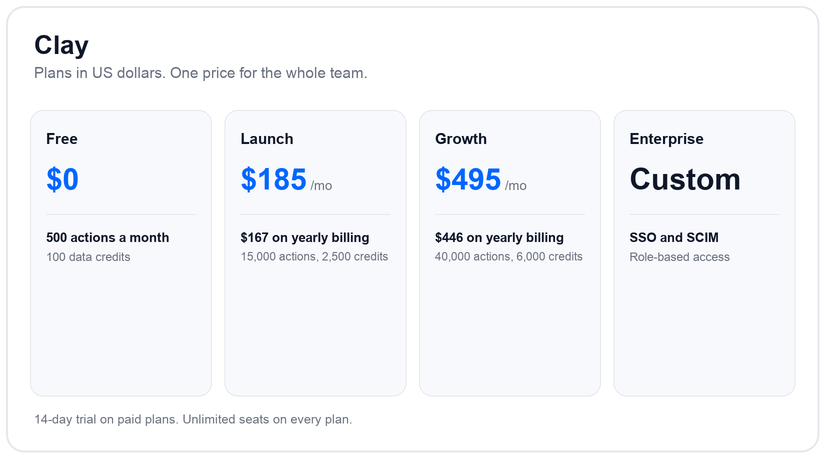
| Starting price | Free plan. Launch is $185 a month on monthly billing ($167 on yearly billing). Growth is $495 ($446 yearly). Enterprise is custom. |
| Seats | Unlimited on every plan |
| Included use | Free: 500 actions and 100 data credits a month. Launch: 15,000 actions and 2,500 data credits. Growth: 40,000 actions and 6,000 data credits. |
| What it automates | Finding and filling in data from many providers, researching each row, and sending email from Launch. Mailboxes bought inside Clay are warmed for you. |
| Fits | Founders and small teams that will build their own lead lists |
| Free plan or trial | Free plan. 14-day trial on paid plans. |
| Funding | $115M Series D at a $7.1B valuation, September 2026, led by Wellington |
A lead list is a list of people you could sell to, with their job titles, companies and contact details. Enrichment means adding missing facts to that list, such as an email address, a phone number or a company size. In Clay each person or company is a row in a table, and each column is a step that fills in one more fact. That makes Clay a workbench for building the list yourself, then sending to it.
Key features of Clay
- Data from 150+ providers: Clay pulls from many data sources in one table. It supports waterfall enrichment, which means trying one provider after another until one finds a result. You can also bring your own API key (a code that connects Clay to a provider you already pay for).
- Claygent: Clay's AI agent. It researches each row on the web, so you can add facts such as what a company sells or who it hired recently.
- Email sending: the email sequencer (a planned series of emails) starts on the Launch plan. Domains for the sequencer start on Growth.
- Mailboxes and warm-up: warm-up means slowly raising your sending volume so email providers learn to trust a new mailbox. Mailboxes bought inside Clay are warmed for you. Buying mailboxes starts on Growth. On Launch you connect mailboxes you already own.
- Replies: each sender gets a reply inbox inside Clay, and the analytics show bounce rates for each domain (a bounce is an email that comes back undelivered). Reply drafts go to Slack for a rep to approve or edit before sending.
- Signals and phone data: phone enrichment and signals start on Launch. Web intent signals (clues from what a company does online) start on Growth.
- CRM and warehouse sync: CRM auto-sync and warehouse sync start on Growth. A CRM is the app where you keep customers and deals, such as HubSpot or Salesforce.
- Team controls: SSO, SCIM and role-based access are on Enterprise. SSO is single sign-on, and SCIM adds and removes users automatically.
How does Clay work?
Clay works like a spreadsheet that fills itself in. The usual path has four steps.
- Build the table. Each row is a person or a company. Each column is one step that adds a fact.
- Add data. Pull facts from the 150+ providers, trying one after another with waterfall enrichment, and let Claygent research the rest on the web.
- Check a small test. Run a few rows first and see how many actions and data credits they use.
- Send and follow up. Email sending starts on Launch. Replies come to a reply inbox inside Clay, and CRM sync starts on Growth.
Who Clay fits
If you are a solo founder who wants to try lead building for free, the Free plan gives 500 actions and 100 data credits a month. If you have one to three sellers and want a rich, custom list, Launch at $185 a month covers the whole team, because seats are unlimited. If you need CRM sync, web intent signals or Clay-bought mailboxes, those start on Growth at $495 a month on monthly billing. If you want a tool that books meetings, booking is not listed in Clay, so plan a separate calendar tool. If you want one flat price per person and a ready-made contact database, Apollo works that way. See the whole field in our AI SDR tools guide.
Clay pricing
Clay has a free plan and three paid tiers. The price is for your whole team, not per person, because every plan has unlimited seats and unlimited tables. Paid plans have a 14-day trial. Prices are in US dollars as of 19 October 2026.
| Plan | Monthly billing | Yearly billing | Actions | Data credits |
|---|---|---|---|---|
| Free | $0 | $0 | 500 a month | 100 a month |
| Launch | $185 a month | $167 a month | 15,000 a month | 2,500 a month |
| Growth | $495 a month | $446 a month | 40,000 a month | 6,000 a month |
| Enterprise | Custom | Custom | Custom | Custom |
Clay counts use in two meters: actions and data credits. The more steps you run on each row, the more you use, so the bill depends on how you build the table. Ask for a test run on a small list before you size a plan. Finding phone numbers and sending email start on Launch. CRM sync starts on Growth.
What does a team of 1, 3 or 5 people pay for Clay?
Clay is priced for the whole team. Every plan has unlimited seats, so the price does not change with the number of people. The meters that grow are actions and data credits.
| Plan | 1 person | 3 people | 5 people |
|---|---|---|---|
| Launch, monthly billing | $185 a month | $185 a month | $185 a month |
| Launch, yearly billing | $167 a month | $167 a month | $167 a month |
| Growth, monthly billing | $495 a month | $495 a month | $495 a month |
| Growth, yearly billing | $446 a month | $446 a month | $446 a month |
How does Clay compare with Apollo and ZoomInfo on price?
Clay charges one price for the whole team. Apollo charges per seat. ZoomInfo is quote only. Prices are in US dollars as of 19 October 2026.
| Tool | Starts at | Free plan or trial | Sends email itself |
|---|---|---|---|
| Clay | Free; Launch $185 a month, monthly billing | Free plan; 14-day trial on paid plans | Yes (from Launch) |
| Apollo | Free; Basic $65 per seat a month, monthly billing | Free plan; 14-day trial on Basic and Professional | Yes |
| ZoomInfo | Quote only | Free trial available | Yes (cadences with a phone dialer and an email tool) |
What should you ask before you buy Clay?
- How many actions and data credits does one row use in my table?
- Do I need CRM sync, web intent signals or Clay-bought mailboxes? Those start on Growth.
- How will I book meetings? Booking is not listed in Clay.
- Is yearly billing worth it? It brings Launch from $185 to $167 and Growth from $495 to $446, about 10% less.
Clay terms in plain words
- Action: one step that Clay runs on a row.
- Data credit: a unit Clay uses when it pulls a fact from a data provider.
- Enrichment: adding missing facts, such as an email address, to a list.
- Waterfall enrichment: trying one data provider after another until one finds a result.
- Claygent: Clay's AI agent that researches each row on the web.
- Sequencer: the part of Clay that sends a planned series of emails.
Pros and good to know
Pros
- A free plan with 500 actions and 100 data credits a month
- Unlimited seats and tables on every plan
- Data from more than 150 providers in one table
- Claygent researches each row for you
- Sends email from Launch, with a reply inbox for each sender
Good to know
- There are two meters: actions and data credits. Cost depends on the steps each row runs.
- CRM sync and Clay-bought mailboxes start on Growth.
- Booking meetings is not listed. Use a separate calendar tool.
- Paid plans have a 14-day trial. Yearly billing saves about 10%.
Best for your situation
Guides & comparisons
Frequently Asked Questions
How much does Clay cost?
Clay has a free plan with 500 actions and 100 data credits a month. Launch is $185 a month on monthly billing ($167 on yearly billing), and Growth is $495 ($446 yearly). Enterprise is custom. Every plan has unlimited seats. Prices are in US dollars as of 19 October 2026.
Is there a free version of Clay?
Yes. The Free plan gives 500 actions and 100 data credits a month, with unlimited seats and tables. Paid plans add more actions and credits, email sending from Launch and CRM sync from Growth. Paid plans have a 14-day trial.
What is Clay?
Clay (clay.com) is a spreadsheet-style tool for building lead lists. It pulls data from more than 150 providers, uses an AI agent called Claygent to research each row, and can send the outreach emails.
Who are Clay's main competitors?
Apollo is a contact database with sending and a free plan, then $65 per seat a month. ZoomInfo is a large database sold by quote only. Unify (free, then $20 or $60 per seat) and Amplemarket ($600 a month on an annual term) also help find and contact buyers. Clay differs because you build the list yourself.
What are Clay actions and data credits?
They are the two meters Clay uses. Each plan includes a set amount every month. Launch includes 15,000 actions and 2,500 data credits, and Growth includes 40,000 actions and 6,000 data credits. The more steps each row runs, the more you use.
Do I need a separate email tool with Clay?
Not at first. Clay sends email from the Launch plan and gives each sender a reply inbox. Mailboxes bought inside Clay are warmed for you, and buying them starts on Growth. On Launch you connect mailboxes you already own. Booking meetings is not listed in Clay.
Does Clay connect to my CRM?
Yes, on the Growth plan and above. CRM auto-sync and warehouse sync start on Growth. The Free and Launch plans do not include them.
Is Clay worth it for a startup?
Clay suits a founder or a small team that will build lead lists step by step and wants them as rich as possible. The Free plan lets you test it, and one price covers any number of seats. If you only want a ready-made contact list, a database tool such as Apollo is simpler.
Bottom line
Clay fits a founder or a small team that wants to build its own lead lists, pull data from many providers and research each row. Before you buy, check three things. Test a small list to see how many actions and credits one row uses. Confirm that the CRM sync you need is on Growth. And plan a separate tool for booking meetings. The free plan and the 14-day trial let you test all three.
Add us as a preferred source on Google, and our reviews and picks show up in your Top Stories and AI Overviews.