




TL;DR: BrightEdge is an enterprise SEO platform, founded in 2007, that now tracks how AI answers treat your brand. Its AI Catalyst product shows how often ChatGPT, Perplexity, Google AI Overviews, Google AI Mode and Gemini name your brand and use your pages as a source. AI Hyper Cube maps the AI questions, rival brands and sources behind those answers. If you run SEO for a large site and want AI visibility in the same system as your rankings and site audits, it fits. It is quote-only and starts with a demo, so a team that wants a simple tracker with a posted price has lighter options. App Score: 7.0/10.
How BrightEdge measures up
Weighted against our AI visibility tools rubric. Sub-scores out of 10; weight in brackets.
Our independent score, from our own weighted rubric and verified pricing, kept separate from any sponsorship. How we rank.
| Starting price | Quote-only. BrightEdge posts no price; you ask for a demo and a custom proposal. |
| Products | Products on one platform: AI Catalyst, AI Hyper Cube, AI Agent Insights, Data Cube X, Share of Voice, Content Advisor, Site Agents Suite |
| Engines tracked | ChatGPT, Perplexity, Google AI Overviews, Google AI Mode, Gemini and other AI platforms (no full list or count posted) |
| Best for | Large teams with a mature SEO program; also offered to mid-market companies and agencies |
| Standout | Deep AI data unified with enterprise SEO |
| Free trial | None shown; access starts with a demo request |
| Founded and HQ | 2007, San Mateo, California |
| Security | Trust page lists SOC 2, ISO 27001, ISO 27701 and ISO 42001 (ISO 42001 stated as certified); SAML/SSO (single sign-on) |
BrightEdge, founded in 2007 by Jim Yu and Lemuel Park, is one of the original enterprise SEO platforms. Catalyst counts how often AI answers name your brand (a mention) or use your pages as a source (a citation), and rates the tone (sentiment). Hyper Cube maps the AI conversations in your category. Both sit beside the keyword, ranking and site data in the same platform. For large teams already in BrightEdge, that single view is the appeal.
Key features of BrightEdge
- AI Catalyst (launched 9 April 2025): counts how often your brand is mentioned and cited in ChatGPT, Perplexity, Google AI Overviews, Google AI Mode, Gemini and other AI platforms, and sets that against your rivals. It splits the result into Mentions Presence (you are named) and Citations Presence (your page is the source).
- Sentiment: marks each AI answer that names your brand Positive, Neutral or Negative and gives the reason.
- Prompt research: builds and tracks the longer questions buyers ask AI (prompts), mapped to the buying journey, and flags when a rival takes over an answer you held. BrightEdge Copilot suggests prompts from your site, search patterns and past queries.
- Recommendations: shows which page holds a citation today, compares your page with it on citations, ranking keywords and estimated traffic, and turns the gaps into a content brief.
- AI Hyper Cube (launched 10 March 2026): lists the AI conversations that matter to your brand and tracks which rival brands appear in them (weighted by search demand). It also shows which websites AI trusts in your category and maps where you win or lose, from early research to purchase.
- AI Agent Insights: shows which AI agents visit your site (the bots that AI assistants such as ChatGPT, Claude, Perplexity and Gemini send to read pages), what they do, and where they hit blocked pages or broken paths.
- AI Early Detection System (announced 12 September 2025): reporting that shows, as it happens, how AI search feeds traffic, leads and revenue, so you can tell a real shift from noise.
- Search tools underneath: Data Cube X (keyword and competitor research), ContentIQ (site audits for millions of pages), Share of Voice (a search visibility score that counts Google AI Overview presence) and Content Advisor (content briefs).
- Site Agents Suite (formerly Autopilot): agents that place internal links, add structured data (code that labels a page for search engines) and push title and headline updates into WordPress, Drupal or another major content management system. A person confirms every change before it goes live.
- BrightEdge MCP: is a connector that links BrightEdge data to AI assistants such as Claude, ChatGPT, Gemini Enterprise and Microsoft Copilot, so you can ask questions in plain language.
Who BrightEdge is best for
If you run SEO for a large site and already work in BrightEdge, AI Catalyst adds AI visibility to the reports you have. If you run an agency, BrightEdge says AI Catalyst lets you manage multiple clients from a single dashboard. BrightEdge also offers AI Catalyst to mid-market companies. If you only want a tracker with a posted price, compare SE Ranking, Peec AI or Otterly.ai. See how it ranks in our best AI visibility tools guide.
BrightEdge pricing
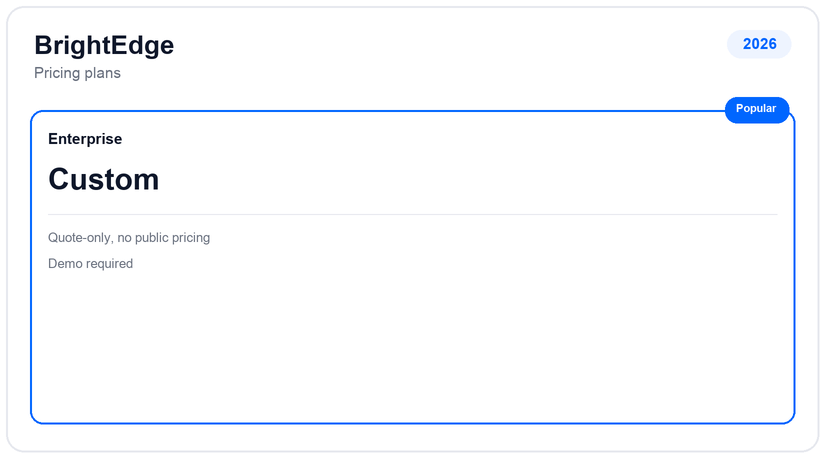
BrightEdge does not publish a price. Its pricing page asks you to get in touch by form or phone, and its product pages end in a request for a demo and a custom proposal. No free tier or self-serve plan is shown. Dollar figures on other sites are not from BrightEdge. In the demo, ask which products the quote includes, how many prompts, markets and users it covers, and how long the contract runs.
BrightEdge competitors
These are the tools buyers set beside BrightEdge. Plans and prices are as of October 2026.
- Conductor: no posted price. Names ChatGPT, Perplexity, Google AI Overviews, Gemini, Copilot and Google AI Mode. Offers a 3-week platform trial.
- seoClarity (Clarity ArcAI): no posted price for ArcAI; a demo is the way in. Names nine engines, including Claude, DeepSeek and Grok.
- Profound: a free 7-day trial, then custom pricing.
- Peec AI: from $95 a month for 50 prompts and a pick of 3 engines (monthly billing).
- Otterly.ai: from $29 a month for 15 prompts on 4 engines (monthly billing).
Pros and cons
Pros
- AI visibility data sits in the same platform as rankings, site audits and content tools
- Reports mentions, citations and sentiment, and names the pages and sources AI engines cite
- AI Agent Insights shows which AI agents visit your site and where they are blocked
- Site Agents Suite can push link, structured-data and title fixes into your content management system, with a person approving each change
Cons
- Quote-only: no price is posted, so you cannot compare cost before a sales call
- No free trial or self-serve sign-up is shown; access starts with a demo request
- BrightEdge does not post prompt limits or a full engine list for AI Catalyst
- AI Agent Insights and Share of Voice are listed for enterprise customers, so ask whether your plan includes them
- BrightEdge describes AI Catalyst as available to its customers; ask in the demo whether it can be bought without the full platform
Related guides
Compare the whole field in our best AI visibility tools guide, see the top Profound alternatives, and learn the method in answer engine optimization and AI brand monitoring.
Frequently Asked Questions
How much does BrightEdge cost?
BrightEdge does not publish a price. You request a demo and get a custom proposal. No free tier or self-serve plan is shown on its site. Dollar figures on other sites are not from BrightEdge.
What does BrightEdge do?
BrightEdge is an enterprise SEO platform founded in 2007. It covers keyword research, site audits, content briefs and reporting. Since April 2025 it also tracks AI search with AI Catalyst, and since March 2026 with AI Hyper Cube and AI Agent Insights.
Is BrightEdge worth it for AI visibility?
It is worth a demo if you run SEO for a large site and want AI mentions, citations and AI bot visits next to your rankings and site audits. If you only need to track a set of prompts and want a posted price, Peec AI and Otterly.ai post theirs. BrightEdge does not.
Which AI engines does BrightEdge track?
AI Catalyst names ChatGPT, Perplexity, Google AI Overviews, Google AI Mode and Gemini, plus other AI platforms. BrightEdge does not post a full list or a count. AI Agent Insights, which tracks AI agents visiting your site rather than the answers they give, names ChatGPT, Claude, Perplexity and Gemini.
What is BrightEdge AI Catalyst?
AI Catalyst is BrightEdge's AI search product, launched on 9 April 2025. It tracks how often your brand is mentioned and cited in AI answers, how those answers describe you (Positive, Neutral or Negative), and which prompts and pages decide who wins.
What is BrightEdge AI Agent Insights?
AI Agent Insights shows which AI agents visit your site. These are the bots that AI assistants such as ChatGPT, Claude, Perplexity and Gemini send to read pages. It also shows what they do there and where they hit blocked pages or broken paths. BrightEdge says nearly 1 in 4 ChatGPT attempts to reach enterprise sites fail. It is listed as available to BrightEdge enterprise customers.
Does BrightEdge help with generative engine optimization (GEO)?
Yes. Generative engine optimization (GEO, also called answer engine optimization or AEO) is the work of getting your brand named and cited in AI answers. BrightEdge brings it together with SEO in one workflow: AI Catalyst measures where you appear in AI answers and recommends fixes, and Content Advisor turns search gaps into briefs built to rank on Google and be cited by AI.
Who are BrightEdge's main competitors?
BrightEdge competes with Conductor, seoClarity and Profound, which sell through demos or custom pricing, and with Peec AI and Otterly.ai, which post prices. Semrush and Ahrefs also sell AI visibility tools with posted prices.
Who founded BrightEdge and where is it based?
BrightEdge was founded in 2007 by Jim Yu and Lemuel Park. It is venture-backed and headquartered in San Mateo, California.
Bottom line
BrightEdge fits a large team that already runs SEO in a full platform and wants AI mentions, citations and AI bot visits measured beside rankings and site health. It does not post a price, so the first step is a demo. If you want a tracker with a posted price, look at Peec AI and Otterly.ai first.
More tools to compare
Add us as a preferred source on Google, and our reviews and picks show up in your Top Stories and AI Overviews.