





Lium is a conversational AI platform built for complex, real-world data work. It integrates geospatial, energy, subsurface, space, and infrastructure datasets into unified intelligence, letting experts query massive, bespoke datasets in natural language and turning weeks of engineering effort into a single conversation.
Lium connects to databases, files, APIs, and instrument outputs, automatically indexing every source so its AI agents already know where everything lives. It is designed for data-intensive industries such as energy, geospatial analysis, scientific research, aerospace, and subsurface exploration, serving enterprises, researchers, and domain experts who need AI that can actually handle their proprietary, complex data formats at terabyte scale.
Key Features of Lium
- Natural Language Data Querying: Ask questions in plain English and get answers drawn from complex, multi-source datasets instantly.
- Universal Data Connector: Plugs into databases, files, APIs, and instrument outputs with automatic indexing and profiling for every source.
- Custom Tool Building: Builds reusable custom tools, datasets, and transformation pipelines tailored to your specific workflows and data formats.
- On-Demand Compute: Automatically provisions heavy compute for terabyte-scale data scanning without requiring DevOps or cluster management.
- Shared Workspace Artifacts: Saves analyses, scripts, charts, and tools as shared artifacts that teammates and future agents can reuse and build upon.
- Multi-Layer Geospatial Reasoning: Combines satellite imagery, terrain models, and vector datasets into unified intelligence across traditionally siloed GIS layers.
- Subsurface Data Interpretation: Interprets seismic surveys and fault probability volumes, building reusable analysis tools that compound across expert sessions.
- Multi-Phase Scientific Workflows: Builds persistent research pipelines where plans, datasets, tools, and outputs stay connected across all sessions.
- Cross-Dataset Normalization: Cross-references datasets never designed to work together, normalizing identifiers and querying structured and unstructured records in parallel.
- Energy System Analysis: Reasons across renewable deployment models, grid integration data, and operational asset intelligence to automate expert diagnostic workflows.
- Infrastructure Simulation Support: Opens raw simulation files, reconstructs model geometry, and validates physics consistency across every active cell.
- Compounding Intelligence Library: Every analysis and tool built in Lium compounds over time, so the same problem never has to be solved twice by any team member.
How to Use Lium
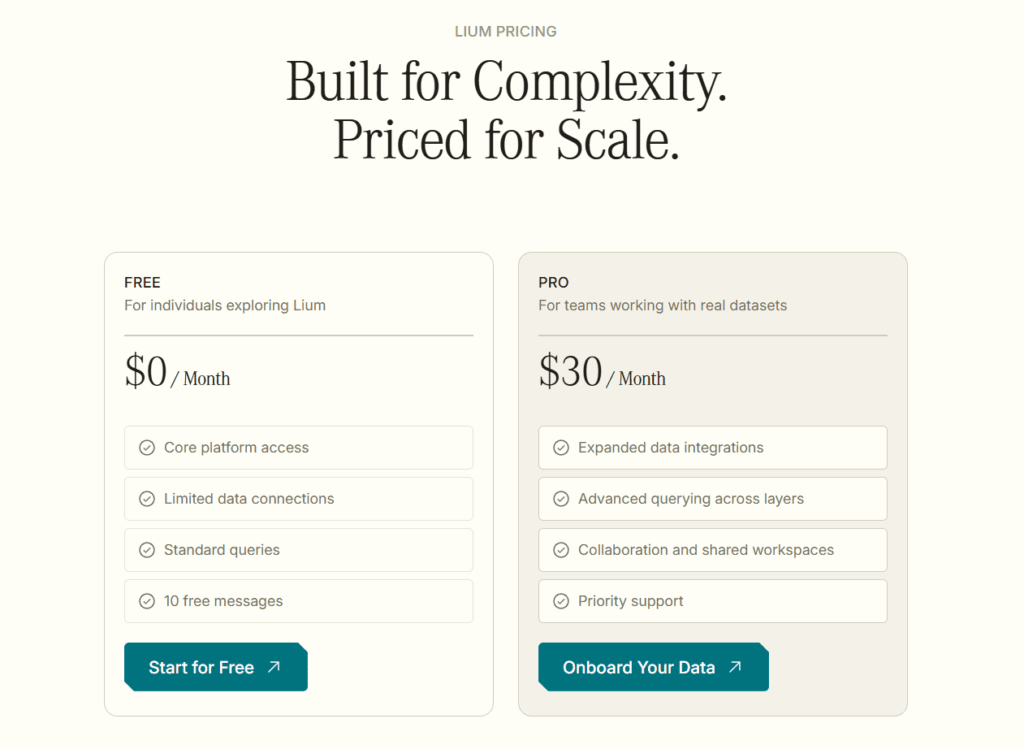
- Sign up for a free account at app.lium.ai with no credit card required to access 10 free messages.
- Connect your data sources, including databases, files, APIs, or instrument outputs, directly from your workspace.
- Lium automatically indexes and profiles each connected source so agents understand your data structure immediately.
- Type a question or task in natural language to query, analyze, or transform your data through conversation.
- Review the generated analysis, code, charts, or datasets that Lium produces in response to your query.
- Have Lium build reusable custom tools or transformation pipelines tailored to your recurring workflows.
- Save outputs as shared workspace artifacts so teammates and future agents can reuse and extend them.
- Upgrade to the Pro plan at $30 per month when you need expanded integrations, collaboration features, and priority support.
Key Use Cases for Lium
- Geospatial Analysis: Process hundreds of thousands of satellite records and build reusable multi-spectral measurement pipelines for recurring analysis tasks.
- Subsurface Exploration: Interpret seismic surveys and fault probability volumes in minutes rather than weeks of traditional engineering collaboration.
- Energy Asset Management: Automate diagnostic workflows across renewable deployment models and grid integration data to accelerate critical energy decisions.
- Scientific Research: Build multi-phase workflows where research plans, datasets, and tools persist across sessions and scale across the entire team.
- Aerospace and Space Intelligence: Surface signals from sparse astrophysical observations and validate computational frameworks directly from design documents.
- Infrastructure Modeling: Open and validate raw simulation files with full geometry reconstruction for outputs directly usable in existing engineering workflows.
- Financial Data Intelligence: Interpret proprietary transaction records and alternative data sources, building queryable intelligence that grows with every analyst query.
Pros and Cons
Pros
- Handles terabyte-scale, bespoke industrial data formats effortlessly
- Builds reusable tools that compound value over time
- No DevOps or engineering expertise required to start
- Free tier available with no credit card needed
- Purpose-built for complex, domain-specific real-world data
Cons
- Lium is heavily focused on advanced industries, making it less suitable for general-purpose data work or everyday business use cases.
- Some high-demand verticals like Financial Services and Marketing are listed as coming soon, limiting coverage for certain industries.
Frequently Asked Questions
What is Lium?
Lium is a conversational AI platform that makes complex, real-world data work easy for domain experts and enterprise teams.
Is Lium Free to Use?
Yes, Lium offers a free plan with 10 messages and no credit card required to get started.
What types of data can Lium work with?
Lium handles geospatial, subsurface, energy, aerospace, infrastructure, and scientific datasets across diverse bespoke formats.
How is Lium different from ChatGPT or Claude?
Lium is purpose-built for complex proprietary datasets and terabyte-scale data that general AI platforms cannot process reliably.
Do I need to be technical to use Lium?
No, Lium uses natural language so non-technical domain experts can query and analyze complex datasets without writing code.
How does Lium handle data security?
Lium is built for enterprise-grade security, keeping sensitive and proprietary datasets protected throughout every analysis session.
Can Lium work for teams?
Yes, the Pro plan includes shared workspaces and collaboration features so entire teams can build on each other’s work.
What is the Pro plan pricing for Lium?
The Pro plan costs $30 per month and includes expanded integrations, advanced querying, shared workspaces, and priority support.