



TL;DR: Vapi is the best AI voice agent platform for developers who want maximum control – it orchestrates any speech-to-text, LLM and text-to-speech provider behind one API, so you assemble a best-of-breed stack rather than accept a vendor’s defaults. That flexibility, plus real enterprise proof (Amazon Ring routes its inbound calls through Vapi), makes it our top developer pick; the trade-offs are a learning curve and latency that varies with the stack you choose. App Score: 8.1/10.
How we scored Vapi
Weighted against our AI voice agent rubric. Sub-scores out of 10; weight in brackets.
Our independent score, from our own weighted rubric and verified pricing, kept separate from any sponsorship. Our methodology.
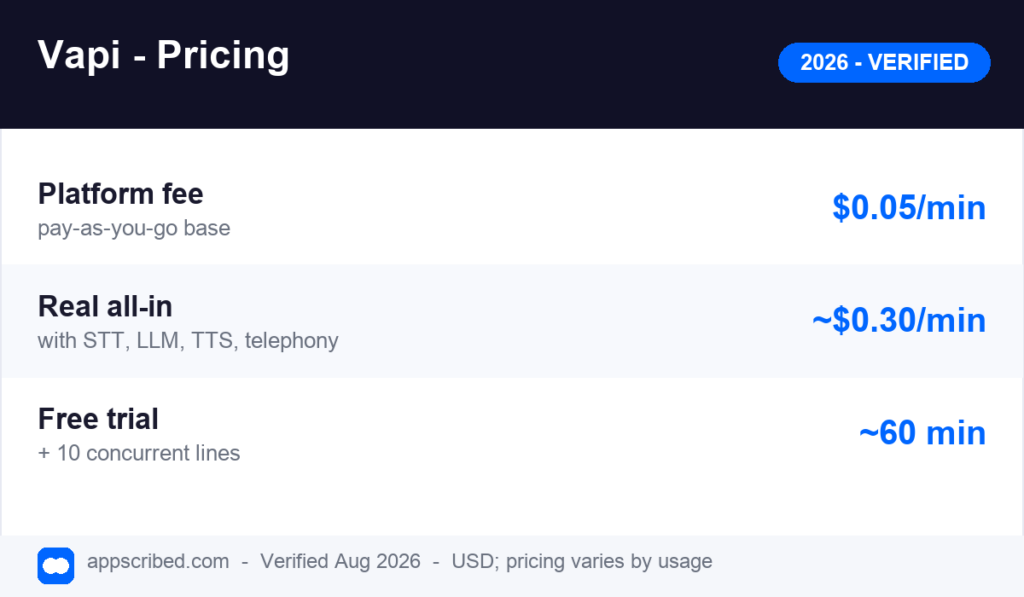
| Starting price | $0.05/min platform fee (pay-as-you-go) |
| Real all-in | ~$0.30/min once STT, LLM, TTS and telephony are added |
| Best for | Developers and technical teams building custom agents |
| Standout | Bring-your-own model + telephony, deepest flexibility |
| Free trial | Yes, ~60 free minutes |
| Type | Dev-first orchestration API |
Key features of Vapi
- Orchestrates any STT (usually Deepgram), any LLM (OpenAI, Anthropic, Google, custom) and 14+ TTS providers (ElevenLabs, Cartesia, PlayHT) behind one API.
- Assistants and Workflows builder with native function/tool calling, post-call webhooks and scheduled events.
- Client and server SDKs (Web, React Native, Flutter, iOS, Python, TypeScript, Go and more) plus a Vapi CLI and MCP server.
- Phone numbers in-dashboard, or import Twilio/Telnyx numbers or BYO carrier via SIP; inbound and outbound.
- Bring-your-own LLM and API keys, so component costs drop to provider cost.
- Enterprise controls: HIPAA and Zero Data Retention add-ons; 99.99% uptime SLA claimed.
Who Vapi is best for
Vapi is for developers and technical teams that want to build a custom voice agent and tune every layer of the stack. If you have engineering resource and want to pick the fastest STT, the smartest LLM and the most natural TTS for your use case – and pay only for what you use – Vapi gives you more control than any other platform here. Non-technical teams and agencies will find it harder going than a no-code builder like Synthflow.
Pros and cons
Pros
- Deepest build flexibility of any platform on our list – any model, any provider.
- Cheapest advertised base ($0.05/min) and BYO keys keep component costs at cost.
- Serious enterprise proof: 1B+ calls, 1M+ developers, Amazon Ring chose it over 40+ vendors.
- Broadest SDK and tooling coverage, plus CLI and MCP for fast developer setup.
Cons
- Latency is configuration-dependent: real-world voice-to-voice is often ~500-900ms, with reviewers reporting occasional spikes.
- Code-first: the dashboard has a learning curve and is not built for non-developers.
- You assemble and pay for the component stack, so true all-in cost (~$0.30/min) is well above the headline $0.05.
Verdict
Vapi is the top pick for developers building production voice agents who value control and best-of-breed flexibility over out-of-the-box simplicity. It scores highest on our list for build power (9.0) and is backed by the strongest enterprise proof in the category. Budget for the real all-in per-minute cost and a short learning curve, and you get the most capable platform for teams that want to own their stack. See how it ranks against every rival in our best AI voice agents guide.
Related guides
Compare more in our cluster: Vapi vs Retell AI, Vapi vs Bland AI, Best Vapi Alternatives and AI Voice Agent Pricing.
Frequently Asked Questions
Is Vapi good for building AI voice agents?
Yes – Vapi is our top developer pick, scoring 8.1 out of 10. It lets you orchestrate any speech-to-text, LLM and text-to-speech provider behind one API, with full function calling and telephony, which is why teams like Amazon Ring build on it.
How much does Vapi cost?
Vapi charges a $0.05/min platform fee, but speech-to-text, LLM, text-to-speech and telephony are billed separately at provider cost, so realistic all-in pricing is around $0.30/min. Bringing your own API keys lowers the component cost. There are about 60 free trial minutes.
Is Vapi no-code?
No. Vapi is developer-first: it has a dashboard, CLI and SDKs, but building and tuning agents assumes engineering resource. If you want no-code, Synthflow or Thoughtly are easier starting points.
How is Vapi’s latency?
Latency depends on the models you choose. A well-tuned stack lands around 550ms, but real-world voice-to-voice is commonly 500-900ms and reviewers report occasional spikes, so test with your own configuration.
Add us as a preferred source on Google, and our reviews and picks show up in your Top Stories and AI Overviews.