



TLDR: Atomic Mail is a genuinely free encrypted email service from Estonia with 10 aliases and no phone number required at signup. It earns an App Score of 6/10. The encryption is real, but two things hold it back: it keeps 7 days of logs including IP addresses, and it has no IMAP and no custom domains, both still on the roadmap. Paid is $7/month, or $5/month billed annually.
Atomic Mail is a young privacy-focused email provider competing with Proton Mail and Tuta. This review covers what the free plan actually includes, what the encryption does and does not cover, the logging policy most reviews skip, and who should pick it over the established alternatives.
Email is only one channel in a business communications stack. If you are also setting up business calling, our best business phone systems guide covers the leading options.
One clarification first. Atomic Mail (atomicmail.io) is not related to “Atomic Mail Sender” or “Atomic Mail Verifier” by AtomPark Software, which is bulk-emailing software from a different company. Most search results for “Atomic Mail” are AtomPark’s products, not this one.
Is Atomic Mail free?
Yes. The free plan requires no phone number and no secondary email address at signup, which is unusual and genuinely useful for privacy. It includes 10 aliases and what Atomic Mail describes as “unlimited storage”.
Treat “unlimited” as a marketing claim rather than a measured figure. Atomic Mail publishes no numeric storage cap anywhere, and no independent test of it exists. By comparison, Proton’s free tier is explicit about giving you 1 GB, and Tuta’s is explicit about 1 GB with zero aliases. A stated limit you can verify is worth more than an unstated one you cannot.
How much does Atomic Mail cost?
| Plan | Price | What you get |
|---|---|---|
| Free | $0 | 10 aliases, “unlimited” storage, full mail app, encrypted email |
| Plus (monthly) | $7 / month | Everything below |
| Plus (annual) | $5 / month | Hide My Email, 15 aliases, custom signature, premium support, AI Suite |
The Plus upgrade is modest: five extra aliases, throwaway addresses via Hide My Email, a custom signature, and an AI suite covering writing assistance, grammar, summarising, translation and read-aloud. If you do not want the AI features, the free plan covers most of what makes Atomic Mail interesting.
Is Atomic Mail safe and legit?
It is a real company: AtomicMail Systems OÜ, registered in Tallinn, Estonia. Its privacy policy states it will “only comply with requests from Estonian judicial authorities and will not honor requests from other authorities.” Estonian jurisdiction and GDPR coverage are genuine advantages.
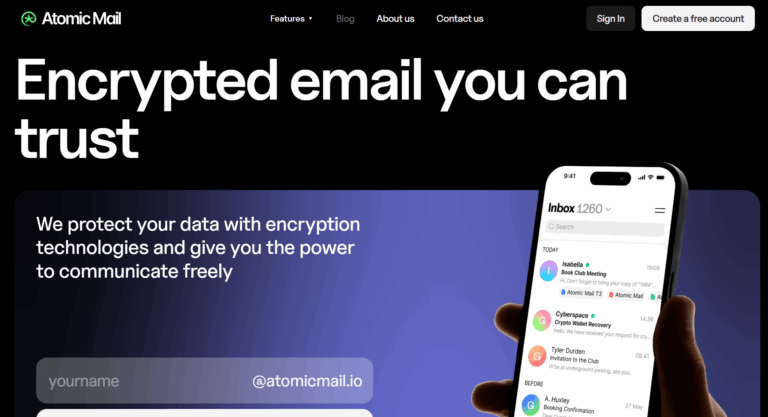
The encryption stack is specified rather than vague, which is a good sign. Atomic Mail names AES-256, ECIES for Atomic-to-Atomic messages, SHA-256, TLS 1.3 and scrypt for key derivation, with client-side encryption and a BIP39 seed phrase for recovery.
Three caveats an honest review has to raise:
- It is not a no-logs service. The privacy policy states plainly: “We keep logs for 7 days, including metadata like IP addresses of remote email servers and SMTP sender and recipient addresses.” Website visitor IPs are also kept 7 days. That is a reasonable anti-abuse policy, but if you assumed a privacy email provider logs nothing, it does.
- No verifiable third-party audit. The security whitepaper says Atomic Mail “undergoes regular security audits by third-party organizations”, but names no auditor, gives no date, and links no report. The service is also not open source and the protocol is proprietary, so nobody outside the company can check the implementation.
- The post-quantum claim is not substantiated. One blog post mentions “incorporating post-quantum cryptographic algorithms” without naming a single algorithm, and post-quantum appears nowhere in the security whitepaper. Do not choose Atomic Mail for post-quantum protection.
Atomic Mail also does not disclose where its servers physically sit, describing them only as “secure data centers”.
What Atomic Mail is missing
This is the section that should decide it for most people. Atomic Mail currently has no IMAP or SMTP bridge, no custom domains, and no calendar. All three are on the published roadmap, none has shipped.
No IMAP means you cannot use Thunderbird, Apple Mail or Outlook with it. No custom domains means you cannot run you@yourbusiness.com through it. For personal privacy email those may not matter. For business use they are disqualifying, which is consistent with there being no Business plan yet.
Encryption to non-Atomic Mail users works through “Encrypt by Password” or “Encrypt as File” rather than PGP. There is no OpenPGP interoperability, so you cannot exchange PGP-encrypted mail with Proton or Tuta users in the standard way.
Atomic Mail vs Proton Mail, Tuta and StartMail
| Service | Entry paid price | IMAP | Custom domain | Open source |
|---|---|---|---|---|
| Atomic Mail | $5/mo annual, $7 monthly | No | No | No |
| Proton Mail Plus | ~$3.99/mo annual | Yes (Bridge) | Yes (1) | Yes |
| Tuta Revolutionary | ~€3.00/mo annual | No (by design) | Yes (3) | Yes |
| StartMail Personal | ~$4.99/mo annual | Yes | Yes (1) | No |
The honest summary: Atomic Mail is not cheaper than the established options, and it offers less. Proton and Tuta are both open source, both audited, both support custom domains, and both cost less annually. Atomic Mail’s genuine differentiators are the no-phone-number signup, the generous free alias count, and the seed-phrase recovery model.
Who should use Atomic Mail?
- Good fit: a free secondary address for sign-ups and spam isolation, where 10 aliases and no phone requirement genuinely matter
- Good fit: anyone who wants encrypted email without linking it to an existing identity
- Poor fit: business use, because there are no custom domains and no Business plan
- Poor fit: desktop email client users, because there is no IMAP
- Poor fit: anyone who requires an audited, open-source provider
Reported user complaints centre on deliverability (messages arriving late or not at all) and slow support, which is typical of a young provider with a small team. We have not been able to verify the scale of these reports.
Pros and Cons
Pros
- Free plan with 10 aliases, no phone number needed
- Named, specific encryption stack rather than vague claims
- Estonian jurisdiction, GDPR, resists non-Estonian requests
- Apps on web, iOS, Android, Windows and macOS
- Seed-phrase recovery instead of a password reset backdoor
Cons
- Keeps 7 days of logs including IP addresses
- No IMAP, no custom domains, no calendar
- Not open source, no verifiable third-party audit
- Post-quantum claim unsupported by its own whitepaper
- Costs more than Proton or Tuta while offering less
Is Atomic Mail free?
Yes. The free plan includes 10 aliases and what Atomic Mail calls unlimited storage, and requires no phone number or secondary email at signup. No numeric storage cap is published anywhere, so treat unlimited as a marketing claim rather than a measured figure.
How much does Atomic Mail cost?
Atomic Mail Plus is $7 per month, or $5 per month billed annually. There are only two tiers, Free and Plus. A Business plan is described as actively being worked on but is not currently available.
Is AtomicMail.io legit?
Yes. It is operated by AtomicMail Systems OU, a registered company in Tallinn, Estonia, and it publishes a detailed security whitepaper naming AES-256, ECIES, SHA-256, TLS 1.3 and scrypt. Note it is not open source and no named third-party audit report has been published.
Is Atomic Mail anonymous?
Partly. Signup requires no phone number or secondary email, which is genuinely anonymous at registration. But Atomic Mail is not a no-logs service: its privacy policy states it keeps logs for 7 days including IP addresses of remote email servers and SMTP sender and recipient addresses.
Does Atomic Mail keep logs?
Yes, for 7 days. The privacy policy states it retains metadata including IP addresses of remote email servers and SMTP sender and recipient addresses, plus website visitor IPs, for 7 days. Email content itself is encrypted client-side and described as inaccessible to the provider.
Does Atomic Mail support IMAP or custom domains?
No. Neither IMAP nor custom domains are available yet, and both appear on the roadmap alongside a calendar. This means you cannot use Thunderbird, Apple Mail or Outlook with it, and you cannot run a business address through it.
Who owns Atomic Mail?
Atomic Mail is operated by AtomicMail Systems OU, registered in Tallinn, Estonia. It is unrelated to Atomic Mail Sender and Atomic Mail Verifier, which are bulk-emailing products from AtomPark Software, a different company.
Is Atomic Mail better than Proton Mail?
For most users, no. Proton Mail Plus costs less annually, is open source, has been independently audited, supports custom domains and offers IMAP through Proton Bridge. Atomic Mail wins on free aliases and on requiring no phone number at signup.
Does Atomic Mail use post-quantum encryption?
There is no evidence that it does. A single blog post mentions incorporating post-quantum cryptographic algorithms without naming any, and post-quantum encryption appears nowhere in the company security whitepaper. Do not choose Atomic Mail for post-quantum protection.
What is the best encrypted email service?
For most people Proton Mail or Tuta, because both are open source, independently audited, support custom domains and cost less than Atomic Mail annually. Atomic Mail is worth considering specifically as a free, anonymous secondary address. Skiff is no longer an option, having shut down in August 2024.