



TL;DR: Decagon is a fast-rising challenger building concierge-grade AI support agents across chat, email and voice, backed by Coatue, a16z and Accel. It resolves complex, multi-step queries well and is winning mid-market and enterprise deals, but pricing is quote-only and usage-based, so it is not a self-serve buy. App Score: 8.1/10.
How Decagon measures up
Weighted against our AI customer service rubric. Sub-scores out of 10; weight in brackets.
Our independent score, from our own weighted rubric and verified pricing, kept separate from any sponsorship. How we rank.
| Starting price | Custom, quote-only (reported around a $50k platform fee plus per-resolution usage) |
| Plans | Mid-market and enterprise, contact sales |
| Channels | Chat, email, voice and SMS |
| Best for | Mid-market to enterprise support teams |
| Standout | Concierge-grade handling of complex queries |
| Free trial | No, contact sales |
Decagon builds AI agents designed to feel like a well-briefed concierge, handling nuanced, multi-step support conversations rather than only simple FAQs. It has scaled quickly against Sierra as the hungry number two, with a recent $250M round at a $4.5B valuation. The product is strong; the go-to-market is sales-led.
Key features of Decagon
- Concierge-grade agents: handles complex, judgement-heavy conversations, not just deflection.
- Omnichannel: chat, email, voice and SMS from one agent.
- Actions and integrations: connects to backend systems to resolve, not just reply.
- Admin and analytics: reporting and controls built for scaling support orgs.
- Rapid deployment: productised onboarding for mid-market and enterprise.
Who Decagon is best for
Decagon fits mid-market and enterprise support teams that need an agent capable of the hard, multi-step cases and can work with a sales-led, usage-based contract. Teams wanting a published price and instant sign-up should compare Intercom Fin or Zendesk AI. Full comparison in our best AI customer service software guide.
Pros and cons
Pros
- Strong on complex, multi-step resolution
- True omnichannel across chat, email, voice and SMS
- Well funded and scaling fast, with real enterprise references
Cons
- Quote-only pricing with a reported platform fee
- Sales-led, so no instant self-serve start
- Younger than incumbents like Zendesk and Intercom
How Decagon pricing works
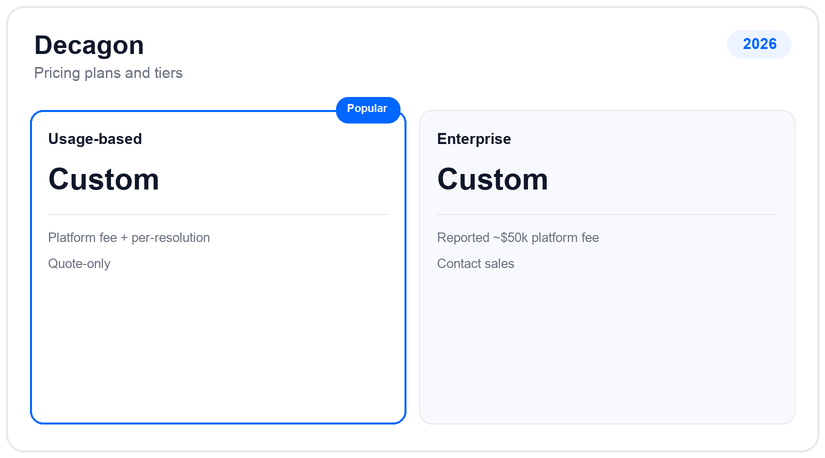
Decagon is quote-only, sold through its sales team on usage-based enterprise contracts. Public reporting points to a platform fee in the region of $50,000 a year plus per-resolution or per-conversation usage on top, though the exact structure is negotiated around your channels and volume. As with the other AI-native enterprise agents, there is no self-serve checkout.
The way to evaluate Decagon on cost is to run a scoped pilot, measure the resolution rate on your own complex tickets, and translate that into a blended cost per resolved conversation. Decagon’s pitch is that it handles the hard, multi-step cases other agents escalate, so the fair comparison is not just price per resolution but how many of your genuinely difficult tickets it closes without a human. For mid-market and enterprise teams that is where its economics either work or do not.
Verdict
Decagon is the challenger to watch: it resolves the hard cases and is closing serious deals. If you are mid-market or enterprise and want more than simple deflection, it belongs on your shortlist alongside Sierra. Compare the field in our best AI customer service software guide.
Frequently Asked Questions
How much does Decagon cost?
What makes Decagon different from Sierra?
Does Decagon handle voice as well as chat?
Is Decagon suitable for small businesses?
Related guides
Keep comparing in our cluster: AI customer service agents, customer service automation, and our best AI customer service software guide.
Add us as a preferred source on Google, and our reviews and picks show up in your Top Stories and AI Overviews.