



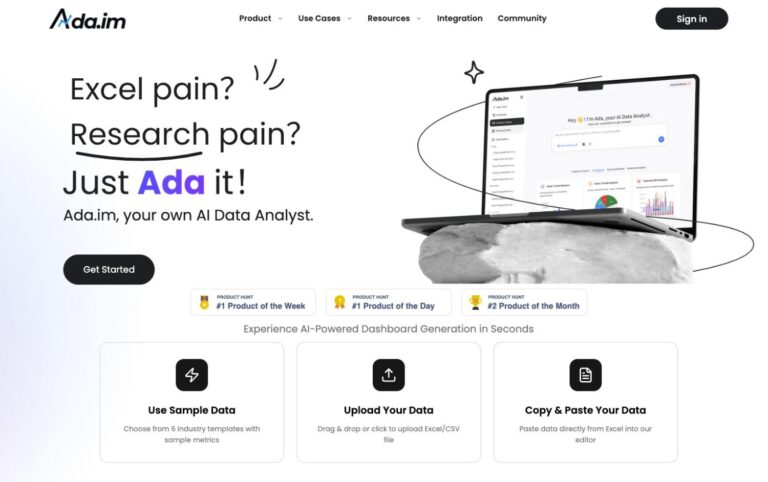
TL;DR: Ada is an enterprise no-code AI agent platform that automates customer resolutions across chat and messaging, used by large brands to deflect high volumes without engineering. It is powerful and brand-safe, but it is sold on custom enterprise contracts with a high conversation commitment, so it is not a fit for small teams. App Score: 8.0/10.
How Ada measures up
Weighted against our AI customer service rubric. Sub-scores out of 10; weight in brackets.
Our independent score, from our own weighted rubric and verified pricing, kept separate from any sponsorship. How we rank.
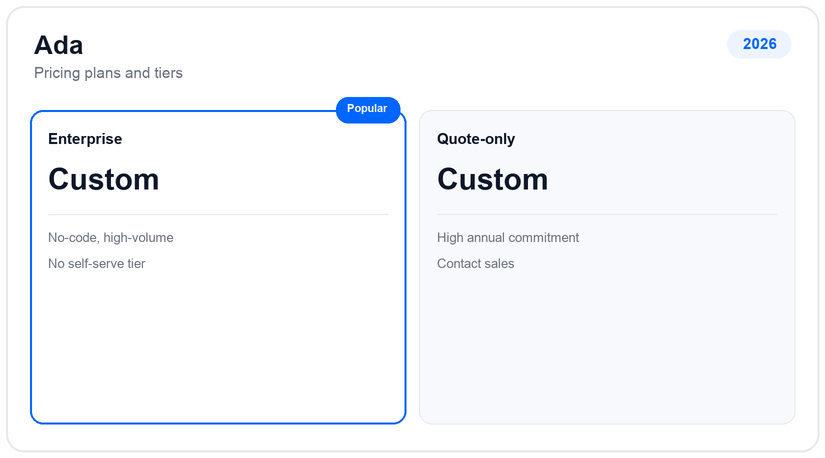
| Starting price | Custom, quote-only (reported to require a high annual conversation commitment) |
| Plans | Enterprise, contact sales |
| Channels | Chat, email, voice and social |
| Best for | Enterprises automating high support volume |
| Standout | No-code automation with brand-safe controls |
| Free trial | No, contact sales |
Ada lets support teams build and run AI agents without code, automating a large share of routine resolutions across channels while keeping tone and answers on-brand. It is a mature, enterprise-focused platform trusted by big consumer brands. The capability is strong; the commercial model is enterprise-only.
Key features of Ada
- No-code agent builder: launch and iterate AI agents without engineering.
- Automated resolution: resolves routine questions across chat, email, voice and social.
- Brand-safety controls: guardrails and tone settings keep answers on-brand.
- Actions and integrations: connects to backend systems to resolve, not just reply.
- Analytics: resolution and coverage reporting for scaling teams.
Who Ada is best for
Ada fits enterprises with high support volume and the budget for a custom deployment that want no-code control over automation. Small and mid-market teams should look at a self-serve, published-price agent like Intercom Fin or Tidio. See the full field in our best AI customer service software guide.
Pros and cons
Pros
- Strong no-code automation at enterprise scale
- Brand-safe controls and multichannel coverage
- Proven with large consumer brands
Cons
- Enterprise-only with quote pricing and a high volume floor
- No self-serve start for small teams
- Needs resources to configure and maintain well
How Ada pricing works
Ada is quote-only and priced for the enterprise. Reporting suggests it requires a substantial annual conversation commitment rather than a low monthly entry point, so it is built for organisations automating very high volumes across chat, email, voice and social. There is no self-serve tier, and cost scales with your committed conversation volume.
The value case rests on Ada’s no-code automation: because your team configures and expands the agent without engineering, the ongoing cost of ownership can be lower than tools that need developer time to maintain. Evaluate it on the total automated-resolution rate you can reach on your own content and systems, then weigh the annual commitment against the agent headcount that volume would otherwise require. For large consumer brands with heavy, repetitive support volume, that math often works; for smaller teams it will not.
Verdict
Ada is a solid enterprise choice when you want no-code control over high-volume automation and can commit to a custom contract. Smaller teams will get there faster and cheaper with a self-serve agent. Compare the field in our best AI customer service software guide.
Frequently Asked Questions
How much does Ada cost?
Is Ada no-code?
Does Ada replace human agents?
Is Ada good for small businesses?
Related guides
Keep comparing in our cluster: customer service automation, AI customer service agents, Intercom Fin alternatives, and our best AI customer service software guide.
Add us as a preferred source on Google, and our reviews and picks show up in your Top Stories and AI Overviews.