




TLDR: AI Undetect is a paid AI humanizer that rewrites AI-generated text to evade detectors, bundled with a free multi-detector checker. It earns an App Score of 6/10. Paid plans run $15 to $45 per month, or $5 to $20 monthly billed annually. The free allowance is a one-time 500 units, not a renewing free tier. Its central claim – “100% undetectable” and “proven to bypass” Turnitin – has never been independently tested, and its own refund policy quietly contradicts it.
This review covers what the tool costs, what the evidence actually says about AI detectors and humanizers, and the risk you take on if you use one for coursework. If you have been falsely accused by a detector, skip to that section – the research there is more useful to you than any humanizer.
Name check: AI Undetect (aiundetect.com) is not Undetectable.ai, which is a larger, separate company. They are frequently confused.
Is AI Undetect free?
There is a free allowance, but it is one-time, not monthly, and the site states it three different ways:
- The signup modal says “500 Free Rewrite Credits”
- The FAQ says “500 words of free AI Humanizer text and 10 AI detector uses”
- The API page says new registrants get “two free uses”
Credits, words and uses are used interchangeably and the numbers do not reconcile. The editor itself is hard-capped at 250 words per request on free. The safest reading: a one-time allowance of roughly 500 units, 250 words at a time, plus 10 detector checks. It does not renew monthly.
How much does AI Undetect cost?
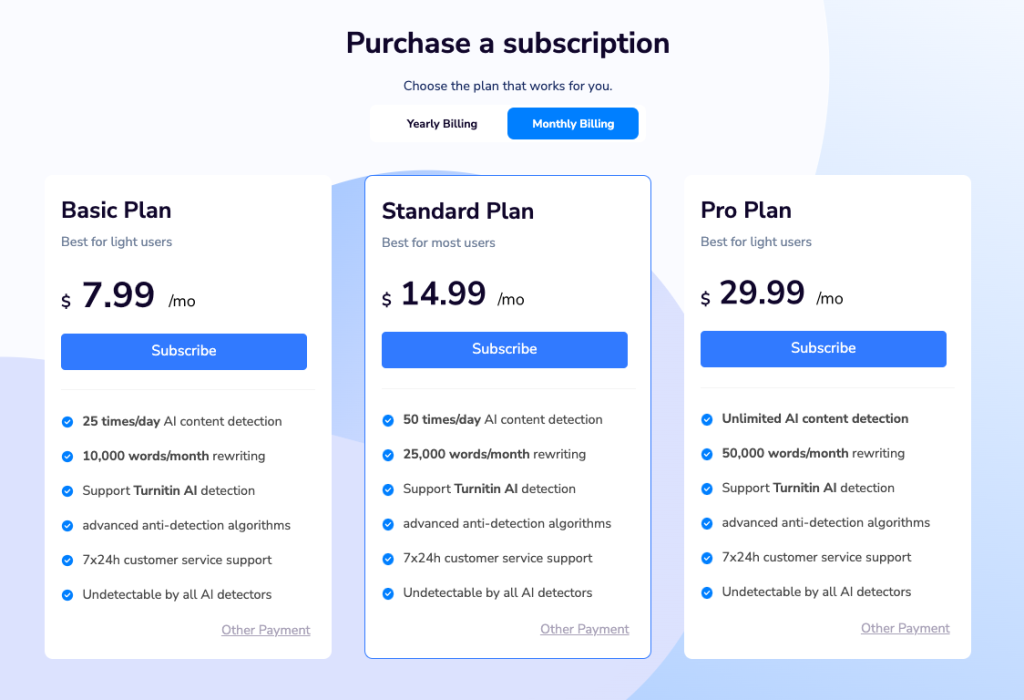
| Plan | Monthly | Billed annually | Words / month | Words per request |
|---|---|---|---|---|
| Basic | $15 | $5 | 15,000 monthly / 10,000 annual | 500 |
| Standard | $25 | $10 | 50,000 | 1,500 |
| Pro | $45 | $20 | Unlimited | 3,000 |
The refund terms are worth reading before buying. Verbatim: refunds are “only available if a submission provably flags as less than 75% human on a reputable AI detector“, within 30 days. Otherwise all purchases are non-refundable.
That clause is doing a lot of work. “A reputable AI detector” is never defined, and the burden of proof sits with you. It is also implicitly an admission that output sometimes fails, which sits awkwardly against the marketing word “guaranteed”.
Does AI Undetect actually work?
Nobody outside the company knows, and that is the honest answer.
AI Undetect claims its output is “100% undetectable”, “undetectable by all AI detectors”, and that its V3 model is “proven to bypass GPTZero, Copyleaks, and Turnitin”. No study, methodology, sample size or third-party audit is published anywhere on the site. The word “proven” is unsupported. We could find no independent test of AI Undetect in any published research.
The Turnitin claim is the weakest of the three, for a structural reason: Turnitin’s detector is not publicly accessible. It runs inside institutional systems, so neither AI Undetect nor you can test whether something “passes” it. Turnitin also shipped dedicated “AI bypasser detection” in August 2025, aimed specifically at text modified by humanizer tools.
What the research does show, on humanizers generally:
- Paraphrasing defeats most detectors. A 2023 NeurIPS paper showed a paraphrasing model dropping one detector’s accuracy from 70.3% to 4.6%.
- A 2023 study of 14 detection tools found roughly 20% of raw AI text was misattributed to humans, rising to about 50% once the text was obfuscated.
- But newer detectors resist. A 2025 working paper running text through a humanizer found one detector still caught nearly 100% of long passages, while GPTZero’s miss rate rose to around 50%.
So “undetectable by all AI detectors” is contradicted by published evidence. Humanizers beat most detectors, not all, and the gap closes as detectors update.
Are AI detectors accurate?
No, and this is the most important section on this page. If you are here because a detector flagged work you wrote yourself, the evidence is strongly on your side.
- Non-native English speakers are disproportionately falsely accused. A 2023 study in Patterns ran 91 human-written TOEFL essays through seven detectors. Average false-positive rate: 61.22%. Nearly 20% were flagged as AI by all seven detectors unanimously, and 97.80% were flagged by at least one. The same essays, reworded to “sound more like a native speaker”, saw false positives fall to 11.77%.
- No detector tested has reached 80% accuracy. A 2023 study in the International Journal for Educational Integrity assessed 14 tools and concluded they “are neither accurate nor reliable”. Its verdict: “a student accused of unauthorised content generation only on this basis would have no possibility for a defence.”
- Accuracy collapses under real conditions. A 2024 study of six detectors found baseline accuracy of 39.5%, falling to 17.4% when evasion techniques were used.
Universities are abandoning detection
This is the strongest evidence available, because it comes from the institutions themselves:
- Vanderbilt disabled Turnitin’s AI detector in 2023, noting that at Turnitin’s own claimed 1% false-positive rate, roughly 750 of its 75,000 annual submissions could be wrongly flagged.
- Washington State University cancelled its Turnitin AI detection contract in February 2026. It reported that between 2023 and 2025, 33% of all review board cases involving alleged AI use ended in a finding of “not responsible” when detection was the only evidence offered.
- University of Waterloo discontinued detection in 2025 after finding that “in more than one instance the product flagged human written text as 100% generated by AI”.
- Montclair State, Michigan State and UC Berkeley have also turned it off. UT Austin classifies AI detection software as “High Risk”.
If you have been accused: ask what evidence exists beyond the detector score. Turnitin’s own guidance says to “use the information to initiate a conversation, not to draw a conclusion”, and its published sentence-level false-positive rate is around 4%. Version history in Google Docs or Word, drafts, notes and your ability to discuss the work are all far stronger evidence than a percentage. Running your own writing through a humanizer to “prove” it is human does the opposite of helping.
The risk of using a humanizer for coursework
Being straight about this, because the marketing around these tools is not.
The rule that catches you is not usually a humanizer-specific ban. It is the existing one: submitting AI-generated work as your own is the violation. Humanizing it is concealment of that violation, not a separate offence. One university states the principle plainly: “attempting to evade detection is itself dishonest.” Typical sanctions ladder from a zero on the assignment to a failing course grade, probation, suspension or expulsion.
Institutions are aware of these tools by name. Santa Fe Community College’s faculty guidance advises instructors to “explicitly ban humanizers in syllabi and define consequences” and names AI Undetect specifically. Washington State University’s provost guidance names the category directly.
Two honest caveats, in the other direction. We found no university academic-integrity code that treats humanizer use as a distinct, separately sanctioned offence, and no documented disciplinary case where a student was sanctioned specifically for using one. Claims that “universities are banning humanizers in 2026” trace back to commercial blogs, not policy documents.
But the most instructive case cuts against relying on evasion. The one major litigated AI-cheating dispute, decided on appeal in February 2026, upheld a university’s expulsion of a student. It turned on human comparison of the work to ChatGPT output, not a detector score, and no humanizer was involved. Beating a detector does not protect you from a committee that simply reads your work and asks you about it.
Who is this genuinely for?
- Defensible: a non-native speaker editing their own writing to read more naturally, where the ideas and drafting are genuinely theirs
- Defensible: marketers and copywriters polishing AI drafts for publication, where no honesty rule is engaged
- Not defensible: passing AI-written work off as your own coursework, which the tool is heavily marketed for and which is misconduct regardless of whether you are caught
Pros and Cons
Pros
- Bundles a multi-detector checker with the rewriter
- Cheap on annual billing, from $5 per month
- Free allowance lets you test output quality before paying
- Tone options and a usable API
Cons
- “100% undetectable” and “proven” are unsupported by any published test
- Turnitin claims are unverifiable, since Turnitin is institution-only
- Free tier described three contradictory ways
- Basic annual gives fewer monthly words than Basic monthly
- Refunds require you to prove failure on an undefined “reputable” detector
- No company address published; named by institutions as a tool to ban