
How much does Claude Code cost?
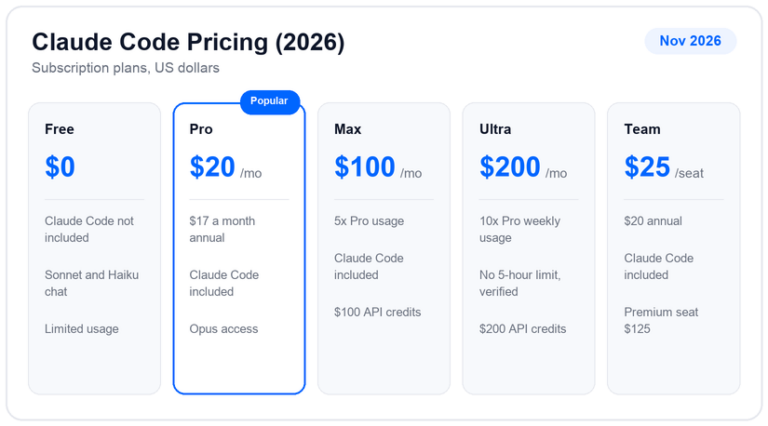
Claude Code pricing has two paths: it is included in every paid Claude plan from Pro at $20 a month ($17 annual), Max at $100 and Ultra at $200, or you pay per token on the API from $0.10 to $8 per million input tokens. Pro suits developers who code daily.
Updated 10 November 2026. Team seats ($25 Standard, $125 Premium monthly) and Enterprise ($20 a seat plus usage) include Claude Code, and Free does not. On API billing, Opus 5.5 costs $4 input and $20 output per million tokens, Sonnet 5.5 costs $2 and $10, and Fable 5.2 costs $8 and $40.
| Free | $0, Claude Code not included |
| Pro | $20/mo ($17 annual), Claude Code included |
| Max | $100/mo, 5x Pro usage |
| Ultra | $200/mo, 10x Pro weekly usage, no 5-hour limit for verified accounts |
| Team | $25/seat Standard, $125/seat Premium monthly, Claude Code included |
| Enterprise | $20/seat annual plus usage at API rates |
| API (per M tokens) | Haiku 5.5 $0.10/$0.50, Sonnet 5.5 $2/$10, Opus 5.5 $4/$20, Fable 5.2 $8/$40 |
Prices in US dollars as of 10 November 2026; they can vary by region and tax.
Claude Code pricing confuses people for one simple reason: there is no separate Claude Code price. The terminal-based coding agent is included in Claude subscriptions and also runs on pay-per-token API billing, so what you pay depends on which path you take.
This page lays out both paths with current 2026 numbers: flat plans, per-model token rates, and where one becomes cheaper than the other. For the chat-side plans in full, see the Claude pricing guide.
How does Claude Code pricing work? Two ways to pay
Claude Code authenticates in 2 ways, and each has its own billing model:
- Subscription login: sign in with a Claude Pro, Max, Ultra, Team or Enterprise account and Claude Code draws on that plan's usage allowance. Flat monthly cost, no per-token metering, and usage limits.
- API key: authenticate with an Anthropic API key and pay per token at the model's rates. No monthly fee and no plan limit, and costs scale with how much the agent works.
Most individual developers should start on a subscription. The API path suits automation, CI pipelines, teams metering usage centrally, and very light users who would not spend $20 of tokens in a month.
What do the Claude Code subscription plans cost in 2026?
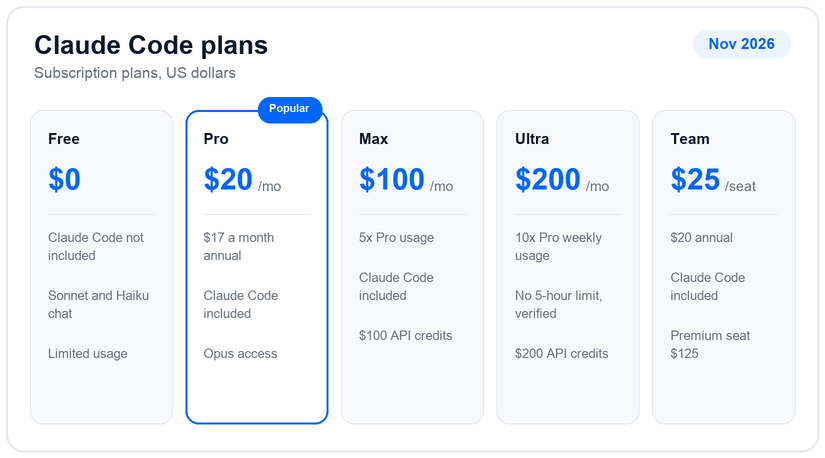
Claude Code is included on 6 plans, from Pro at $20 a month to Enterprise, and it is not included on Free.
| Plan | Price | Claude Code access |
|---|---|---|
| Free | $0 | Not included |
| Pro | $20/month ($17/month annual) | Included, the lowest-cost way in |
| Max | $100/month | Included, 5x Pro usage every 5 hours and every week |
| Ultra | $200/month | Included, 10x Pro weekly usage and no 5-hour limit for verified accounts |
| Team Standard | $25/seat/month ($20 annual) | Included, with more usage than Pro |
| Team Premium | $125/seat/month ($100 annual) | Included, 5x Standard usage |
| Enterprise | $20/seat/month annual plus usage at API rates | Included, with admin and security controls |
There is no separate Claude Code subscription and no per-seat Claude Code add-on: the tool is the same on every plan. What the higher plans buy is usage. Agentic coding uses a lot of tokens because every file read, edit and test run counts. Max and Ultra also include monthly API credits ($100 and $200) for the Claude Platform.
What does Claude Code cost on the API? Token rates by model
On API billing, Claude Code costs whatever the model it runs costs, from $0.10 to $8 per million input tokens.
| Model | Input per M tokens | Output per M tokens | Notes |
|---|---|---|---|
| Claude Fable 5.2 | $8 | $40 | Top tier for the longest tasks, 1M context window |
| Claude Opus 5.5 | $4 | $20 | The opus alias in Claude Code on the Anthropic API |
| Claude Sonnet 5.5 | $2 | $10 | The sonnet alias, for daily coding |
| Claude Haiku 5.5 | $0.10 up to 100K-token prompts, $0.50 above | $0.50 up to 100K, $2.50 above | The haiku alias, for simple tasks |
| Claude Opus 5 and Opus 4.8 | $5 | $25 | Older Opus models, still listed |
| Claude Sonnet 4.6 | $3 | $15 | Earlier balanced model |
| Claude Haiku 4.5 | $1 | $5 | Earlier fast model |
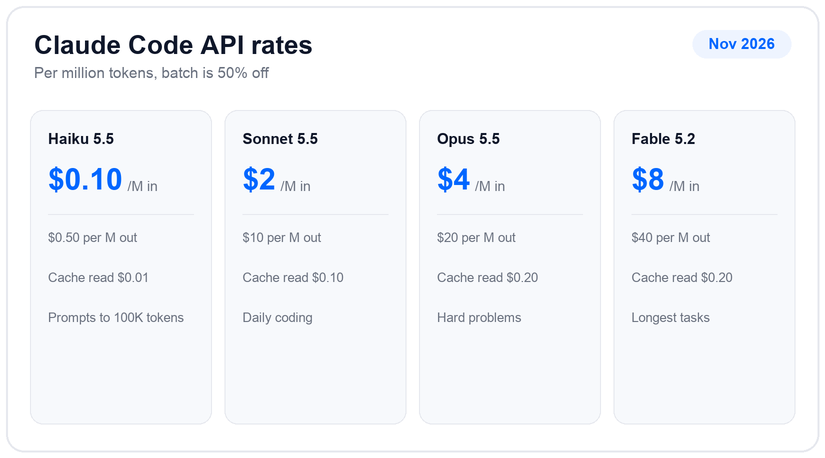
Two mechanics matter more than the sticker rates. First, prompt caching: Claude Code reuses your codebase context across turns, and a cache read costs 0.05 to 0.1 times the input price, applied automatically. Second, output-heavy work: agent sessions produce a lot of output tokens (code, diffs, reasoning), and output costs 5 times input on the Opus, Sonnet, Haiku and Fable rows above, which is why long Opus sessions add up fast. Batch processing takes 50% off for work that can wait, and the AI API prices per million tokens guide compares these rates with OpenAI, Gemini and DeepSeek.
Claude Code's own cost guide puts the average at about $13 per developer per active day and $150 to $250 per developer per month across enterprise deployments, with costs below $30 per active day for 90% of users.
Is a subscription or the API cheaper for Claude Code?
The answer depends on how many days a month you code with an agent, because the average active day costs about $13 in tokens:
- One active day a month: API billing can cost less than Pro, because the average active day costs about $13 in tokens.
- Daily coding: Pro at $20 wins, because at about $13 per active day the API passes $20 after the second day.
- Heavy daily agent use: Max at $100 or Ultra at $200, where the flat rate acts as a cost ceiling that API billing does not have.
- CI, automation and headless runs: API billing, with a spend limit, because subscriptions are for people working in the loop.
How can you keep Claude Code costs down?
4 habits keep a Claude Code bill predictable:
- Match the model to the task. The sonnet alias (Sonnet 5.5, $2 and $10) handles most day-to-day coding; save opus (Opus 5.5, $4 and $20) and fable for the hardest problems.
- Track spend with /usage. The Session block in /usage shows token usage and a cost estimate for the current session; Pro, Max and Ultra subscribers see plan usage bars instead.
- Let caching work. Long-running sessions in the same project reuse cached context, while scattered one-off sessions pay for it again.
- Set spend limits. Claude Code's cost guide covers team spend limits, which turn a runaway-agent risk into a bounded number.
How does Claude Code compare with Cursor on price?
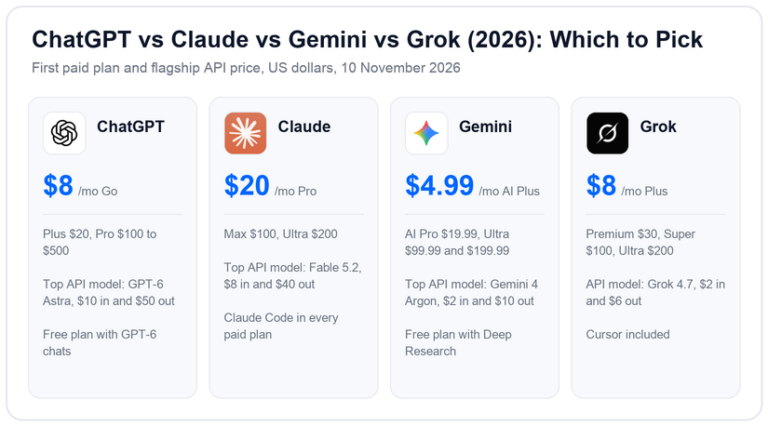
Claude Code starts at $20 a month on Pro and tops out at $200 on Ultra.
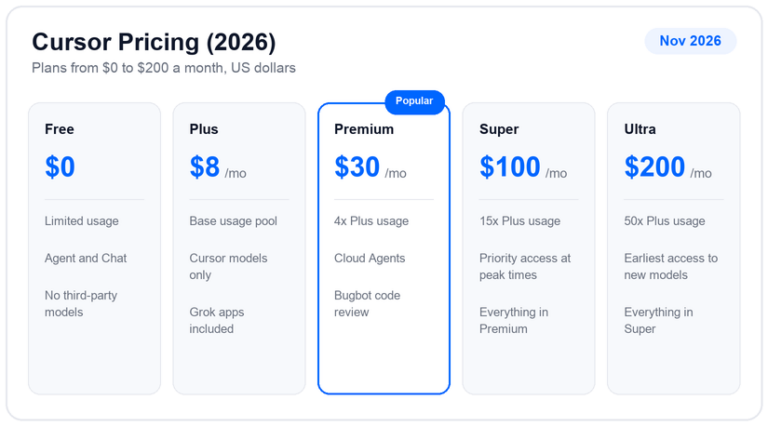
Cursor starts at $8 on Plus (Cursor models only) or $30 on Premium, and it also tops out at $200 on Ultra.
The difference is workflow: Claude Code is terminal-native and model-first, and Cursor is IDE-native. The Cursor pricing breakdown covers its plans, its weekly usage pool and its third-party model rates. For releases, deprecations and price moves on the model side, the Claude updates hub tracks them.
Is Claude Code worth the price?
Claude Code pricing is simple once you see the two paths: subscriptions buy predictability and the API buys flexibility.
Pro at $20 is the lowest-cost way to find out how much you will use it. If you hit limits every week, Max at $100 is the next step. If you wire Claude Code into automation, API billing with a spend limit fits better.
Frequently asked questions
These 11 questions cover Claude Code subscription and API costs.
How much does a Claude code cost you?
Claude Code has no separate price. It is included with every paid Claude plan: Pro at $20 a month ($17 annual), Max at $100, Ultra at $200, Team seats at $25 or $125, and Enterprise at $20 a seat plus usage. Automation and CI workloads can pay per token on the API instead.
Is the $20 Claude Code worth it?
Pro at $20 a month includes the same Claude Code tool the higher plans use. The difference is the usage allowance: daily agentic coding can reach Pro limits, and then Max at $100 is the next plan.
Can you use Claude Code for free?
Not on the Free plan: Claude Code is not included there. It needs a paid plan (Pro or above) or an API key with credits. A month of Pro at $20 or a few dollars of API credit are the lowest-cost ways to try it.
Does Claude Code use API credits if I have a Pro subscription?
No. When you log in with a Pro, Max, Ultra or Team account, Claude Code draws on your plan's usage allowance. API billing applies when you authenticate with an API key instead. Max and Ultra plans also include monthly API credits ($100 and $200) for the Claude Platform.
Which models does Claude Code use?
You choose per session: the fable, opus, sonnet and haiku aliases resolve on the Anthropic API to the Fable model, Opus 5.5, Sonnet 5.5 and Haiku 5.5. On API billing the cost follows the model: Opus 5.5 at $4 and $20 per million tokens, Sonnet 5.5 at $2 and $10, Haiku 5.5 at $0.10 and $0.50, and Fable 5.2 at $8 and $40.
What happens when I hit my Claude Code usage limit?
On subscription plans you wait for the limit to reset, move to a higher plan, or turn on usage credits to keep working at API rates. On the API there is no plan limit: you keep paying per token, which is why runaway agent sessions are a cost risk on API billing.
Is Claude Max worth it for Claude Code?
Max at $100 a month gives 5x Pro usage every 5 hours and every week, plus $100 in monthly API credits. It fits once you reach Pro limits more than a couple of times a week. Ultra at $200 gives 10x Pro weekly usage with no 5-hour limit for verified accounts.
Is Claude Code cheaper on the API or a subscription?
Across enterprise deployments Claude Code averages about $13 per developer per active day, so a developer who uses it on one day a month can pay less on the API than for Pro at $20. Daily users are usually cheaper on a subscription, because agentic sessions use a lot of tokens.
Does Claude Code pricing include prompt caching?
Yes. Claude Code uses prompt caching automatically, and a cache read costs 0.05 to 0.1 times the input price on the API: $0.20 per million tokens on Opus 5.5, $0.10 on Sonnet 5.5 and $0.01 on Haiku 5.5.
How much does Claude Opus 5.5 cost for Claude Code?
On API billing, Claude Opus 5.5 costs $4 per million input tokens and $20 per million output tokens, with cache reads at $0.20. On subscriptions there is no per-token charge: Opus is included on Pro, Max, Ultra and Team plans within the plan's usage limits.
Is Claude Code included in Claude Team plans?
Yes. Claude Code is included on Team plans, both the Standard seat ($25 a month, or $20 annual) and the Premium seat ($125, or $100 annual), and on Enterprise at $20 a seat plus usage at API rates.
Best for your situation
Guides & comparisons
Add us as a preferred source on Google, and our reviews and picks show up in your Top Stories and AI Overviews.