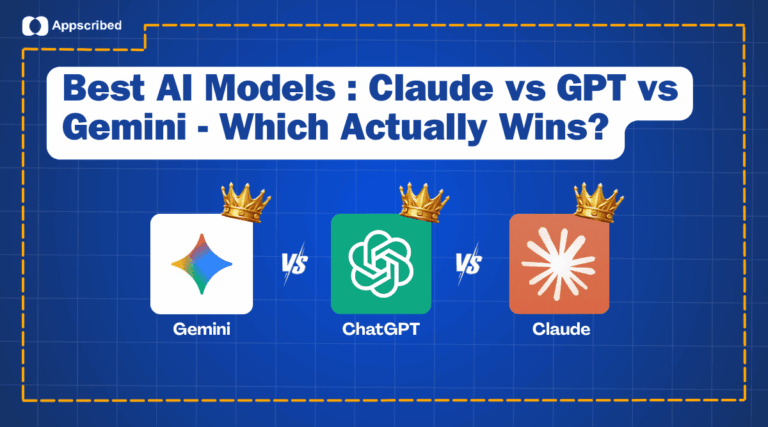

Picking a frontier AI model in 2026 is a strategic call for startups and engineering teams. This data-driven comparison puts the four current flagships side by side – OpenAI GPT-5.6, Anthropic Claude Opus 5, Google Gemini 3.1 Pro, and xAI Grok 4.6 – on API pricing, context windows, coding and agentic strength, and where each one wins. For plan-level pricing, see our ChatGPT, Claude, Gemini, and Grok pricing guides, and our best AI models roundup for use-case picks.
Executive summary
- GPT-5.6: OpenAI’s generally-available flagship, sold in three durable API tiers (Sol, Terra, Luna). The broadest ecosystem and a strong all-rounder for reasoning and product features.
- Claude Opus 5: The strongest choice for agentic coding and long-horizon autonomous work, near Fable 5’s intelligence at half the price.
- Gemini 3.1 Pro: The cheapest flagship per token and the strongest on multimodal and long-context workloads, with Gemini 3.7 Flash as a very cheap coding/agents workhorse alongside it.
- Grok 4.6: The value flagship on output tokens, with real-time X data and the largest consumer top tier.
Quick comparison: GPT-5.6 vs Opus 5 vs Gemini 3.1 Pro vs Grok 4.6
| Feature | GPT-5.6 | Claude Opus 5 | Gemini 3.1 Pro | Grok 4.6 |
|---|---|---|---|---|
| API price, in / out per 1M | $5 / $30 (Sol); $2 / $12 (Terra) | $5 / $25 | $2 / $12 (≤200K); $4 / $18 (>200K) | $2 / $6 (500K) |
| Context window | Extended (GPT-5 family) | 1M input / 128K output | 1M input | 500K |
| Best at | Broad reasoning, product ecosystem | Agentic coding, long-horizon work | Multimodal, long context, cost | Real-time X data, value output |
| Cheapest paid consumer plan | ChatGPT Plus $20/mo | Claude Pro $20/mo | Google AI Pro $19.99/mo | SuperGrok $30/mo |
| Availability | GA (API + ChatGPT) | API, Pro, Max default | API (preview), consumer plans | API + SuperGrok tiers |
Pricing & total cost of ownership
On the API, Grok 4.6 ($2 / $6) and Gemini 3.1 Pro ($2 / $12) are the cheapest flagships, while GPT-5.6 Sol ($5 / $30) and Claude Opus 5 ($5 / $25) sit at the premium end. Output tokens dominate real bills for agentic and coding work, which is where Grok 4.6’s $6 output and Gemini’s $12 are noticeably cheaper than GPT-5.6 Sol’s $30. If you want a cheaper OpenAI tier, GPT-5.6 Terra ($2 / $12) matches Gemini on input. For most individuals the flat consumer plans – all clustered around $20/month – are cheaper than paying per token; step to the API only when you are automating or embedding a model in a product.
Context windows and scale
Claude Opus 5 and Gemini 3.1 Pro both offer a 1M-token context window, with Opus 5 adding up to 128K output tokens per request. Grok 4.6 runs a 500K window and bills at a higher tier above 200K tokens. GPT-5.6 carries the extended context of the GPT-5 family. For very long documents or whole-codebase reasoning, Opus 5 and Gemini 3.1 Pro are the safest picks.
Coding & agentic capabilities
This is where the models separate. Claude Opus 5 is the strongest for agentic coding – multi-file features, large refactors, and long autonomous runs that finish without hand-holding – and it is the default in Claude Code (see our Claude Code pricing guide). GPT-5.6 is a close, versatile second with the deepest tool and ecosystem support. Gemini 3.7 Flash is the value play for coding and agents at $0.75 / $3.75 per 1M tokens, and Grok 4.6 is competitive when you also need live web or X context. If coding is your primary workload, start with Opus 5 or the cheaper Gemini 3.7 Flash and benchmark on your own repository.
Reasoning, multimodality, and factuality
Gemini 3.1 Pro leads on native multimodal reasoning across text, image, and long context. GPT-5.6 is the most broadly capable generalist and the safest default for mixed product workloads. Claude Opus 5 is the sharpest reasoner on hard, structured problems, and Grok 4.6 differentiates on real-time information from X rather than raw benchmark scores. All four are strong enough that your data, latency, and cost constraints should decide the pick more than headline benchmarks.
Which model should you choose?
- Agentic coding and long-horizon work: Claude Opus 5 (or Gemini 3.7 Flash for a cheaper workhorse).
- Broadest ecosystem and general product work: GPT-5.6.
- Multimodal, long-context, cost-sensitive: Gemini 3.1 Pro.
- Real-time information and value output: Grok 4.6.
Final verdict
There is no single winner in 2026 – each flagship owns a lane. Claude Opus 5 is the coding and agent leader, GPT-5.6 the safest all-round default, Gemini 3.1 Pro the multimodal and cost champion, and Grok 4.6 the value and real-time pick. Match the model to your workload and budget, and remember that the value tiers (Gemini 3.7 Flash, Claude Sonnet 5, GPT-5.6 Terra/Luna) deliver most of the capability at a fraction of the flagship price.
Frequently asked questions
Is Claude Opus 5 or GPT-5.6 better for coding?
For agentic coding – multi-file changes, large refactors, and long autonomous runs – Claude Opus 5 is generally the stronger pick and is the default in Claude Code. GPT-5.6 is a close, more ecosystem-rich second. Both cost around $5 input per million tokens; Opus 5 is cheaper on output ($25 vs GPT-5.6 Sol’s $30). Benchmark both on your own repo before committing.
Which frontier model is cheapest?
On the API, Grok 4.6 ($2 input / $6 output per million tokens) and Gemini 3.1 Pro ($2 / $12) are the cheapest flagships, and Gemini 3.7 Flash is cheaper still at $0.75 / $3.75. GPT-5.6 Sol ($5 / $30) and Claude Opus 5 ($5 / $25) are the premium tier. On consumer plans, all four land near $20/month except SuperGrok at $30.
GPT-5.6 vs Gemini 3.1 Pro – which should I pick?
Pick Gemini 3.1 Pro for multimodal work, long context, and lower cost ($2 / $12 vs GPT-5.6 Sol’s $5 / $30). Pick GPT-5.6 for the broadest ecosystem, tool support, and general product reliability. GPT-5.6 Terra ($2 / $12) closes the price gap if you want to stay on OpenAI.
Which model has the largest context window?
Claude Opus 5 and Gemini 3.1 Pro both offer a 1M-token context window, with Opus 5 adding up to 128K output tokens per request. Grok 4.6 runs 500K, and GPT-5.6 uses the extended GPT-5-family context. For whole-codebase or very long-document tasks, Opus 5 or Gemini 3.1 Pro are the safest.
Add us as a preferred source on Google, and our reviews and picks show up in your Top Stories and AI Overviews.