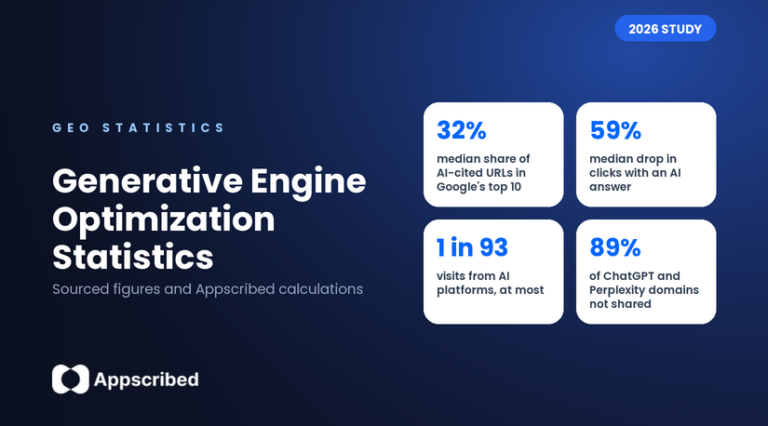
Generative engine optimization (GEO) statistics from 16 publishers: in 5 of 7 published measures from 4 studies, fewer than 40% of URLs that AI answers cite also rank in Google's top 10 (Appscribed median: 35%). Every figure has a source, a date and a limit. Use it if you need a number with its source.
Executive summary: answers at a glance
Each engine cites a largely different set of sources (89% of cited domains are not shared between ChatGPT and Perplexity in one study),[1] AI platforms send 1 visit in 93 to 1 visit in 400,[2, 3] and clicks are 47% to 62% lower when an AI answer appears.[4, 5, 6, 7] In tests, adding quotations, statistics or cited sources raised citations; schema markup did not.[8, 9]
| Question | Short answer | Our number |
|---|---|---|
| Do AI answers cite pages that rank in Google's top 10? | Often not: in 5 of 7 published measures from 4 studies, fewer than 40% of the URLs AI answers cite also rank in Google's top 10 (median 35%).[10, 11, 12, 13] | 35% median |
| Do AI answers cost clicks? | Clicks are 47% to 62% lower when an AI answer appears (median 59%, four datasets); one study found zero-click searches fell 6.6%.[4, 5, 6, 7, 14] | 59% median |
| How much traffic do AI platforms send? | 1 visit in 93 to 1 visit in 400 (1.08% to 0.25% of site visits).[2, 3] | 1 in 93 to 1 in 400 |
| Is an AI visitor worth more? | 4.4 times an organic search visitor on conversion rate in one study,[15] an implied 1.1% to 4.6% of a site's conversion value. | 1.1% to 4.6% |
| Do ChatGPT and Perplexity cite the same sources? | 87% not shared in our 67-question test (89% in a 100,000-prompt study).[1] Perplexity also cites top-10 Google pages 3.6 times as often as ChatGPT.[13] | 89% 3.6 times 87% |
| How often does Google show an AI Overview? | On 15.7% to 78.3% of keywords depending on who measures, a 5-fold gap (median 37%).[2, 6, 11, 14, 16] | 5-fold gap |
| Who gets cited? | 66% median from company sites in one study; others find 84% earned media and 86% brand-managed.[17, 18, 19] | 66% median |
| How old are the pages AI answers cite? | 2.8 years old for ChatGPT and 3.2 for Perplexity; ChatGPT's pages are 28% fresher than Google organic results.[20] | 2.8 to 3.2 years |
| What raises how often a page is cited? | +27% to +41% in the share of an answer credited to a page from adding quotations, statistics or cited sources in a lab test; +22% for quotations on a live engine.[8] Schema markup was not distinguishable from zero.[9] | 27% to 41% 22% schema |
| What do AI visibility tools cost? | $29 to $300 a month at entry (median $95); 10 of 11 tools offer a free tier, trial or free checker. | $95 median |
Plain terms: a citation is a source an AI answer links to. A median is the middle value. Top 10 means Google's first page. A URL is one page address; a domain is a whole site. Long-tail prompts are specific, rarely asked questions. Enterprise sites belong to large companies. Earned media is coverage by outside publishers; brand-managed sources are sites and listings a company controls. An AI Overview is the AI-written answer at the top of Google results. A lab test uses a test set, not live engines. Schema markup is code that labels what a page contains. Conversion rate is the share of visits that become sign-ups or sales.
Tools that track these numbers are compared in the guide to AI visibility tools; the original study is the full study of 196,554 AI citations; done-for-you work is under GEO services.
Ranking in Google does not reliably predict being cited by AI
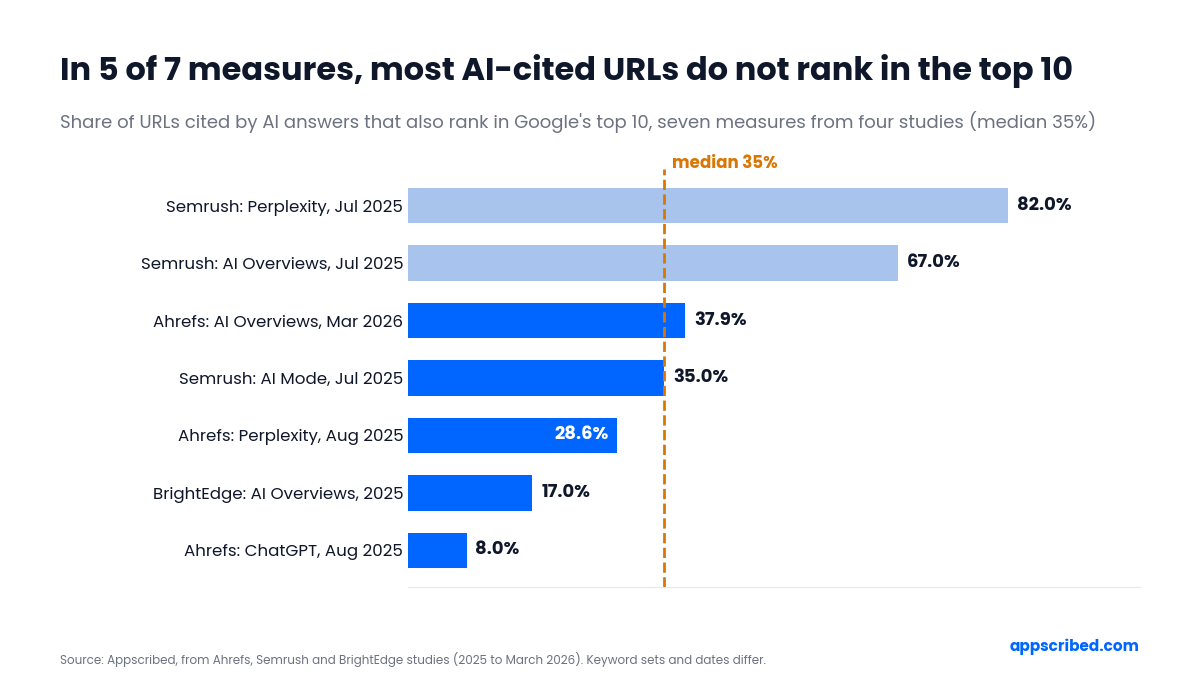
In 5 of 7 published measures from 4 studies, fewer than 40% of the URLs AI answers cite also rank in Google's top 10 (median 35%, range 8% to 82%). Appscribed Statistic 1
Chart 1. This chart shows the share of cited URLs that also rank in Google's top 10, by measure.
Use this chart
The measures run from 8.0% for ChatGPT (15,000 long-tail prompts, August 2025)[13] to 82% for Perplexity (5,000 keywords, mid-2025)[12].
Perplexity cites top-10 Google pages 3.6 times as often as ChatGPT: 28.6% of its cited URLs rank in the top 10, against 8.0%.[13] Appscribed Statistic 2
Both figures come from one study using the same prompts.
The share of AI Overview citations that also rank in the top 10 went from about 76% in July 2025 to 37.9% in March 2026, about half.[10] Appscribed Statistic 3
The two studies (1.9 million citations, then 863,000 keyword results) read search results differently, so the drop shows direction, not an exact size.
What this means: do not read Google rank as AI visibility. Ask each engine the questions your buyers ask and see who is named.
Keep in mind: the studies use different keyword sets, engines and dates, so the figures are a range, not one answer. On Appscribed's pages (AI tools reviews and comparisons), the 59 pages with 1,000 or more Bing Copilot citations (392,866 in 90 days) earned 99 Google clicks in 16 months of Search Console data (all countries); 50 of the 59 average worse than position 20 in Google and 1 averages top 10.
AI engines cite largely different sets of sources
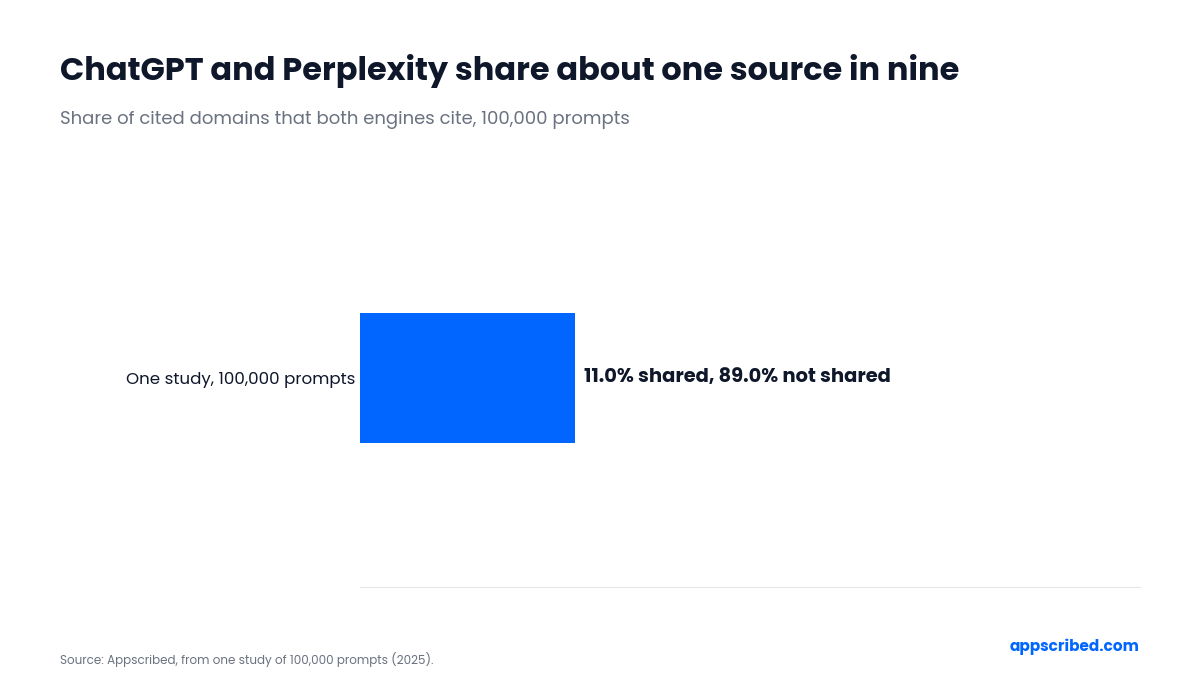
89% of the domains ChatGPT and Perplexity cite are not shared between the two (one study, 100,000 prompts, 2025).[1] Appscribed Statistic 8
Chart 2. This chart shows the share of cited domains that both engines cite.
Use this chart
In pairs of engines, between 6% and 16.4% of cited domains are shared in the same data. Appscribed's own test of 67 AI receptionist questions points the same way: 87.3% of cited domains were not shared by ChatGPT and Perplexity.
What this means: check each engine on its own, because a citation on one does not carry to another.
Keep in mind: this is one 2025 study of 100,000 prompts, and engines change fast.
Company sites supply a median 66% of AI citations in one study; others sort sources differently
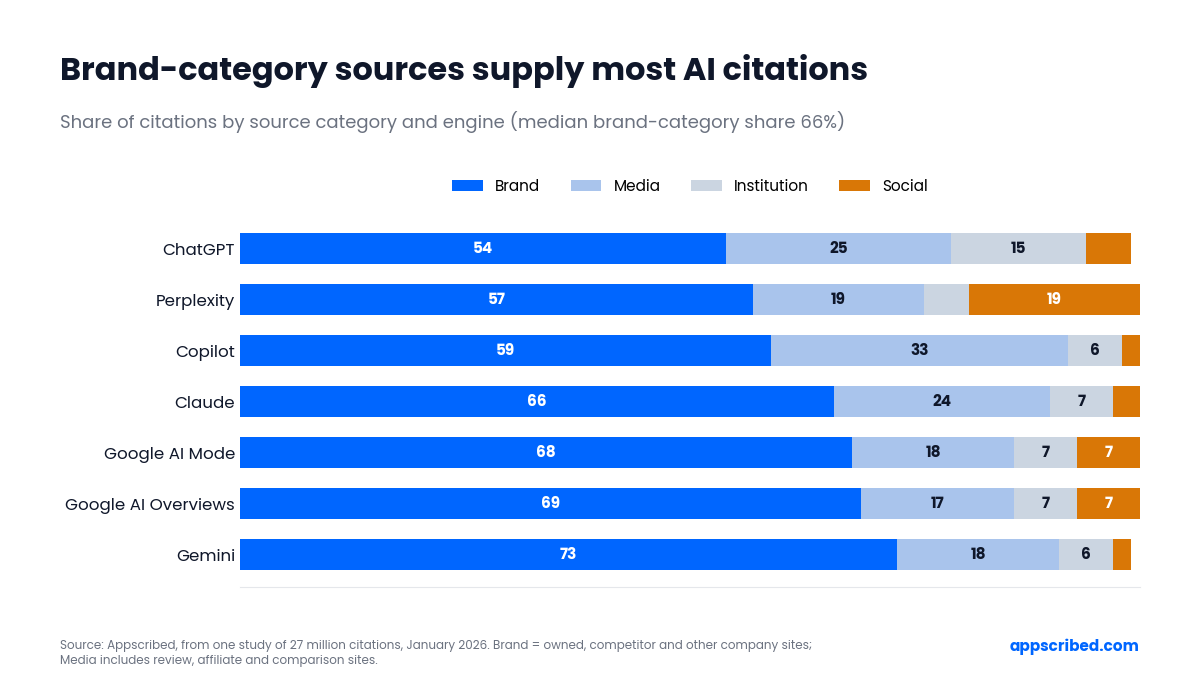
Company sites (owned, competitor and other company sites) supply a median 66% of citations across seven AI engines (range 54% to 73%).[17] Appscribed Statistic 11
Chart 3. This chart shows the share of citations by source type and engine.
Use this chart
Perplexity draws 3.8 times as much from social sources as ChatGPT (19% against 5%), and ChatGPT's top domain is Wikipedia at 7.8% of its citations[21].
Old pages get cited too: cited pages average 2.8 to 3.2 years old
The page ChatGPT cites is 2.8 years old on average and Perplexity's is 3.2 years; ChatGPT's pages are 28% fresher than Google organic results.[20] Appscribed Statistic 12
One publisher measured this across about 17 million cited URLs.
What this means: page age is not a barrier, so check what a page earns before rewriting it.
AI Overviews appear on 15.7% to 78.3% of keywords, depending on who measures
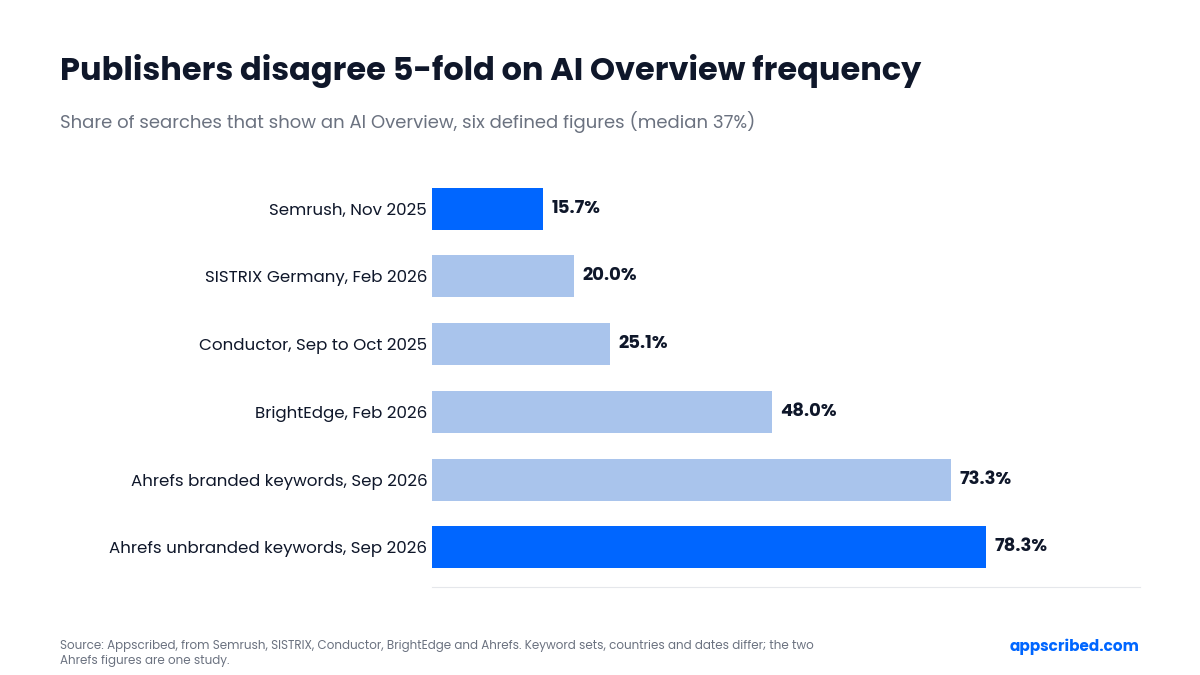
Publishers measure AI Overviews on 15.7% to 78.3% of keywords, a 5-fold gap (median of six figures 37%). Appscribed Statistic 9
Chart 4. This chart shows the share of searches with an AI Overview, by study.
Use this chart
The six figures[2, 6, 11, 14, 16] come from five studies, from November 2025 to September 2026.
What this means: ask which keywords a number covers, and measure AI Overviews on your own keywords.
Keep in mind: the studies use different keywords, countries and dates, so the gap is disagreement, not a trend.
Clicks are 47% to 62% lower when an AI answer appears
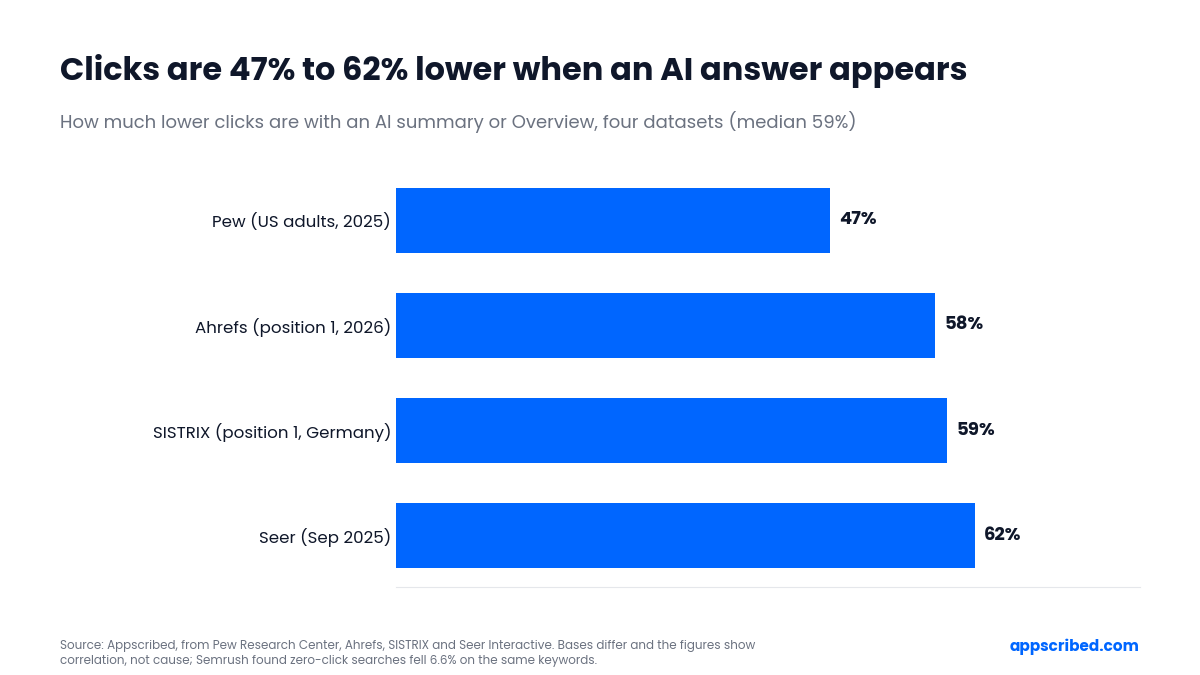
Clicks are 47% to 62% lower when an AI answer appears, across four datasets (median 59%); in one study, zero-click searches fell 6.6% instead. Appscribed Statistic 4
Chart 5. This chart shows how much lower the click rate is with an AI answer, by dataset.
Use this chart
The studies measure different things: all visits by 900 US adults (March 2025)[4], the click rate on the first result for 300,000 keywords[5] and in Germany[6], and the click rate on unpaid results for 3,119 search terms[7].
What this means: plan for fewer clicks per ranking page, and count whether AI answers name your brand.
Keep in mind: these figures show that clicks and AI answers go together, not that one causes the other. In one keyword set, zero-click searches (searches that end without a click) fell 6.6% instead[14].
AI search sends few visits, but in one study they converted better
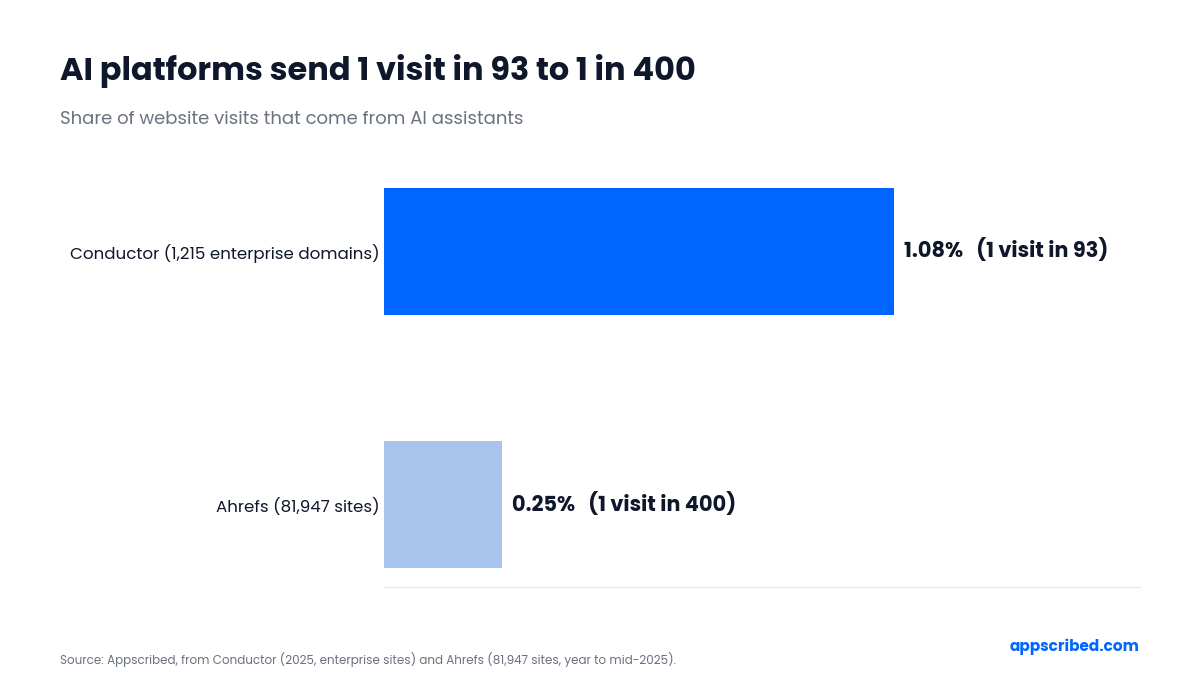
AI platforms send 1 visit in 93 to 1 visit in 400, from 1.08% to 0.25% of site visits. Appscribed Statistic 5
Chart 6. This chart shows the share of site visits from AI platforms, by sample.
Use this chart
The high figure covers 1,215 enterprise sites (May to September 2025)[2] and the low one 81,947 sites (year to mid-2025)[3]. In the second study, Google sent about 210 times more referrals than the three largest AI platforms[3].
An AI search visitor converted 4.4 times as well as an organic search visitor on average in one study, which puts AI's implied share of a site's conversion value at 1.1% to 4.6%.[15] Appscribed Statistic 6
This is an estimate: it applies the 4.4 times to the range in Statistic 5 and counts every other visit as one organic visit.
What this means: treat AI as a small channel with valuable visits, and keep search work in place.
Keep in mind: the visit share is a range from two samples, and the value figure is a one-study estimate.
In tests, evidence raised AI citations and schema markup did not
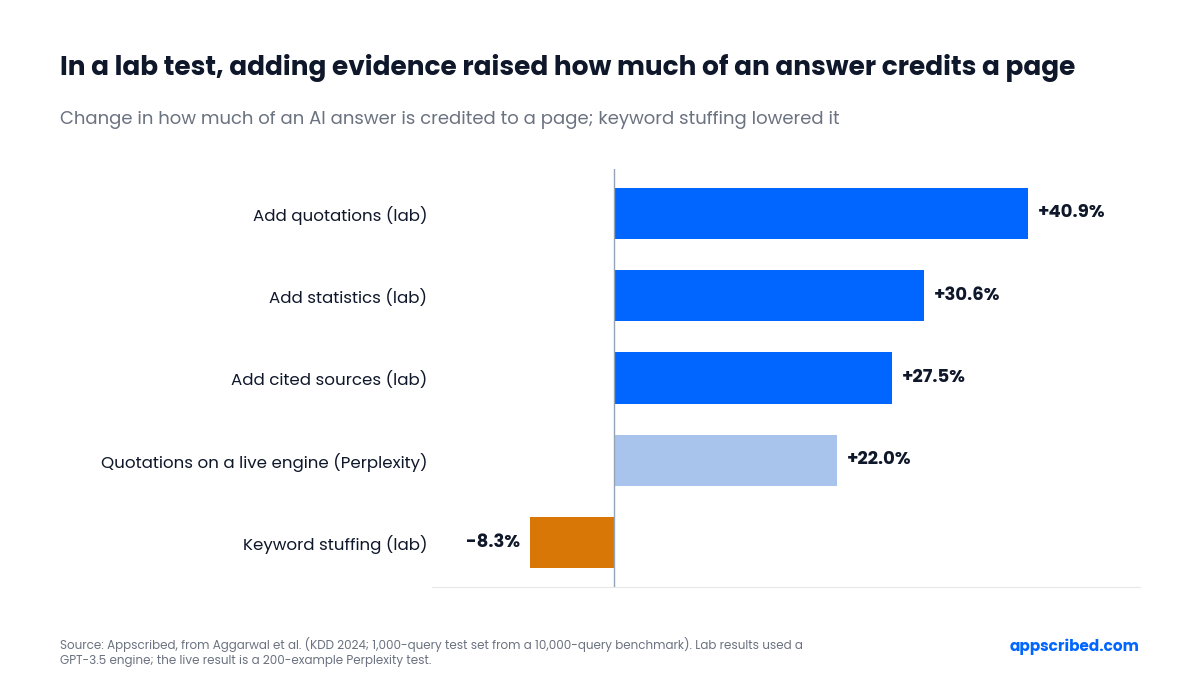
Adding quotations, statistics or cited sources raised the share of an answer credited to a page by 27% to 41% in a controlled test; keyword stuffing cut it 8%. Appscribed Statistic 14
Chart 7. This chart shows the change in credit a page gets in an answer, by tactic.
Use this chart
The lab test used 1,000 queries[8]. Added cited sources lifted a page ranked fifth by 115.1% and cut a page ranked first by 30.3%[8].
The same tactic worked about half as well on a live engine: quotations added 22% on Perplexity, against 41% in the lab.[8] Appscribed Statistic 15
The live test had 200 examples, and keyword stuffing came out about 10% worse than baseline.
What this means: add quotations, statistics and cited sources to key pages, avoid keyword stuffing, and do not rely on schema markup (Statistic 16).
Keep in mind: the lab used an older AI engine (GPT-3.5, 2023 to 2024), so expect smaller gains on live engines.
Entry prices for AI visibility tools run $29 to $300 a month
Entry prices of AI visibility tools run $29 to $300 a month (median $95); 9 of 11 tools have a listed price and 10 of 11 offer a free tier, trial or free checker. Appscribed Statistic 19
The nine listed prices are each tool's cheapest paid plan on 4 November 2026, and billing terms differ. Counting one tool at its $50 one-platform package instead of its $199 plan would put the median at $71.
| Entry price a month | Tools (of 11) |
|---|---|
| $29 to $49 | 3 |
| $71 to $99 | 3 |
| $199 to $300 | 3 |
| Quote only | 2 |
What this means: try a free option before paying $29 to $300 a month.
Keep in mind: prices change often, so confirm before buying.
Six further numbers on crawling, buying intent, schema, test pages, usage and market size
| Statistic | What the number says | Keep in mind |
|---|---|---|
| Statistic 7 Appscribed | OpenAI's crawlers fetch 1,091 pages for every visit they send back, 202 times Google's 5.4; Perplexity fetches 195 (36 times Google) and Anthropic 38,066 (7,049 times Google).[22] | A crawl is not a visit, and this is July 2025 data. |
| Statistic 10 Appscribed | Since October 2024 (end month not given) transactional queries in AI Overviews rose 7.0 times (2.0% to 13.9%) and commercial 2.3 times (8.2% to 18.6%); informational fell from 91.3% in January 2025 to 57.1% in October 2025.[14] | This is one publisher's data, and the periods differ. |
| Statistic 13 Appscribed | ChatGPT's information-seeking messages come to about 630 million a day, at most 4.6% of Google's daily searches (at least 13.7 billion, from more than 5 trillion searches a year in January 2025); all ChatGPT messages equal at most 19.2%.[23, 24] | A chat message is not a search, and the figures date from January 2025 (Google) and June 2025 (ChatGPT). |
| Statistic 16 Published figure | Adding schema markup moved AI citations by +2.2% (ChatGPT) and +2.4% (AI Mode), neither distinguishable from zero; citations fell 4.6% in AI Overviews, a change the study does not attribute to schema.[9] | 1,885 pages with schema were compared with 4,000 control pages (August 2025 to March 2026) in a test that was not randomized (pages were not picked by chance). |
| Statistic 17 Published figure | For a new brand, 82% of the new AI mentions it gained came from answers that cited its test pages; for established brands the share was 6%.[25] In about a quarter of cases, a page was cited once for one question on one assistant and never again.[25] | This used 34 test pages and 9,886 answers (February to May 2026) with no control group (no similar pages left unchanged for comparison), so it shows a pattern, not proof. |
| Statistic 18 Appscribed | Estimates of the 2026 GEO software market differ 2.9 times, from USD 370 million to USD 1,089 million; by 2030 the gap grows to 4.4 times.[26, 27] | The two estimates cover different things, and the 2030 figures assume the same growth every year. |
Publishers disagree by up to 5-fold on the same question
| What is measured | Low figure | High figure | Why they differ |
|---|---|---|---|
| Keywords with a Google AI Overview | 15.7% (10 million+ keywords, November 2025)[14] | 78.3% (September 2026 monthly average, US desktop results)[16] | The keyword sets, countries and dates differ. |
| AI Overview citations that rank in the top 10 | 17% of sources (February to July 2025)[11] | 67% of URLs (5,000 keywords, mid-2025)[12] | One counts sources, the other URLs; the keyword sets differ. |
| Clicks when an AI answer appears | 47% lower (all visits, March 2025)[4] | 62% lower (click rate on unpaid results, September 2025)[7] | The bases differ (all visits or click rate); one study found zero-click searches fell 6.6%.[14] |
| Citations by source type | 66% from company sites (median of seven engines)[17] | 84% earned media[18]; 86% brand-managed[19] | Each study sorts sources and queries in its own way. |
| AI share of site visits | 0.25% (81,947 sites)[3] | 1.08% (1,215 enterprise sites)[2] | One covers enterprise sites, the other 81,947 sites; both are 2025. |
In Appscribed's own data, longer questions earn a larger share of AI citations
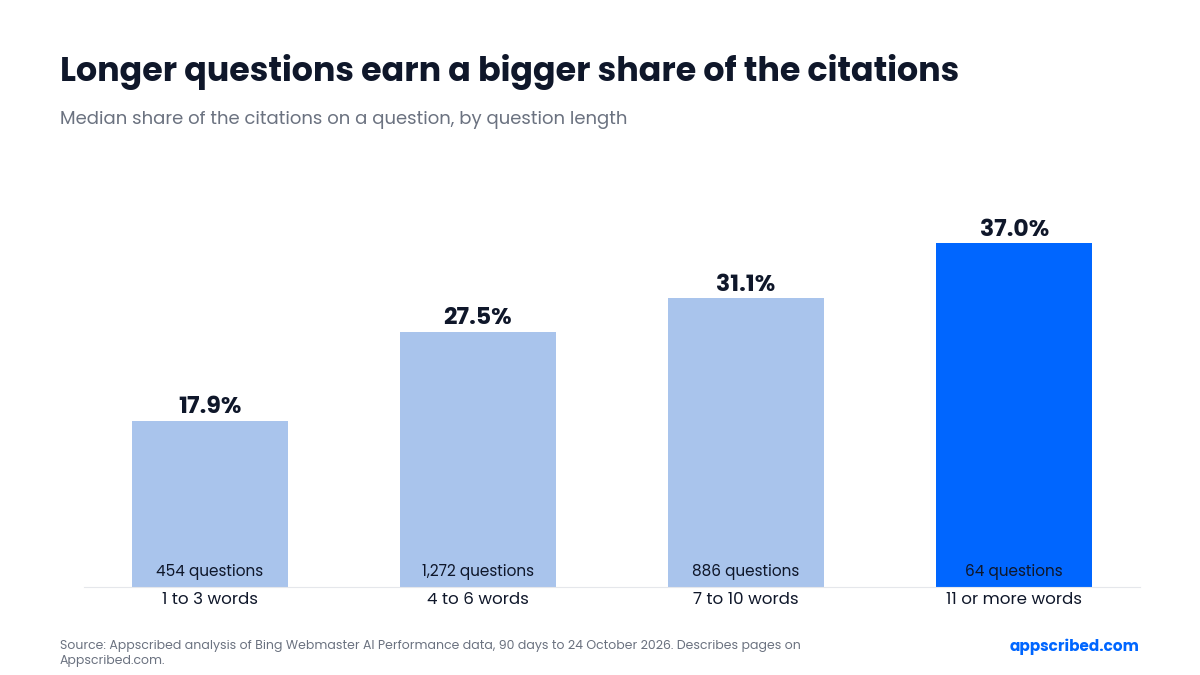
Bing Copilot cited Appscribed pages 431,012 times across 356 pages in 90 days; questions of 11 or more words earned a 37.0% median share, against 17.9% for 1 to 3 words. Appscribed data Statistic 20
Chart 8. This chart shows the median share of citations on a question, by question length.
Use this chart
Citation share is Bing's per-question measure of Appscribed's share of the citations on that question. The median is 37.0% for questions of 11 or more words (64 questions) against 17.9% for 1 to 3 words (454 questions).
What this means: questions of 11 or more words earned the largest citation share, so cover the long, specific questions your buyers ask.
Keep in mind: this describes one site and 64 long questions, so it shows a pattern, not a cause.
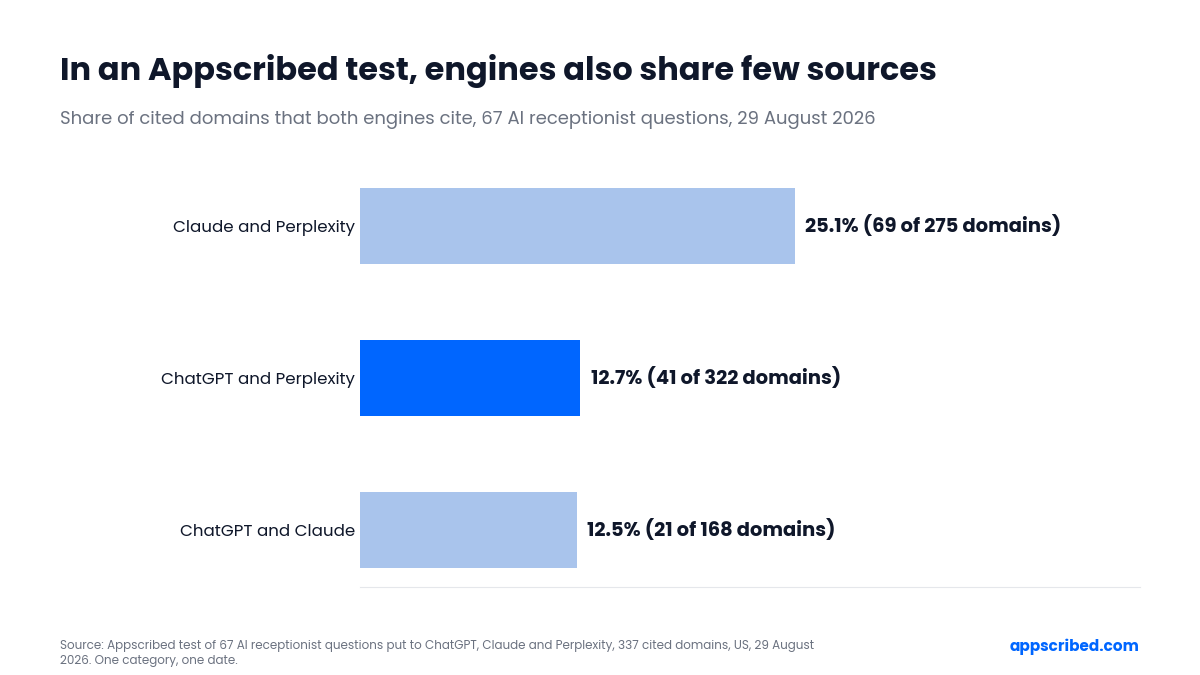
In an Appscribed test of 67 AI receptionist questions, 87.3% of the domains ChatGPT and Perplexity cite were not shared (12.7% overlap, 41 of 322 domains). Appscribed data Statistic 8b
Chart 9. This chart shows the share of cited domains that each pair of ChatGPT, Claude and Perplexity cite in common.
Use this chart
Across ChatGPT, Claude and Perplexity, 73.0% of cited domains (246 of 337) came from one engine only.
What this means: Appscribed's smaller test points the same way.
Keep in mind: this test covers one category (AI receptionists), one date (29 August 2026) and 67 questions in the US.
Appscribed figures come from Appscribed pages (AI tools reviews and comparisons) cited by Bing Copilot in the 90 days to 24 October 2026: 431,012 citations across 356 pages. One site, one niche.
What to do next
- Ask each AI engine your buyers' questions and note who is named. Statistic 1
- Add quotations, statistics and cited sources to key pages; avoid keyword stuffing; do not rely on schema markup. Statistic 14
- Check what a page earns before rewriting it. Statistic 12
- Plan for fewer clicks per ranking page; track AI visits as a small channel that may convert better. Statistic 4
- Try a free option before paying $29 to $300 a month. Statistic 19
Cite this page
Each number has its own link (#stat-1 to #stat-20), and each chart has a Use this chart box with its embed code.
Frequently asked questions
Is GEO replacing SEO?
No: AI platforms send 1 visit in 93 to 1 visit in 400 (1.08% to 0.25% of site visits), and Google sent about 210 times more referrals than the three largest AI platforms in a study of 81,947 sites.
Is AI replacing SEO?
Not on these numbers, but clicks are 47% to 62% lower when an AI answer appears (median 59%, four datasets).
What is the best tool for generative engine optimization?
Entry prices run $29 to $300 a month (median $95), and 10 of 11 tools offer a free tier, trial or free checker (4 November 2026).
How many Google searches are there a day?
At least 13.7 billion, by Appscribed's division of Google's annual count of more than 5 trillion (January 2025).
What are the most cited domains in ChatGPT?
Wikipedia leads, at 7.8% of ChatGPT's citations.
How to appear in AI searches?
Adding quotations, statistics or cited sources raised the share of an answer credited to a page by 27% to 41% in a lab test, and quotations added 22% on a live engine.
Best for your situation
Guides & comparisons
Notes on the data
- Figures that use the same definition can be quoted as given (Statistics 2, 3, 8, 8b, 10, 14 to 17, 20). Ranges and medians (1, 4, 5, 7, 9, 11, 12) should be quoted as a range with the number of studies. Estimates (6, 13, 18, 19) should be labelled.
- A median is the middle of several different measures, not one measured value. Most figures are from 2025 and 2026.
Sources
Numbers in square brackets point to this list; medians and ratios are Appscribed's.
- Profound, Answer Engine Citation Overlap Strategy, July 2025.
- Conductor, The 2026 AEO / GEO Benchmarks Report, July 2026.
- Ahrefs, AI Traffic Has Increased 9.7x in the Past Year, June 2025.
- Pew Research Center, Do people click on links in Google AI summaries?, July 2025.
- Ahrefs, Update: AI Overviews Reduce Clicks by 58%, February 2026.
- SISTRIX, AI Overviews in Germany: How Much Click-Through Rates Are Really Dropping, February 2026.
- Seer Interactive, AIO Impact on Google CTR: September 2025 Update, November 2025.
- Aggarwal et al., GEO: Generative Engine Optimization, June 2024.
- Ahrefs, We Tracked 1,885 Pages Adding Schema. AI Citations Barely Moved., May 2026.
- Ahrefs, Update: 38% of AI Overview Citations Pull From The Top 10, March 2026.
- BrightEdge, AI Overviews at the One-Year Mark: Presence, Size, and What They're Citing, February 2026.
- Semrush, Google AI Mode vs. Traditional Search & Other LLMs [Study], June 2025, updated July 2025.
- Ahrefs, Only 12% of AI Cited URLs Rank in Google's Top 10 for the Original Prompt, August 2025.
- Semrush, Semrush Report: AI Overviews' Impact on Search in 2025, December 2025.
- Semrush, We Studied the Impact of AI Search on SEO Traffic, June 2025, updated July 2025.
- Ahrefs, AI Overviews Currently Appear for 83% of Branded Searches, October 2026 (figures used: 73.3% branded and 78.3% unbranded, September 2026 monthly averages in the same study).
- Profound, Who Shapes AI Answers? Introducing Enhanced Citation Categories, January 2026.
- Muck Rack, Earned media still drives 84% of AI citations. Here's what that means for PR., May 2026.
- Yext, Yext Research: 86% of AI Citations Come from Brand-Managed Sources, October 2025.
- Ahrefs, New Study: AI Assistants Prefer to Cite Fresher Content, July 2025.
- Profound, AI Platform Citation Patterns, June 2025.
- Cloudflare, The crawl-to-click gap: Cloudflare data on AI bots, training, and referrals, August 2025.
- OpenAI, How People Use ChatGPT, September 2025.
- Google, AI, personalization and the future of shopping, March 2025.
- Ahrefs, Self-Promotional Content Works, Until It Backfires (AI SEO Experiment), July 2026.
- Meticulous Research, Generative Engine Optimization (GEO) Software Market 2036, October 2026.
- Dimension Market Research, Generative Engine Optimization Market Size Report 2026-2034, February 2026.
Need clarification on a figure or how it was derived? Write to partnerships@appscribed.com.
Prices are as of 4 November 2026 and can change.
Add us as a preferred source on Google, and our reviews and picks show up in your Top Stories and AI Overviews.