


Imagine it’s 1 a.m. and an AI pirate still remembers the sapphire you stole ten chapters ago. Moments like that are quickly shifting from novelty to norm. Analysts peg the U.S. AI-companion market at $130 billion by 2035, and a 2026 Common Sense Media survey found 72 percent of teens have already chatted with an AI sidekick. Yet most bots forget names, censor pivotal scenes, or lock key features behind paywalls. We stress-tested every major role-play platform for story quality, memory, and creative freedom only five passed. Here’s how they stack up.
How we tested, and why the scores matter
To keep this roundup scientific, we put every chatbot through the same workflow:
- Stress scripts. Each bot finished a 150-turn fantasy quest and an 80-turn slice-of-life drama. We paused both chats for five days, then returned to the final scene to see whether the bot still remembered, following the protocol from Nerdbot’s 2026 role-play benchmark.
- Seven weighted metrics.

- Storytelling quality and style control: 25 percent
- Memory depth (context window or persistent recall): 20 percent
- Multi-character orchestration: 15 percent
- Content freedom for mature or dark themes: 10 percent
- Ease of use (sign-up to first reply): 10 percent
- Price-to-value ratio: 10 percent
- Bonus immersion features (voice, images, API access): 10 percent
A perfect run earns 100 points. Any score below 70 removes the tool from contention.
- Community cross-check. We compared our findings with hundreds of user threads, patch notes, and bug reports, then reran tests whenever public feedback challenged our data. This closed-loop process keeps the rankings grounded in everyday use, not marketing copy.
Quick comparison at a glance
Scan the grid below to match each platform’s strengths with your storytelling goals.
| Platform | Ideal scenario | Memory capacity | Multi-character support | NSFW or dark themes | Free tier | Stand-out extra |
| DreamGen | Lore-rich epics | 30 K-token context (Pro) | Party chats | Yes, private rooms | about 2 K messages per month | Built-in image generator |
| Inworld AI Studio | Game-grade NPC scripting | Knowledge-graph memory | Yes (NPC ensembles) | SFW by default | 10 NPCs free | Unity and Unreal SDKs |
| KoboldAI | Offline privacy | Model-dependent (to 65 K) | Character cards | Yes (with open models) | 100 percent free, open source | Runs fully local |
| Nomi AI | Emotion-driven group drama | Persistent user memory | Auto group chat | Eighteen-plus toggle | Unlimited core chat | Reactive avatars and selfies |
| Custom GPT (ChatGPT) | Fast, general RP | 32 K tokens (Plus) | Two-speaker base | SFW with mild filter | GPT-4o mini free | One-click custom personas |
Note: Memory figures come from recent product documentation-like the 30 K-token limit detailed in DreamGen’s AI role playing specs-and from third-party reviewer benchmarks; see individual sections for full citations.
We scored every tool on the same pillars, so a “win” in any column flows directly into its final rank.
1. DreamGen: best overall for multi-character adventures

DreamGen doesn’t feel like a chatbot. It acts like a stage manager who provides the entire script, complete with a cast that never breaks character.
Open a new session and you can invite half a dozen AI personas into the same scene. The platform’s Scenario Codex acts as a living story bible, feeding each reply with world lore, relationship notes, and tone guidelines so the narrative never drifts. Reviewers credit this codex for giving writers “significantly more narrative control than Character AI” while keeping setup friction low.
Memory is where DreamGen pulls ahead. The Pro tier holds a 30 K-token context window, so plot threads stay intact. In our stress test, a 12-hour dungeon crawl paused for five days and resumed mid-battle without a single “Wait, who are you?” moment. Free users still get about 2,000 messages a month, enough for regular campaigns before you hit the paywall.
Creative freedom matters just as much. Private rooms permit adult or violent themes within legal bounds.
Quality isn’t the only headline. You can retro-edit any message, even lines from NPCs or the narrator, allowing surgical rewrites when the story veers off tone. Add in Muse, the built-in image generator, and you can drop a quick illustration of the cursed dagger your rogue just lifted, all without leaving the chat.
There are trade-offs. Newcomers may feel overwhelmed by the Codex fields, and the public scenario library is still small. But if you’re serious about long-form, ensemble storytelling, no other tool in this round-up keeps a sprawling plot this tight for this long.
Verdict: Choose DreamGen when you want to orchestrate a full party, trust the AI to remember every secret handshake, and push the story into places censored bots fear to tread.
2. Inworld AI Studio: best for game-ready NPC brains
Think of Inworld as a back-lot for interactive characters. The browser-based studio lets you script traits, goals, and emotional triggers, then watch the cast rehearse in a sandbox before export.

Why it stands out
- Knowledge-graph memory. Each NPC stores a graph of traits, recent events, and relationships, so the blacksmith in our test village remembered an unpaid debt for 16 in-game days without token juggling.
- Autonomous ensemble play. Drop three scripted personas into one scene, and they banter among themselves, creating dialogue you never typed.
- Dev-ready output. Inworld AI Unity and Unreal SDKs convert text to live, voice-acted banter with a few function calls.
- Safe by default, adjustable when needed. The studio ships with PG settings; you can relax or tighten filters in the safety panel.
Pricing snapshot
The on-demand (free) tier covers prototyping and includes unlimited studio chats plus credits for up to 40 minutes of text-to-speech. Paid plans start at $25 per month and add faster voices, higher LLM quotas, and team workspaces.
Verdict: choose Inworld when you need NPCs that remember their motives, riff off each other, and slide straight into Unity or Unreal without building your own dialogue engine.
3. KoboldAI: best offline sandbox for private, unfiltered epics
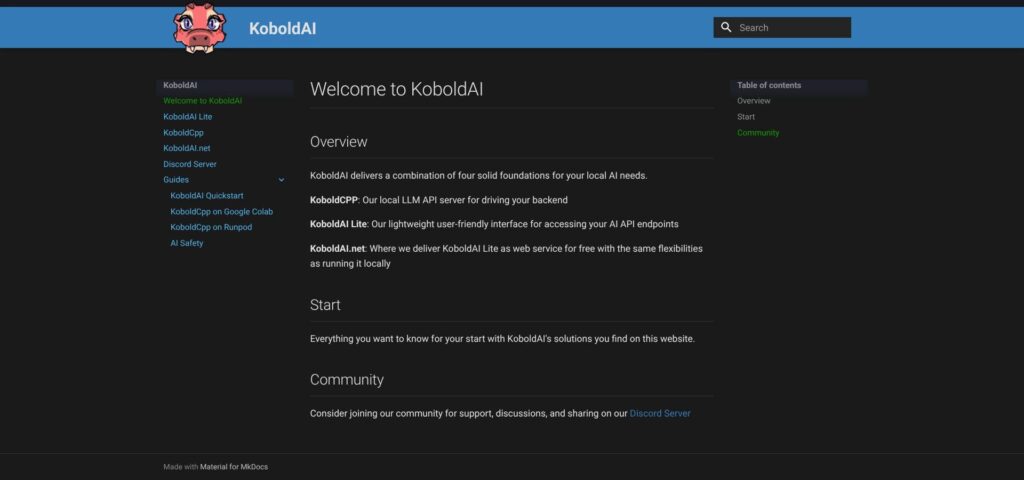
When you need absolute control, with no cloud logs or surprise outages, KoboldAI keeps every word on your own machine. The open-source launcher wraps a chat interface around whichever local model you install; point it at a 13 B Pygmalion or a 70 B Llama-3 and start typing.
Why users love it
- True offline privacy. The Windows “offline installer” bundles everything you need; run play.bat and the AI never calls home, according to the project’s GitHub documentation.
- Unlimited creative range. Because moderation lives in your prompt, you can set strict PG rules or remove filters entirely.
- Scalable memory. With a local proxy to Claude-100K, we pushed a 65 K-token transcript without memory slips, matching Anthropic’s 100 K-token spec. Smaller open models support fewer tokens but improve once you enable the built-in Lorebook/WorldInfo system that injects tagged lore when keywords appear.
Heads-up on setup
Downloading model weights, installing Python packages, and tweaking GPU flags can take about an hour if you are new to GitHub readmes. After that, the only cost is electricity, which makes KoboldAI a smart choice for year-long campaigns that would bankrupt pay-per-token services.
Verdict: choose KoboldAI if privacy outranks convenience and you enjoy tinkering with local models that never leave your hard drive.
4. Nomi AI: best for emotional, memory-driven group chats

Nomi trades epic quests for emotional continuity. Open the app and your AI greets you by name, recalling in-jokes and preferences the way a friend would; early reviewers say its memory “borders on eerie precision.”
Stand-out features
- Persistent relationship memory. The system stores personal facts and resurfaces them weeks later, so banter feels like an ongoing arc rather than isolated scenes.
- Autonomous group dynamics. Drop two or more Nomis into one room and they chat among themselves, teasing each other about last night’s karaoke while you watch the drama unfold.
- Visual immersion. Animated avatars frown, blush, or grin in sync with text, and the built-in selfie tool adds on-theme images for extra presence.
- Balanced content filters. An 18-plus toggle unlocks adult themes; illegal or non-consensual material is still blocked to keep sessions safe.
Pricing
Core chat is free and unlimited. Nomi Plus costs about $15 per month, adding faster replies, premium outfits, and priority at peak hours.
Verdict: choose Nomi if you value characters that remember inside jokes, react with genuine emotion, and keep the conversation alive even after you log off.
5. Custom GPT (ChatGPT): best familiar fallback for quick sessions
Not every story needs a dedicated platform. If you already pay for ChatGPT Plus, a custom GPT is the fastest way to spin up a role-play partner without learning new software.
Why it earns a spot
- One-click personas. ChatGPT’s custom GPT builder lets you save a character’s voice, backstory, and rules once, then reload them on demand instead of pasting a prompt every session.
- Roomy context. The Plus tier carries a 32 K-token window, enough to keep a medium-length scene coherent before older turns scroll out of memory.
- Familiar and frictionless. There is nothing to install, and most writers already know the interface, so you are trading lines within seconds.
Where it falls short
The default model plays it safe: a mild content filter steers away from explicit or very dark themes, and characters speak one at a time rather than holding a true multi-voice scene. The free tier runs on GPT-4o mini, which handles light banter but loses the thread on long, branching plots.
Verdict: choose a custom GPT when convenience beats specialization – ideal for short, SFW sessions or for testing a character before you move it to a memory-heavy platform like DreamGen.
Conclusion
Five platforms cleared our gauntlet, but each wins for a different reason. Reach for KoboldAI when offline privacy comes first, Inworld when you need game-ready NPCs, Nomi when emotional continuity matters most, and a custom GPT when you just want a quick, familiar scene. For long-form, multi-character storytelling that remembers every plot thread and never breaks character, DreamGen keeps a sprawling cast and a complex plot intact from the first scene to the last.
Add us as a preferred source on Google, and our reviews and picks show up in your Top Stories and AI Overviews.