
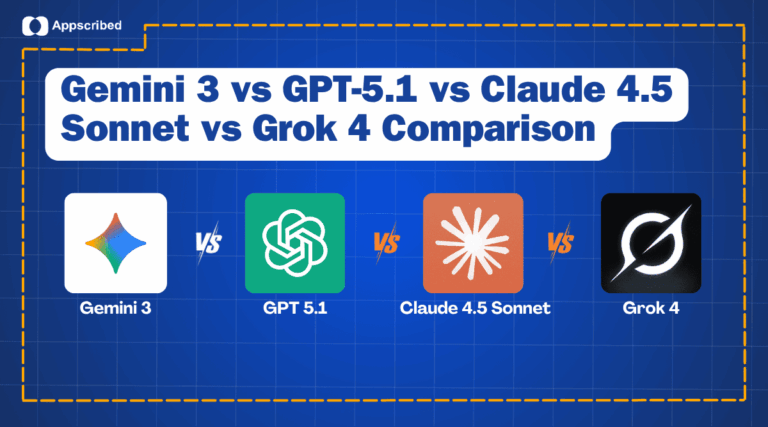
Choosing the right frontier AI model in 2025 is a strategic decision for startups and mid-sized tech teams. This concise, data-driven comparison evaluates pricing, context windows, coding and reasoning benchmarks, multimodal capabilities, enterprise readiness, and practical use recommendations.
Executive summary
Gemini 3 Pro: Leading on many public benchmarks and multimodal reasoning; positioned as premium enterprise offering with a context-tiered pricing model and large context window.
Grok 4 (Fast / extended context): Lowest token costs and very large context window (marketed up to 2M tokens); best fit for high-volume batch work and large-context analysis.
Claude 4.5 Sonnet: Strongest on code-editing and code-review benchmarks (SWE-Bench); emphasizes safety and agentic use. For the current Anthropic default model, see our Claude Sonnet 4.6 guide, for the workflow layer above the model, see our Claude Code breakdown, for cost structure use our Claude pricing guide, and for the broader product timeline use our latest Claude updates hub.
GPT-5.1: Mature ecosystem, balanced performance; vendor updates focus on iterative improvements for coding and reasoning.
Quick comparison of Gemini 3 vs GPT-5.1 vs Claude 4.5 Sonnet vs Grok 4
| Feature | Gemini 3 Pro | GPT-5.1 | Claude 4.5 Sonnet | Grok 4 (Fast) |
|---|---|---|---|---|
| Input / output pricing (per 1M tokens) | Premium, tiered by context | Moderate / vendor-dependent | Higher than GPT, vendor-published tiers | Lowest publicly reported |
| Context window (input / output) | ~1M input / ~64K output (claims) | Not fully published | ~200K (Sonnet) – expanded options reported | Up to ~2M (Fast variant) |
| SWE-Bench / code editing | Strong | Strong | Leads SWE-Bench in many public leaderboards | Limited public data |
| Reasoning & multimodal | Marketed as best-in-class across many tests | Competitive | Solid for agentic tasks; hybrid reasoning | Competitive but optimized for scale/cost |
| Enterprise SLA / compliance | Enterprise SLAs and region controls (vendor offering) | Mature ecosystem; some enterprise controls | Strong safety/enterprise focus | Public SLA details limited |
Pricing & total cost of ownership
- Grok 4 (Fast) offers the best raw token economics for high-volume workloads. If you run many large, non-latency-sensitive jobs (logs, batch transforms, large document analysis), Grok dramatically reduces operational costs.
- Gemini 3 Pro uses context-tiered pricing; premium cost may be offset by fewer round trips and higher task success on complex reasoning.
- GPT-5.1 typically sits between extremes, providing predictable integration value for teams already invested in its ecosystem.
- Claude 4.5 Sonnet is priced to reflect its focus on safe, high-accuracy code editing and enterprise use.
Recommendation: For internal, cost-sensitive pipelines use the lowest-cost model (Grok). For customer-facing, high-value features that rely on reasoning and multimodal inputs, prioritize a premium model and measure ROI.
Context windows and scale
- Grok 4 (Fast) is designed to handle very large inputs (marketed up to ~2M tokens), which simplifies workflows that would otherwise require chunking and orchestration.
- Gemini 3 Pro offers very large input context (~1M tokens) with more limited output length (~64K), which can affect very long form generation.
- Claude 4.5 Sonnet provides a large but smaller context relative to Grok and Gemini (Sonnet targeted at long contexts with special tooling).
- GPT-5.1 context details are evolving and not always fully public; plan conservatively.
Practical impact: Fewer calls = lower orchestration complexity, lower token overhead and simpler architecture.
Coding & agentic capabilities
- Claude 4.5 Sonnet performs exceptionally well on code-editing and SWE-Bench style tests; this translates to fewer failed attempts and lower token burn in code review workflows.
- Gemini 3 Pro shows strong competitive coding and terminal automation results in vendor and public tests.
- GPT-5.1 remains a reliable all-rounder with mature developer tooling.
- Grok 4: public, detailed coding benchmark data is scarcer; its strength is scale and cost rather than documented coding dominance.
Reasoning, multimodality, and factuality
- Gemini 3 Pro leads many public multimodal and reasoning evaluations and shows strong performance on math and science benchmarks in vendor reports.
- Claude 4.5 Sonnet emphasizes conservative, safety-oriented outputs and strong agentic reasoning for workflows that must minimize hallucinations.
- GPT-5.1 has iterative improvements emphasizing reasoning and coding.
- All models: factuality and hallucination risk remain non-zero. Production systems should use grounding, retrieval augmentation and human-in-loop verification.
Enterprise readiness
- Gemini 3 Pro: vendor publishes enterprise availability, region controls and SLA options.
- Claude 4.5 Sonnet: Anthropic emphasizes alignment and enterprise features; suited for regulated domains.
- Grok 4: pricing and scale are public, but enterprise SLAs and compliance details are less disclosed publicly.
- GPT-5.1: mature tools and ecosystem support enterprise adoption; specific SLA details depend on the vendor arrangement.
Deployment recommendations
- Use Grok 4 for internal tooling, high-volume batch, and large-context analytics.
- Use Gemini 3 Pro for customer-facing, multimodal, reasoning-heavy differentiators.
- Use Claude 4.5 Sonnet for code-heavy pipelines and where conservative outputs are essential.
- Keep GPT-5.1 for general-purpose needs and rapid prototyping when you rely on its ecosystem.
Also Read
Analyzing OpenAI GPT-4o: Features, Access and Comparison with GPT-4
ChatGPT Canvas vs. Claude Artifacts: An In-Depth Comparison
Final verdict
There’s no single winner for all use cases. Match model selection to context size, cost constraints, performance needs, and regulatory requirements. A hybrid approach – low-cost model for bulk tasks, premium model for value-driving features, and a code-optimized model for review pipelines – often yields the best ROI.