
Claude Opus 4.6 is Anthropic’s premium Claude model for people who want the highest ceiling for coding, long-context reasoning, and heavier agent-style work. If you want the newer release, compare it with our Claude Opus 4.7 guide. If Sonnet is the practical default, Opus is the model you move to when the work is harder, more connected, or simply too big for a lighter tier to stay reliable.
If you are deciding whether Anthropic’s premium model family is enough reason to choose Claude overall, see our Claude vs ChatGPT comparison.
The useful question is not “is Opus smarter in theory?” It is whether Opus gives you enough extra depth to justify the higher cost. For many casual users, the answer is no. For code-heavy teams, researchers working across large context windows, and people pushing Claude into longer-horizon tasks, the answer can be yes.
If you are mapping the wider Claude product, read this alongside our Claude updates hub, Claude Sonnet 4.6 guide, Claude Code guide, and Claude pricing guide.
What is Claude Opus 4.6?
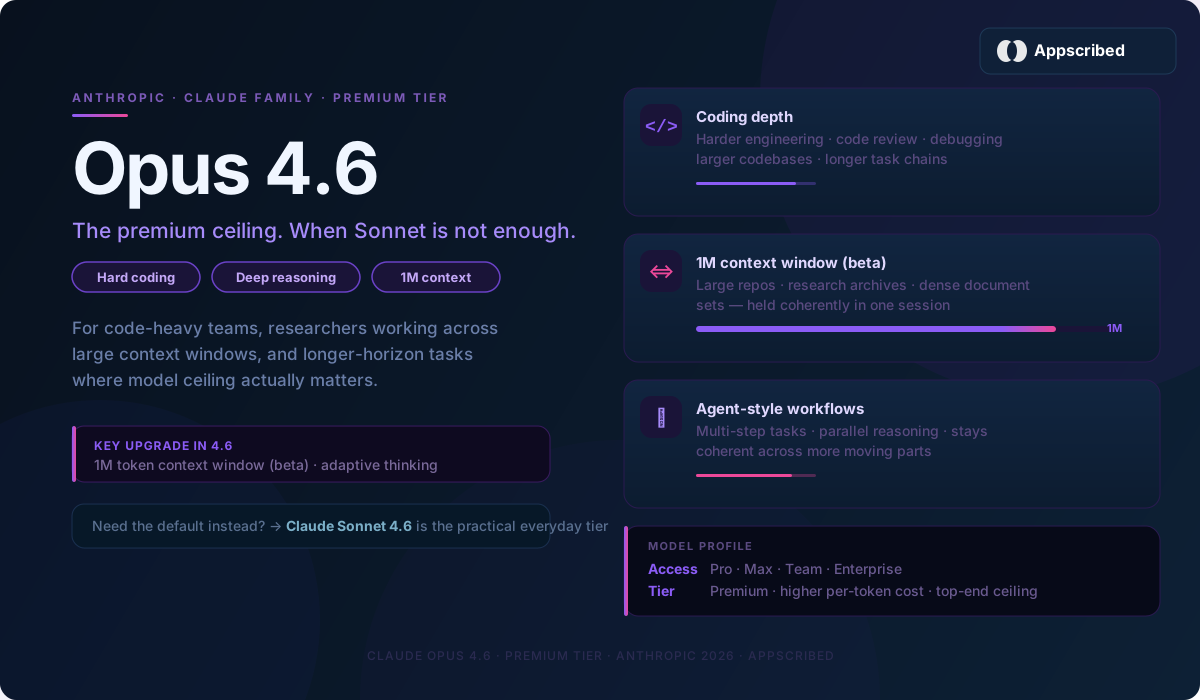
Claude Opus 4.6 is Anthropic’s top-end Claude model for the hardest work in the lineup. It is the version you look at when you care more about coding depth, longer-running reasoning, and larger connected tasks than about lower cost or broad default access.
That is what separates it from Sonnet. Sonnet is the everyday Claude most people can use. Opus is the model for users who are trying to push the ceiling.
Quick answer: why Claude Opus 4.6 matters
- For coding-heavy users, Opus is the Claude tier most clearly positioned for harder engineering work and longer task chains.
- For long-context work, the 1M token beta matters because it lets Claude stay coherent across bigger codebases and document sets.
- For the Claude lineup, Opus is the premium answer to the question, “what do I use when Sonnet is not enough?”
That is why Opus belongs in the cluster. It is not just a new model label. It defines the top end of Claude’s serious-work story.
What changed with Claude Opus 4.6?
Claude Opus 4.6 pushes further into the kind of work that breaks weaker models first: longer engineering tasks, harder code review, deeper debugging, larger codebases, and research or document workflows that need a lot of context to stay connected.
The 1M token beta context window is part of that story, but the more important point is what that larger window allows: Opus can keep more of the task in view at once. That matters when you are working across a big repo, a research archive, or a dense set of interconnected documents.
Claude Opus 4.6 pricing
Claude Opus 4.6 is the expensive Claude for a reason. This is not the model Anthropic is trying to make everyone use all day by default. It is the premium tier for users who need higher-end reasoning and are willing to pay for it.
That is also why pricing should be read in context, not in isolation. If you are deciding between Claude plans or model tiers, Opus only makes sense when the extra depth changes the quality of the work enough to justify the cost. If that is still unclear, our Claude pricing and plans guide is the better place to compare Pro, Max, and API economics.
Is Claude Opus 4.6 free?
No, Claude Opus should be thought of as the premium Claude lane, not the free Claude lane. If your priority is broad access and everyday usage, Sonnet is the more realistic model to start with.
That does not make Opus niche. It just means Anthropic is using it as the top-end answer for people who want the most capable Claude rather than the most practical Claude.
Claude Opus 4.6 vs Claude Sonnet 4.6
This is the real buying question for most people.
- Use Sonnet 4.6 if you want the practical default for coding, writing, analysis, and general daily work.
- Use Opus 4.6 if you want the premium Claude for harder coding, longer-running tasks, and higher-context work.
In other words, Sonnet is the better answer for most users. Opus is the better answer for users who already know they are hitting the limits of the default tier.
If you are still unsure, read our Claude Sonnet 4.6 guide next. That page makes the “default vs premium” split much easier to judge.
Claude Opus 4.6 and Claude Code
Opus matters even more once you connect it to developer workflows. The premium Claude tier makes the most sense when the work itself is heavier: larger code changes, longer reasoning chains, more complex debugging, and agent-style workflows where the model has to stay coherent across more moving parts.
That is why Opus pairs naturally with Claude Code. The better the workflow surface gets, the more valuable the premium model becomes for the hardest tasks inside it.
Who should use Claude Opus 4.6?
- Use it if you are working across large codebases or large connected document sets.
- Use it if you need the highest Claude ceiling for coding or long-context analysis.
- Use it if Sonnet already feels good but not quite deep enough for your hardest tasks.
- Skip it if your work is mostly everyday chat, light coding, or general writing.
- Skip it if you mainly care about value and broad access rather than top-end performance.
Our take
Claude Opus 4.6 matters because it gives the Claude lineup a real premium top tier instead of just a slightly better default. If you are comparing against the newer release, our Claude Opus 4.7 guide is the next page to read. The best AI product lines are not only about one flagship. They are about giving users a clear ladder from practical to premium.
Right now, Opus is the Claude tier for users who want more depth than Sonnet can reliably offer on the hardest work. That does not mean everyone should rush to it. It means Opus is worth paying attention to if your work is hard enough that model ceiling actually matters.
Frequently Asked Questions
What is Claude Opus 4.6?
Claude Opus 4.6 is Anthropic’s premium Claude model for harder coding, longer-running reasoning, and higher-context work where the default Claude tier may not be enough.
Is Claude Opus 4.6 free?
No. Claude Opus should be treated as the premium Claude lane, not the free or default lane.
How is Claude Opus 4.6 different from Sonnet 4.6?
Sonnet 4.6 is the practical default for most daily work, while Opus 4.6 is the higher-end Claude model for harder coding, deeper reasoning, and larger connected tasks.
Who should use Claude Opus 4.6?
Claude Opus 4.6 is best for users working across larger codebases, heavier research sets, or more demanding agent-style workflows where model ceiling matters.
Add us as a preferred source on Google, and our reviews and picks show up in your Top Stories and AI Overviews.