
The Claude updates that matter are the ones that change how people actually work with it: stronger models, better coding performance, deeper research, better tool access, and more capable agent-style workflows. That’s what this page tracks.
If you’re here for the latest Claude updates, this page is built to do two things fast: show you what changed, and tell you whether it matters.
If you want the strongest current Claude breakdowns beyond the hub, start with our Claude Code guide for the developer workflow angle and our Claude Sonnet 4.6 guide for the current default-model angle.
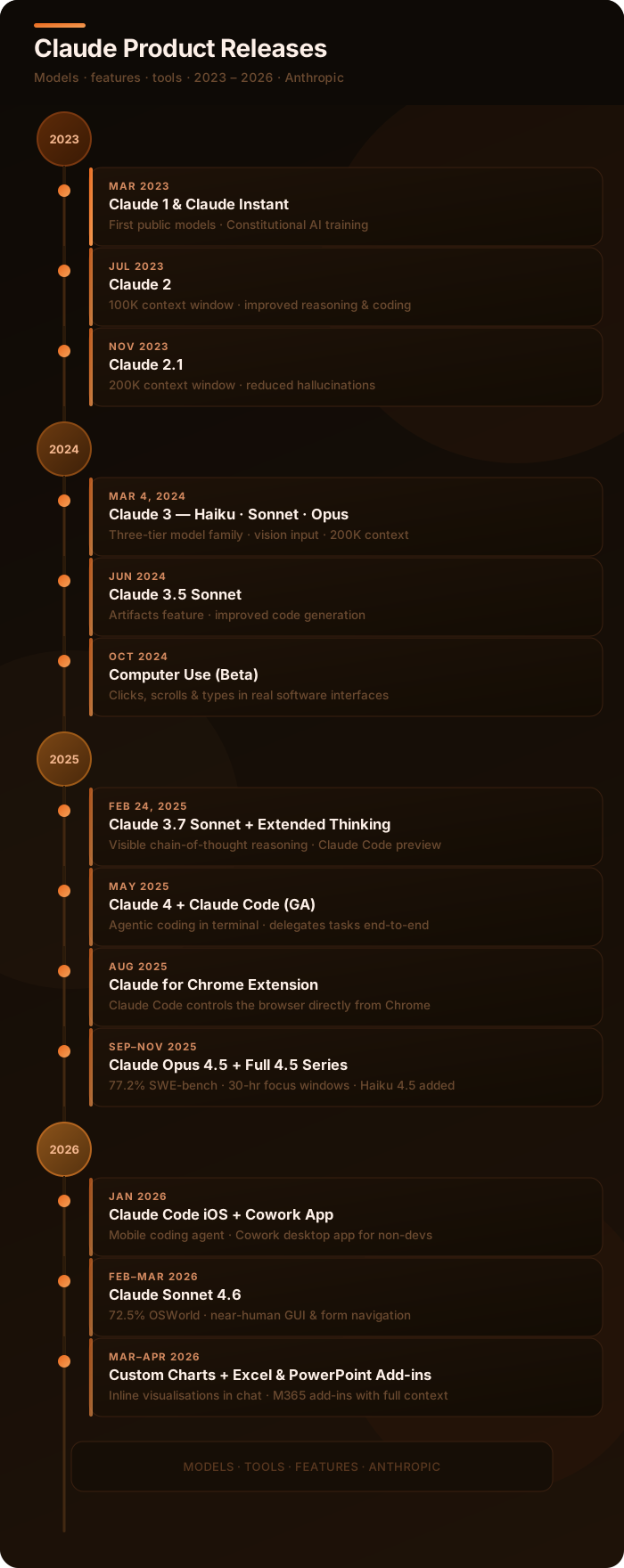
Most Important Claude Updates In 2026 So Far
The pattern across 2026 is clear – Anthropic has been systematically pushing Claude into the kind of work that previously required entire teams. Here’s what actually shipped.
March onwards – Computer use in Cowork and Claude Code let Claude open apps, navigate browsers, click, fill spreadsheets, and run tools directly on your screen – with no setup required. Paired with the Dispatch feature, users can now send a task from their phone and come back to finished work on their desktop. If you want the full workflow breakdown, read our Claude Code guide.
February 24 — Cowork gained 13 new enterprise connectors and 10 domain-specific plugins, covering legal, finance, HR, engineering, equity research, investment banking, and more. The legal plugin handles contract review, NDA triage, and clause-by-clause redlining. The finance plugins cover financial modelling, earnings analysis, pitch book preparation, and due diligence. Connectors now include DocuSign, FactSet, Harvey, Google Workspace, LegalZoom, MSCI, and S&P Global. Enterprises can also build and publish their own private plugins through a new admin marketplace. Cowork also gained recurring task scheduling – configure a daily briefing or weekly report once and Claude runs it on its own.
February 20 – Claude for Excel and PowerPoint add-ins arrived, letting Claude work directly inside Microsoft Office. The add-ins share full conversation context across both apps, so an analysis Claude runs in Excel informs the deck it builds in PowerPoint – no manual exporting between tools.
February 17 – Claude Sonnet 4.6 brought those same capabilities into the model most people use daily. Coding, long-context reasoning, computer use, and agent planning all stepped up – along with a 1M token context window of its own in beta. Frontier-level capability is no longer a premium-only feature.
February 10 – Cowork launched on Windows, bringing full feature parity with macOS – file access, multi-step task execution, MCP connectors, and all plugins available on both platforms.
February 5 – Claude Opus 4.6 raised the ceiling for serious work. Coding, code review, debugging, and long-running delegated tasks all improved. The headline was the 1M token context window in beta — enough to hold an entire codebase, a research archive, or a dense document library in one session without losing the thread. On professional benchmarks, it posted the highest legal reasoning score of any Claude model, and held the top position for financial tasks like due diligence and market intelligence synthesis.
The through-line for 2026: Claude has stopped being a chat product and started being a work system – one that operates across your files, your tools, your calendar, and your professional workflows, with domain expertise built in rather than bolted on.
What Changed In Claude Recently
The current Claude story is really about five overlapping shifts.
- Models got stronger. Sonnet and Opus both kept moving up in coding, reasoning, and sustained task execution.
- Claude Code became real. Claude is no longer just useful for code explanation. It is increasingly useful for delegated engineering work.
- Research and integrations expanded the product. Claude is more useful when it can work across web results, connected tools, and your own context instead of starting every task from zero.
- Computer use kept improving. That matters because it pushes Claude closer to real workflow execution rather than pure text generation.
- Plan and access changes made heavy usage more viable. Anthropic has been shaping Claude for serious users, not just casual experimentation.
If you compare Claude now with Claude from early 2024, the difference is not subtle. Claude has moved from “smart assistant with strong writing” toward “high-end work model for coding, research, and agent-style tasks.”
Latest Claude Model Updates
The model side of Claude has been the clearest source of momentum.
Claude Opus 4.6
Opus 4.6 matters because it pushes Claude further into premium coding and agent territory. The model is better at planning across longer engineering tasks, reviewing code more carefully, and working more reliably across large codebases. The 1M context beta is not just a flashy number. It is useful when the work itself is too large or too interconnected for smaller context windows to stay stable.
Claude Sonnet 4.6
Sonnet 4.6 may be even more strategically important than Opus 4.6 because it improves the model more people are likely to use day to day. If Claude’s practical default gets materially better at code, design, spreadsheet work, and long-context tasks, that changes adoption faster than a premium top-end model alone.
Claude 4.5 Wave
Late 2025 was also a big reset for the Claude lineup. Sonnet 4.5, Haiku 4.5, and Opus 4.5 pushed the product into a stronger three-tier model story: fast, strong, and premium. That made Claude easier to position for both light everyday work and serious coding-heavy tasks.
One of the most important product truths here is that Claude’s model story has become easier to understand than it used to be. There is now a clearer ladder from speed and affordability up to heavy-duty reasoning and coding.
Claude Code And Workflow Updates
Claude Code deserves special attention because it changed the conversation around Claude from “great writing and reasoning model” to “serious developer workflow tool.”
Claude Code first mattered when Anthropic showed that Claude could move beyond code suggestions and operate more like an engineering agent inside the terminal. The newer model releases matter because they made that coding behavior stronger, more stable, and more realistic for real teams.
That is also why Claude updates should be watched through a workflow lens. Better coding performance inside Claude does not just improve benchmark talk. It changes what developers are willing to trust Claude with.
Research, Integrations, And Connected Context
Another major shift was Claude becoming more connected to real work context. Research, Google Workspace access, and integrations matter because they reduce one of the biggest weaknesses of raw chat interfaces: lack of relevant context.
When Claude can work across the web, your documents, and connected tools, it stops feeling like a blank-slate assistant and starts acting more like a work surface. That is particularly important for research-heavy teams, strategy work, document review, and knowledge workflows.
The practical impact is simple: Claude gets more useful when it can reason with your actual material instead of forcing you to restate everything manually every time.
Claude Update Timeline
2026
- February 17, 2026: Claude Sonnet 4.6 raised the day-to-day Claude default for coding, long-context work, design, and computer use.
- February 5, 2026: Claude Opus 4.6 pushed Claude’s top-end performance further into large-codebase, debugging, review, and long-running agent tasks.
2025
- November 24, 2025: Claude Opus 4.5 strengthened Anthropic’s premium model story and pushed harder into coding, agents, and computer use.
- October 15, 2025: Claude Haiku 4.5 made Claude’s fast model much more capable, especially for low-latency coding and agent tasks.
- September 29, 2025: Claude Sonnet 4.5 improved coding, computer use, and agent performance while making Claude Code more practical.
- May 22, 2025: Claude 4 launched with Claude Opus 4 and Claude Sonnet 4, marking a major product step forward for coding, reasoning, and longer-horizon agent work.
- May 1, 2025: Claude integrations expanded what Claude could connect to, while advanced research pushed Claude deeper into long-form information work.
- April 15, 2025: Research and Google Workspace access made Claude more useful for connected knowledge work instead of isolated chat sessions.
- April 9, 2025: The Max plan gave heavy users a more realistic way to use Claude as an everyday work tool, not just a capped assistant.
- February 24, 2025: Claude 3.7 Sonnet introduced hybrid reasoning and brought Claude Code into the picture as a serious developer workflow move.
2024
- October 22, 2024: the upgraded Claude 3.5 Sonnet, Claude 3.5 Haiku, and computer use beta showed that Anthropic was pushing Claude toward agentic software workflows.
- July 16, 2024: the Claude Android app expanded Claude’s device footprint and made the product more available across daily use cases.
- June 21, 2024: Claude 3.5 Sonnet raised Claude’s model quality sharply and helped establish Claude as a top-tier reasoning and coding option.
Our Take
The real Claude story is not that Anthropic keeps shipping new model names. It is that Claude is becoming more useful in work that is multi-step, tool-connected, and too large for shallow chat.
That is why the Claude update cycle matters.
Claude has a stronger claim in coding, long-context reasoning, connected research, and agent-style work than it did a year ago. The useful question is not whether Anthropic can generate hype. It is whether Claude is becoming a better tool for serious work.
Right now, it is.
Related Reading
- What Is Claude Code? How It Works, Pricing, Web Access, and Why It Matters
- Claude Sonnet 4.6: Pricing, Access, Context Window, and Why It Matters
- Best AI Models 2026: Claude vs GPT vs Gemini Compared
- ChatGPT Canvas vs. Claude Artifacts: An In-Depth Comparison
- Claude 3.5 Sonnet Vs GPT-4o
- ChatGPT Latest Updates in 2026
Frequently Asked Questions
What is the latest Claude update?
The latest major Claude updates in early 2026 were Claude Opus 4.6 and Claude Sonnet 4.6. Both pushed Claude further in coding, long-context reasoning, and agent-style work.
What is new in Claude in 2026?
The biggest 2026 changes so far are stronger Opus and Sonnet models, better long-horizon coding performance, a 1M token context beta on Opus and Sonnet 4.6, and a broader push toward research and delegated work.
Why do Claude updates matter?
Claude updates matter because they often change how useful Claude is in real workflows like coding, research, spreadsheets, documents, and long-running agent tasks. This is more than cosmetic product churn.
Is Claude Code part of the Claude updates story?
Yes. Claude Code is one of the most important parts of the Claude product story because it shifts Claude from code assistance into delegated engineering work and terminal-based workflows.
Where should I track Claude updates?
If you want the major model, product, and workflow changes in one place, this page is meant to be the running Claude updates timeline rather than a raw changelog dump.