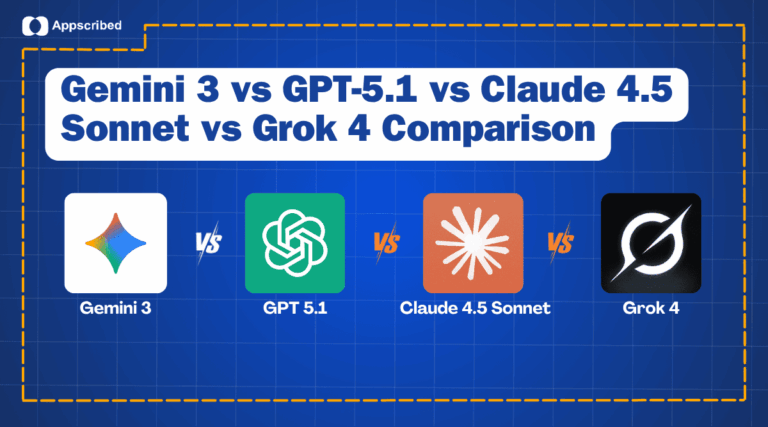

Updated March 28, 2026: If you’re searching for the best AI models in 2026, the answer is no longer one static model number. The market now moves fast enough that a durable comparison has to focus on model families first: OpenAI’s GPT-5 family, Anthropic’s Claude 4.6 family, and Google’s Gemini family.
That matters because vendor naming is now split across different surfaces. OpenAI’s latest developer docs point users to GPT-5.4 as the flagship for complex reasoning and coding. Anthropic has moved to Claude Opus 4.6 and Claude Sonnet 4.6. Google’s Gemini API docs still center Gemini 2.5 Pro as the state-of-the-art reasoning model for developers, while some Google AI consumer plan pages now reference Gemini 3 Pro experiences inside Google products. Older January 2026 articles age quickly because they lock onto one label and then never recover.
This refresh compares the current leaders using official OpenAI, Anthropic, and Google product and developer documentation available on March 28, 2026. The goal is simple: help you decide which model family is actually best for your workflow right now.
Quick Answer: Which AI Model Should You Use?
If you want the safest all-around default: choose the GPT-5 family. If you care most about coding-heavy work and polished writing: choose the Claude 4.6 family. If you need long context, multimodal input, or stronger price-to-performance: choose the Gemini family, especially Gemini 2.5 Pro on the API side.
There is no universal winner in 2026. The right model depends on whether you optimize for coding reliability, long-document analysis, natural writing, tool use, latency, budget, or ecosystem fit.
The Current Leaders: Claude vs GPT vs Gemini in 2026
- Best all-around model family: OpenAI GPT-5, because OpenAI’s latest docs position GPT-5.4 as the flagship for complex reasoning, coding, and professional workflows.
- Best for code-heavy teams and polished writing: Anthropic Claude 4.6, with Opus 4.6 for frontier performance and Sonnet 4.6 for a more accessible default tier.
- Best for long context, multimodal analysis, and value: Google’s Gemini family, with Gemini 2.5 Pro remaining the clearest current developer-facing reference point.
If you prefer one sentence over a long comparison, use this rule: GPT for balanced professional work, Claude for code and prose quality, Gemini for context, multimodal workflows, and cost efficiency.
GPT-5 Family: Best Overall for Professional Work
OpenAI’s current model documentation tells users to start with gpt-5.4 if they want the flagship for complex reasoning and coding. That is the clearest official signal that the GPT-5 family is still OpenAI’s strongest all-around recommendation for people who need one model that can handle research, coding, writing, tool use, and general professional workflows.
Why GPT-5 stays near the top in 2026:
- OpenAI describes GPT-5.4 as its best intelligence at scale for agentic, coding, and professional workflows.
- The latest developer docs show a roughly 1M-class context window and 128K max output, which keeps GPT competitive on long-context work.
- GPT-5.4 supports structured outputs, function calling, web search, file search, code interpreter, image generation, and other tool-heavy workflows through OpenAI’s current APIs.
- OpenAI also gives cost-sensitive users a clearer path down the stack with GPT-5 mini and GPT-5.4 nano.
Best use cases for GPT-5: mixed professional work, complex reasoning, multi-step problem solving, enterprise workflows, tool-using agents, and teams that need one strong general-purpose default instead of a specialist model for every task.
Where GPT-5 is not automatically the winner: if your work is deeply code-centric and you care about long-horizon software engineering performance more than broad versatility, Claude Opus 4.6 is a serious alternative. If you process huge documents, PDFs, audio, images, and Google-native workflows at scale, Gemini can be the more practical choice.
Claude 4.6 Family: Best for Coding Teams and Natural Writing
Anthropic’s current lineup is easier to read than it was earlier in the year. Claude Opus 4.6 is the premium frontier model for coding, agents, and difficult enterprise work. Claude Sonnet 4.6 is the widely available default model in Claude for Free and Pro users and now covers more everyday professional work than older Sonnet tiers did.
Why Claude Opus 4.6 Stands Out
Anthropic positions Opus 4.6 as its smartest model and specifically calls out better long-running coding, stronger code review and debugging, and better reliability in larger codebases. Anthropic also says Opus 4.6 leads Terminal-Bench 2.0 and other demanding evaluations, which is why Claude remains one of the most credible answers to the question, what is the best AI model for coding in 2026?
- Built for professional software engineering, complex agentic workflows, and high-stakes enterprise tasks.
- Available with a 1M token context window in beta on the Claude Platform.
- Supports hybrid reasoning, adjustable effort controls, and long-running context-compaction workflows for agents.
- Pricing starts at $5 per million input tokens and $25 per million output tokens, so it is clearly a premium choice.
Why Claude Sonnet 4.6 Matters More Than Many People Think
Sonnet 4.6 is not just the cheaper Claude. Anthropic says it is now the default model for Free and Pro users and that it delivers frontier performance across coding, agents, and professional work at scale. For many users, Sonnet 4.6 is the real reason Claude is so competitive in 2026, because it brings much of Claude’s style, clarity, and coding strength to a more practical price tier.
- Pricing starts at $3 per million input tokens and $15 per million output tokens.
- Anthropic says Sonnet 4.6 is a full upgrade across coding, computer use, long-context reasoning, agent planning, knowledge work, and design.
- Anyone can chat with Sonnet 4.6 in Claude, so it is one of the easiest current frontier models to try in practice.
Best use cases for Claude 4.6: code-heavy teams, agentic coding workflows, long code reviews, polished writing, professional communication, and users who consistently prefer Claude’s tone and judgment over more utilitarian alternatives.
Gemini Family: Best for Long Context, Multimodal Work, and Value
Google’s model story is the most fragmented across consumer and developer surfaces, so it helps to be explicit. If you want the clearest official developer benchmark point today, use Gemini 2.5 Pro. Google’s Gemini API docs describe it as a state-of-the-art thinking model for complex reasoning, code, math, STEM work, large datasets, codebases, and documents. At the same time, Google AI plan pages now reference access to Gemini 3 Pro in some consumer-facing product experiences. The safest comparison point for specs and API pricing remains Gemini 2.5 Pro.
- Gemini 2.5 Pro supports text, image, audio, video, and PDF inputs.
- Google lists an input token limit of 1,048,576 and output token limit of 65,536.
- It supports structured outputs, function calling, code execution, search grounding, URL context, and batch processing.
- Gemini 2.5 Pro API pricing starts at $1.25 per million input tokens and $10 per million output tokens for prompts up to 200K tokens, which is one of the clearest price advantages among frontier models.
Google also now bundles more advanced Gemini access into Google AI plans, Google Search, Workspace, NotebookLM, Chrome, and developer products. That wider product footprint is a real advantage if you are already deeply embedded in Google’s ecosystem.
Best use cases for Gemini: very large documents, multimodal analysis, long-context research, code and document review, Google-native workflows, AI Studio experimentation, and teams that care heavily about price-to-performance.
Head-to-Head: Claude vs GPT vs Gemini in 2026
Coding
Best pick: Claude 4.6, especially Opus 4.6 if you work on large codebases or agentic coding workflows. Anthropic’s own release positioning is the clearest and most aggressive here, and Claude remains the model family most likely to be chosen specifically for software engineering quality rather than as a general assistant that also codes.
Close second: GPT-5.4. OpenAI’s latest docs still position GPT-5.4 as the flagship for coding and professional work, so GPT is absolutely not out of the running for developers. It is often the safer default if you want one model that can code well and still be your best general assistant.
Strong third option: Gemini 2.5 Pro. It is clearly strong enough for serious coding work, but its sharper edge is the combination of coding, massive context, multimodal inputs, and lower API pricing.
Writing and Content Creation
Best pick: Claude Sonnet 4.6 for polished, natural writing. Claude still has the strongest reputation for clean prose, measured tone, and output that feels less templated. If your work is heavy on articles, reports, messaging, or client-facing writing, Claude is often the most comfortable choice.
Best all-around alternative: GPT-5.4. GPT is stronger when your writing tasks sit inside a broader workflow that includes research, structured outputs, spreadsheets, or tool use.
Best fact-heavy and document-heavy option: Gemini. Gemini is especially compelling when writing is downstream from large document analysis, PDF review, or Google-native research.
Reasoning and Complex Professional Work
Best pick: GPT-5.4. OpenAI’s current docs explicitly frame GPT-5.4 as the flagship for complex reasoning and professional workflows, and the model family remains the most straightforward all-purpose answer if you want one premium model to carry broad, difficult tasks.
Top challenger: Claude Opus 4.6. Anthropic makes strong official performance claims for Opus 4.6 on professional knowledge work and agentic tasks, so users who already prefer Claude should not read this section as a landslide for GPT.
Long Context and Multimodal Analysis
Best pick: Gemini 2.5 Pro. Google’s current docs are unusually clear here: Gemini 2.5 Pro is designed for code, math, large datasets, codebases, documents, and multimodal input types that include audio, images, video, text, and PDFs.
Also strong: GPT-5.4 and Claude 4.6 both now advertise 1M-class context windows in current official documentation, so the old story that Gemini is the only long-context frontier model is no longer true. But Gemini still has the clearest overall positioning for long-document and multimodal workflows.
Price-to-Performance
Best pick: Gemini 2.5 Pro for API users. At $1.25 in / $10 out for prompts up to 200K tokens, Google’s pricing is easier to justify for many high-volume workloads than GPT-5.4’s $2.50 in / $15 out or Claude Sonnet 4.6’s $3 in / $15 out.
Premium coding choice: Claude Opus 4.6 at $5 in / $25 out remains a specialist pick for users who think the extra quality is worth the extra cost.
Real-World Use Cases: Which Model Family Fits Best?
For Software Developers
Primary recommendation: Claude 4.6 if your work is deeply code-first.
Secondary recommendation: GPT-5.4 if you want broader tool use and general professional versatility.
Budget/value option: Gemini 2.5 Pro if context size and price matter heavily.
For Researchers and Analysts
Primary recommendation: Gemini 2.5 Pro for very large documents, mixed media, and long-context work.
Secondary recommendation: GPT-5.4 for deep reasoning and structured professional workflows.
Third recommendation: Claude Opus 4.6 for synthesis-heavy and judgment-heavy analysis.
For Writers, Marketers, and Client-Facing Teams
Primary recommendation: Claude Sonnet 4.6 for polished output and better prose feel.
Secondary recommendation: GPT-5.4 when writing sits inside a broader tool-enabled workflow.
Third recommendation: Gemini if your work starts from long source material or Google-native collaboration.
For Students and Educators
Primary recommendation: GPT-5 family for broad academic help and explanations.
Secondary recommendation: Gemini family for large-paper analysis and PDF-heavy research.
Third recommendation: Claude family for essays, reports, and polished writing support.
For Google-Centric Teams
Primary recommendation: Gemini family. Google’s AI plans now reach into Search, Workspace, NotebookLM, Chrome, and developer tooling, so the ecosystem advantage is real if your company already lives inside Google products.
Pricing Breakdown: API Comparison in 2026
If you build on APIs or care about production cost, this is where the trade-offs become clearer.
- GPT-5.4: about $2.50 per million input tokens and $15 per million output tokens.
- Claude Sonnet 4.6: about $3 per million input tokens and $15 per million output tokens.
- Claude Opus 4.6: about $5 per million input tokens and $25 per million output tokens.
- Gemini 2.5 Pro: about $1.25 per million input tokens and $10 per million output tokens for prompts up to 200K tokens, with higher rates beyond that threshold.
Bottom line: Gemini is the easiest frontier model to justify on raw API value, GPT-5.4 is the balanced premium default, Claude Sonnet 4.6 is close enough in price to compete strongly, and Claude Opus 4.6 is for users who knowingly want the premium coding and agentic tier.
Should You Use More Than One Model?
Yes, in many professional setups the best answer is not to choose one forever. A practical stack in 2026 often looks like this:
- Gemini for long documents, PDFs, multimodal review, and Google-native research.
- GPT for broader professional execution, structured workflows, and all-purpose reasoning.
- Claude for code-heavy tasks, final writing polish, and agentic coding workflows.
If you only want one subscription or one API default, start with the model family that matches your highest-value workflow. If you regularly switch between coding, writing, research, and multimodal analysis, a multi-model setup can absolutely make sense.
Also read: ChatGPT Canvas vs Claude Artifacts and DeepSeek vs ChatGPT.
How to Choose the Best AI Model for Your Workflow
- Start with your main job. Are you mostly coding, writing, doing research, or trying to cover everything with one model?
- Decide whether ecosystem fit matters. Teams already living inside Google tools should not ignore Gemini’s integration advantage. Teams already building deeply against OpenAI or Anthropic ecosystems should factor that in too.
- Compare cost at your real usage level. Frontier quality matters, but token pricing matters too if you run high-volume workflows.
- Test with your own tasks. The model that looks best on paper is not always the one your team will prefer day to day.
FAQs: Best AI Models 2026
Which AI model is best overall in 2026?
There is no single universal winner, but the safest all-around default right now is the GPT-5 family. OpenAI’s latest developer docs recommend GPT-5.4 as the flagship for complex reasoning and coding, while Claude and Gemini are often better picks for more specialized workflows.
Is Claude better than ChatGPT for coding?
Claude is still one of the strongest answers for code-heavy work in 2026, especially with Claude Opus 4.6. If your workflow is deeply focused on software engineering, code review, and long-running agentic coding tasks, Claude can be the better choice. If you want one model that codes well but also stays strong across broader professional work, GPT-5 is often the safer all-purpose option.
Which AI model is best for writing?
Claude Sonnet 4.6 is the strongest current choice for many writing-heavy users because Claude still tends to produce more natural, polished prose. GPT-5 remains excellent when writing is part of a wider workflow that also includes research, structured outputs, or tool use.
Which AI model is best value for API users?
Gemini 2.5 Pro currently has one of the clearest price advantages among frontier models. Google’s published Gemini API pricing puts it below GPT-5.4 and Claude Sonnet 4.6 on input and output token cost for many common workloads.
Which AI model has the largest current context window?
At the frontier tier, the gap is much smaller than it used to be. OpenAI’s GPT-5.4, Anthropic’s Claude 4.6 tier, and Google’s Gemini 2.5 Pro all now advertise roughly 1M-class context windows in current official documentation, though Gemini still has the clearest overall positioning for long-document and multimodal analysis.
Should I use more than one AI model?
Yes, many professionals now use multiple model families. A common setup is Gemini for long-context research, GPT for general professional work, and Claude for code-heavy or writing-heavy tasks.
What is the best AI model for Google Workspace users?
Gemini is usually the easiest recommendation for people already working deeply inside Google’s ecosystem. Google now extends Gemini access across Search, Workspace, NotebookLM, Chrome, and developer tooling, which can make the overall workflow more seamless.
How often should you revisit an AI model comparison in 2026?
More often than most roundup articles do. Model naming, plan access, and flagship recommendations now change quickly, so comparisons that are not refreshed regularly can become outdated fast even if the title still ranks.
Conclusion: The Right AI Model Depends on the Job
The best AI models in 2026 are not arranged in one simple ladder. GPT-5 is the strongest all-around professional default. Claude 4.6 is still the sharpest answer for many coding-first teams and polished writing workflows. Gemini remains the most compelling choice for multimodal analysis, large-context work, Google-native workflows, and price-conscious API usage.
If you are choosing only one, pick the model family that best matches your highest-value workflow. If you want the strongest overall setup, test more than one. In 2026, the real edge comes from matching the task to the model, not from assuming one brand wins everything.