
Customer service in 2026 is no longer defined by call center size or ticket volume. It is defined by speed, availability, and clarity. Customers expect instant responses, accurate information, and consistent communication across every interaction. Traditional support channels like phone calls and email are still relevant, but they are no longer the fastest or most efficient way to meet modern expectations.
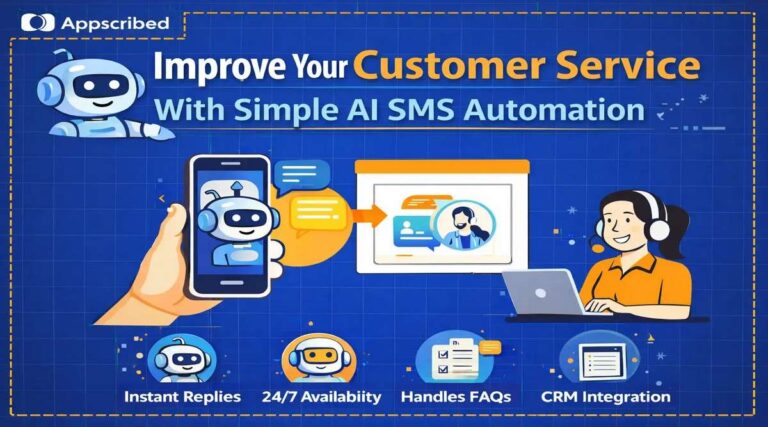
Text messaging has emerged as one of the most effective customer communication channels, and when combined with artificial intelligence, it becomes a scalable, always-on service layer. AI SMS Automation allows businesses to respond instantly, manage thousands of conversations simultaneously, and maintain high-quality customer experiences without overwhelming support teams.
This shift is not about replacing humans. It is about using AI to remove friction, reduce delays, and allow customer service teams to focus on conversations that truly require human judgment.
Why Traditional Customer Support Models Are Struggling
Most customer service issues do not come from complex problems. They come from slow responses, missed follow-ups, and inconsistent communication. Manual workflows struggle to keep up with growing customer bases, especially when businesses operate across time zones or high-volume environments.
Phone-based support introduces wait times. Email creates long response cycles. Live chat requires agents to be constantly online. These models are difficult to scale without significantly increasing costs.
AI-powered SMS automation addresses these limitations by delivering instant, automated responses while still allowing seamless escalation to human agents when needed. This hybrid approach improves efficiency without sacrificing service quality.
The Role of AI in Modern SMS Automation

AI SMS automation goes far beyond sending scheduled messages or basic autoresponders. Modern systems use machine learning and natural language processing to understand customer intent, context, and urgency.
Key AI-driven capabilities include:
- Intent detection to identify what the customer is asking
- Context awareness using conversation history and CRM data
- Automated decision-making for routing, escalation, or resolution
- Continuous learning to improve response accuracy over time
This intelligence allows businesses to handle customer interactions dynamically instead of relying on rigid scripts.
How CRM With Text Messaging Creates Intelligent Conversations
When SMS automation is connected to a CRM, it becomes far more powerful. Every message is linked to customer profiles, purchase history, previous conversations, and behavioral data.
CRM with text messaging enables:
- Personalized responses based on customer data
- Automatic updates to customer records after each interaction
- Consistent messaging across sales, support, and operations
- Clear conversation ownership and accountability
For example, if a customer asks about an order status, the AI can pull real-time data from the CRM and respond instantly. If the conversation becomes complex, the system can route it to the appropriate agent with full context attached. Achieving this kind of real-time context typically requires an AI customer data platform that unifies customer profiles, purchase history, and behavioral data from every channel into one connected source businesses can act on instantly.
Platforms offering advanced CRM-based messaging, such as modern AI SMS automation solutions, allow teams to manage thousands of conversations without losing personalization or control.
Being Available 24/7 Without Overloading Your Team
One of the biggest advantages of AI-powered SMS tools is continuous availability. Customers no longer need to wait for business hours to get basic support.
AI can handle:
- Order confirmations and status updates
- Appointment scheduling and reminders
- Frequently asked questions
- Policy explanations and basic troubleshooting
This reduces after-hours pressure on support teams while maintaining a responsive customer experience. Human agents can focus on higher-value interactions during working hours instead of answering repetitive questions.
Faster Response Times and Their Impact on Customer Trust
Response time is one of the strongest predictors of customer satisfaction. Studies consistently show that customers associate fast replies with professionalism and reliability.
AI SMS automation reduces response times from hours or even minutes, to seconds. Even when the issue cannot be resolved immediately, acknowledgment messages reassure customers that their request has been received and is being handled.
Over time, this consistency builds trust. Customers feel heard, informed, and respected. These small interactions accumulate into long-term loyalty and higher lifetime value.
Preventing Issues Before They Escalate
Many customer complaints can be prevented with proactive communication. AI-powered SMS tools excel at identifying moments where intervention is needed.
Examples include:
- Automated reminders for appointments or renewals
- Follow-up messages after purchases or service interactions
- Notifications about delays, changes, or required actions
By addressing potential issues early, businesses reduce inbound complaints and improve overall satisfaction. Customers appreciate transparency and proactive updates, even when problems occur.
Personalization at Scale With AI-Driven Messaging
One common concern about automation is that it feels impersonal. In practice, AI often enables more personalization than manual workflows.
AI systems can dynamically insert:
- Customer names
- Past interaction references
- Product or service details
- Location or preference-based information
Because the AI has access to CRM data, every message can feel tailored instead of generic. This level of personalization would be difficult to maintain manually at scale.
Helping Support Teams Focus on High-Value Conversations
When agents spend most of their time answering repetitive questions, service quality suffers. Fatigue increases, and complex issues receive less attention.
AI SMS automation removes repetitive workload by handling routine interactions automatically. Support teams can then focus on:
- Complex problem-solving
- Relationship-building conversations
- Retention and upsell opportunities
- Empathetic customer support
This improves both employee satisfaction and customer outcomes.
Why Simple, AI-Driven Systems Outperform Complex Tools
Large, feature-heavy customer service platforms often require extensive training and ongoing management. Complexity increases the risk of errors and slows adoption.
AI SMS automation works because it is simple at the surface while powerful underneath. Customers text naturally. AI processes the message intelligently. Teams manage conversations from a unified dashboard.
This simplicity accelerates adoption, reduces operational friction, and delivers measurable improvements faster.
The Long-Term Business Impact of AI SMS Automation
The benefits of AI-powered SMS support compound over time:
- Lower support costs per interaction
- Higher customer satisfaction scores
- Reduced churn
- Improved team productivity
- Better data for decision-making
As AI models learn from ongoing interactions, response quality and accuracy continue to improve. This creates a self-optimizing customer service system that scales with the business.
Also Read:
Best Helpdesk Ticketing Systems for 2 Person IT Team
Best AI-Powered CRM Tools for 2026
How to Reduce Support Documentation Time with AI Knowledge Base Articles
Conclusion
Customer service does not need to be complicated to be effective. It needs to be fast, reliable, and consistent. AI SMS automation delivers all three by combining intelligent technology with the simplicity of text messaging.
By integrating AI-driven SMS tools with CRM systems, businesses can respond instantly, personalize interactions, and support customers around the clock without overwhelming their teams.
In 2026, the companies that stand out will not be the ones with the largest support departments, but the ones that use AI intelligently to make every customer feel heard. AI SMS automation is no longer a future concept. It is a practical, scalable solution for better customer service today.
Add us as a preferred source on Google, and our reviews and picks show up in your Top Stories and AI Overviews.