
Managing cloud infrastructure costs is a top priority for businesses looking to get the most out of their cloud budgets. While cloud services like AWS offer immense flexibility and power, costs can quickly spiral out of control if resources are not managed effectively. This is where AWS Spot Instances come into play. Businesses can dramatically reduce their cloud spending while maintaining performance by understanding how to use these instances strategically.
In this article, we’ll investigate optimizing cloud costs using AWS spot instances and why they are such a powerful cost-saving tool.
AWS Spot Instances and Their Cost Advantage
AWS Spot Instances lets users bid for unused EC2 capacity at much lower prices than on-demand costs. Such cases are best suited to jobs that can be interrupted and those that are not critical and can handle interruption.
The prices of spot Instances vary within supply and demand, though they can be up to 90% cheaper than standard on-demand instances. This makes them particularly well-suited for situations where an application will process many items at one time, such as data analysis or for containerized workloads, and other applications where response time is not a significant concern.
It is quite easy to understand why Spot Instances are so effective: they allow businesses to make the most of their cloud budgets. It reveals the organized workloads that do not need to be up and running most of the time and must be replaced by cheaper Spot Instances. This means that companies can acquire the same level of computing power for a fraction of the cost and manage their scale requirements. The first step to optimizing AWS is to understand existing AWS pricing models and how to plan workloads around them.
Strategies to Optimize Cloud Costs Using Spot Instances
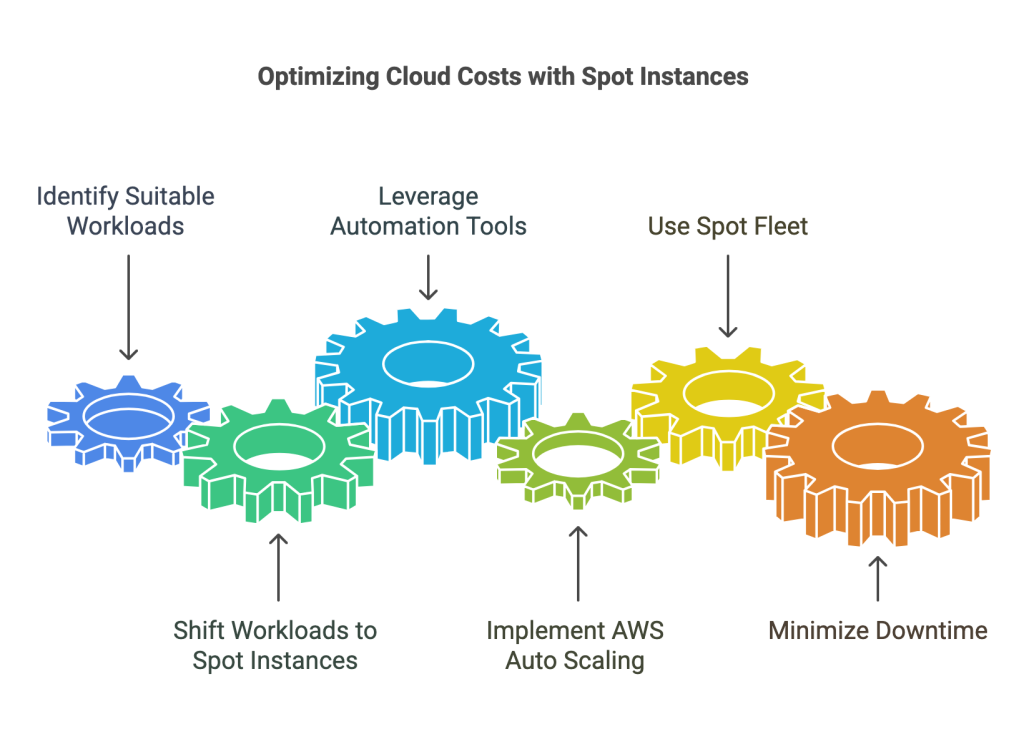
When using Spot Instances for cost optimization, it is necessary to consider the workload level strategy. Not all workloads can be run on Spot instances, so it is important to determine which ones can be interrupted.
For example, batch jobs, large-scale simulations, and rendering can comfortably be run on spot instances since they are not very affected by interruption. When such workloads are migrated to Spot Instances, the saving is achieved quickly.
There are several key points for making the best out of Spot Instances, and automation is one of the most important. AWS Auto Scaling and Spot Fleet allow businesses to automatically provision Spot Instances according to the organization’s requirements.
For instance, AWS Spot Fleet allows users to set capacity and move between running Spot Instances and On-Demand Instances. This means that no matter how long a Spot Instance runs, tasks are always waiting to be processed so that workloads do not stop. Automation tools help businesses maintain performance while not frequently checking capacity.
Designing Fault-Tolerant Systems for Spot Instances
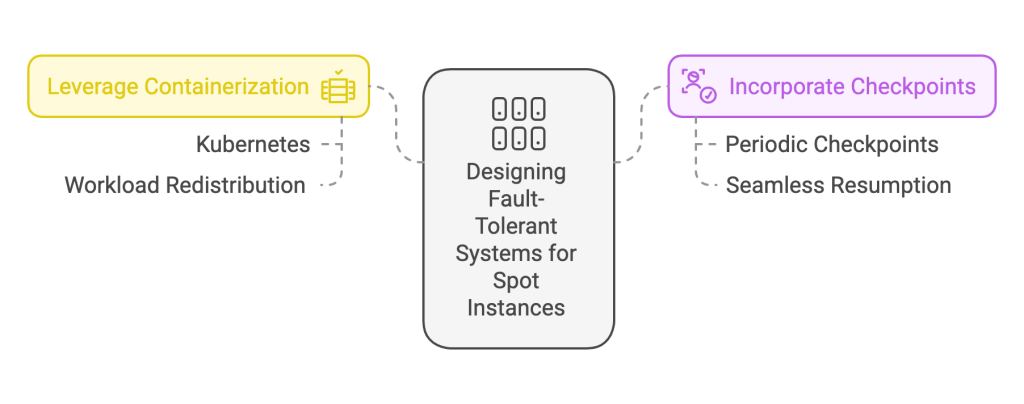
Interruptions can be viewed as a weakness, but in fact, it is not necessarily a bad aspect; if the system is well-designed, the impact of interruptions can be minimized. To make use of Spot Instances efficient, fault-tolerant systems are essential.
One is to use container orchestration tools that work well in automatically handling interruptions by redistributing the running workload to other instances. Containers are lightweight and can be provisioned very quickly, and because of this, they are well-suited to Spot Instances.
The second strategy is to include checkpoints in long processes so that it becomes easier to monitor the progress of a process. Checkpoints allow the workloads to provide periodic saves in case a Spot Instance is lost; the workload can continue from where it was. This means interruptions do not result in wasted computing time or huge lag time, for example.
Real-World Benefits of AWS Spot Instances
As the ability to save money with AWS Spot Instances has been established, these services have become popular with businesses of all sizes.
Many businesses have successfully integrated Spot Instances into their operations, achieving notable cost reductions:
- Big Data and AI: Organizations process vast datasets and train machine learning models at significantly lower costs.
- Startups and SMEs: Small businesses scale their cloud resources affordably, using Spot Instances for experimentation, development, and testing without heavy financial burdens.
Spot Instances empower businesses of all sizes to innovate and scale without compromising their budgets, levelling the playing field for startups competing with larger enterprises.
Conclusion
AWS Spot Instances can be considered a revolutionary tool to cut costs for businesses interested in cloud computing services. As such, enterprises can leverage idle EC2 capacity to save a lot of money without having to cause a degradation in performance. However, to achieve integration successfully, there is the need to plan for the workload, automate, and have a fault-tolerant system.
For enterprises that effectively leverage Spot Instances, the scalability of their cloud expenditures is possible while expanding operations. In today’s competitive technological environment, optimizing cloud costs is more critical than ever. Leveraging Spot Instances not only drives cost efficiency but also positions businesses for sustainable growth.
Add us as a preferred source on Google, and our reviews and picks show up in your Top Stories and AI Overviews.