
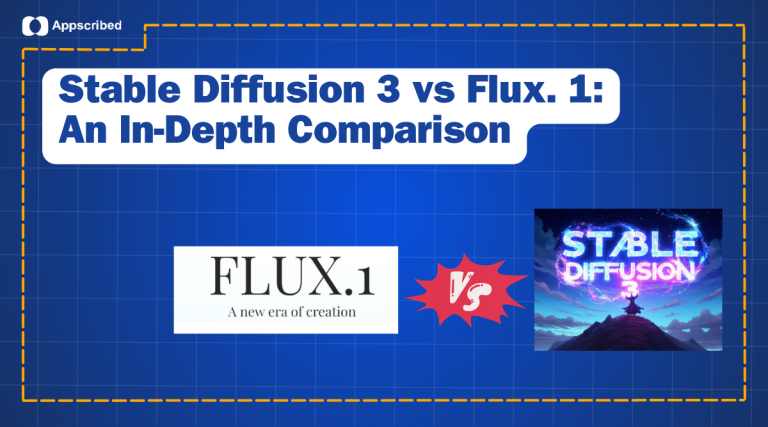
The world of AI image generation has become more competitive than ever, with models like Stable Diffusion 3 and Flux 1 (or Flux. 1 from Blackforest Labs) leading the way. These two models represent different approaches to AI image generation: open-source accessibility versus commercial precision. Whether you’re a business exploring the right AI model to use or a professional in the creative industry, it’s essential to understand the key differences between these two models.
In this article, we will break down these two models based on their features, use cases, ease of access, and pricing, helping you decide which fits your workflow best.
Overview of Stable Diffusion 3

Stable Diffusion 3 is the latest release from Stability AI, a leader in open-source AI models. Stable Diffusion 3 builds on the success of earlier versions by offering improved text-to-image generation capabilities, enhanced precision, and the ability to produce high-resolution images. The key feature that makes Stable Diffusion stand out is its open-source nature, making it accessible to a global community of users who can modify and run the model on local hardware.
Key Features
- Open-Source: Free to download and modify, giving users total control.
- Advanced Text-to-Image Handling: Improved prompt interpretation for better image accuracy.
- High-Resolution Outputs: Capable of producing large, detailed images suitable for creative projects.
- Flexible Use: Available to run locally or through cloud services, making it versatile for different workflows.
Overview of Flux 1

Flux 1 is an AI-powered image generator developed by Blackforest Labs. Unlike the open-source nature of Stable Diffusion, Flux 1 is a commercial platform designed for professional use. Flux 1 excels at generating photorealistic images, making it ideal for industries such as product design, media, and advertising. Its focus is on speed, precision, and delivering highly detailed, realistic visuals quickly.
Key Features:
- Photorealism: Generates life-like images with exceptional detail.
- Commercial Platform: Offers built-in tools for controlling lighting, textures, and other fine details.
- Fast Processing: Optimized for high-speed image generation and commercial usage.
- Professional Support: Comes with dedicated customer support for troubleshooting and assistance.
Stable Diffusion 3 vs. Flux 1: Feature Comparison
| Features | Stable Diffusion 3 | Flux 1 |
|---|---|---|
| Model Type | Open-source, free, Enterprise License available for dedicated support | Pure commercial, subscription-based |
| Image Quality | High-quality, creative, artistic outputs | Highly realistic, photorealistic visuals |
| Text-to-Image Understanding | Advanced prompt interpretation | Precise rendering, realistic outputs |
| Customization | Fully customizable (code access) | Limited customization, fine-tuning tools |
| Speed | Moderate (depends on hardware) | Fast, optimized for efficiency |
| Support System | Community-driven (open source), Dedicated support for Enterprise | Professional support by Blackforest Labs |
| Best For | Creative projects, research, experimentation | Professional design, advertising, media |
| Integration | Highly integrative with other open-source tools | Proprietary ecosystem |
| Accessibility | Free to use, accessible globally | Paid, requires subscription |
Use Cases
Stable Diffusion 3 is Ideal For:
- Creative Artists: With its open-source flexibility, artists can explore a wide range of styles, from abstract designs to detailed landscapes. Its ability to interpret complex prompts makes it a favorite for those experimenting with AI-generated art.
- Researchers and Developers: The model’s open-source nature allows for fine-tuning and experimentation. Developers can integrate it into broader AI projects or research applications that require image generation.
- Small Businesses: Given that Stable Diffusion 3 is free for non-commercial use under $1 million in revenue, it’s a great option for those looking to create personal projects or small businesses.
Flux 1 is Ideal For:
- Professional Designers and Media Creators: Flux 1’s focus on photorealistic image generation makes it perfect for professionals in fields like product design, advertising, and media, where high-quality visuals are essential.
- Advertising and Marketing Agencies: With its fast image generation and ability to deliver precise, real-world visuals, Flux 1 is suited for time-sensitive campaigns that need quick turnarounds without compromising on quality.
- Developers and Small Teams: For those looking for speed and efficiency, Flux 1 [Schnell] provides a low-cost option for personal use or local development, making it a great tool for developers who need quick image outputs for prototypes or small projects.
Accessibility and Ease of Use
Stable Diffusion 3
Stable Diffusion 3 is open-source, making it free for anyone to use. You can download the model and run it on local hardware, though doing so requires a decent GPU and some technical skills. However, for users who want a more straightforward experience, there are cloud-based services where you can use Stable Diffusion without worrying about hardware.
The vast open-source community also provides a wealth of resources, from tutorials to forums, which makes it easier for new users to get started.
Flux 1
Flux 1, as a commercial platform, is easier to use out of the box. There’s no need for technical setup or local hardware. Users can access the platform via a subscription and begin generating images right away. Flux 1 offers a user-friendly interface with professional-grade tools for adjusting the details of your generated images.
Blackforest Labs also provides dedicated customer support, ensuring a smooth experience for professionals who rely on fast, high-quality results.
Pricing and Availability
Stable Diffusion 3
Stable Diffusion 3 offers a range of licensing options based on usage, making it accessible to various user types, from individual creators to large enterprises. Here’s a breakdown:
Community License:
- Free for Non-Commercial Use: Individuals and organizations generating less than $1 million in annual revenue can use the models for free under the Stability AI Community License. This applies to non-commercial use as well as small-scale commercial activities, such as small businesses or personal projects.
- Fine-Tuning Allowed: Users can modify or fine-tune the models and use the results commercially, as long as they meet the revenue requirement.
- No Limits on Content Creation: You can create an unlimited number of media files without restriction as long as you comply with the license’s terms.
Enterprise License:
- For Large Commercial Use: If your company generates over $1 million annually, you will need to purchase an Enterprise License. This option includes commercial use rights, enhanced support, and custom pricing tailored to large-scale operations.
- Enterprise-Grade API: Companies can access the Stable Diffusion 3 API for enterprise-grade use, ensuring faster and reliable image generation with high availability.
These flexible licensing options make Stable Diffusion 3 highly accessible for small creators while also accommodating larger commercial users with customized solutions.
Flux 1
Flux 1 offers three variants of the model, each with different pricing and usage capabilities:
Flux 1 [Pro]
Designed for the highest-quality, professional-grade image generation, Flux 1 [Pro] is priced at $0.055 per image. It offers the best performance in terms of prompt adherence and image realism, making it suitable for commercial and enterprise use.
Flux 1 [Dev]
A distilled version of the Pro model, Flux 1 [Dev] is available for non-commercial use and is priced at $0.030 per image. It’s ideal for developers and researchers working in non-commercial environments.
Flux 1 [Schnell]
Optimized for speed and personal use, Flux 1 [Schnell] is available for $0.003 per image and is licensed under Apache 2.0, making it more accessible to hobbyists and developers looking for fast, local image generation.
Commercial users of Flux 1 can integrate it via APIs provided by partners such as Replicate and FAL, making it highly versatile for various professional workflows.
Conclusion
When comparing Stable Diffusion 3 and Flux 1, it becomes clear that both models excel in different areas, making each suitable for distinct use cases. Stable Diffusion 3, with its open-source model, offers flexibility to small businesses. Its ability to be customized and run locally makes it a strong choice for users who want full control over their image generation projects without financial constraints.
On the other hand, Flux 1 is designed for professionals who prioritize speed, photorealism, and precision. Its commercial-grade performance, along with fast image generation and built-in tools for fine-tuning, make it the preferred choice for industries such as advertising, media, and design.
In summary:
- If you need customization, open-source access, and are working on personal or small-scale projects, Stable Diffusion 3 is the ideal choice.
- If you’re a professional looking for photorealistic results, reliability, and speed for commercial purposes, Flux 1 is the more powerful and precise tool.